Amazing Stories Sixty Years of the Best Science Fiction
Curated by Asimov, this anthology maps science fiction’s evolution from imaginative adventures into a logical discipline of thought, revealing the genre’s maturation and ongoing progress.
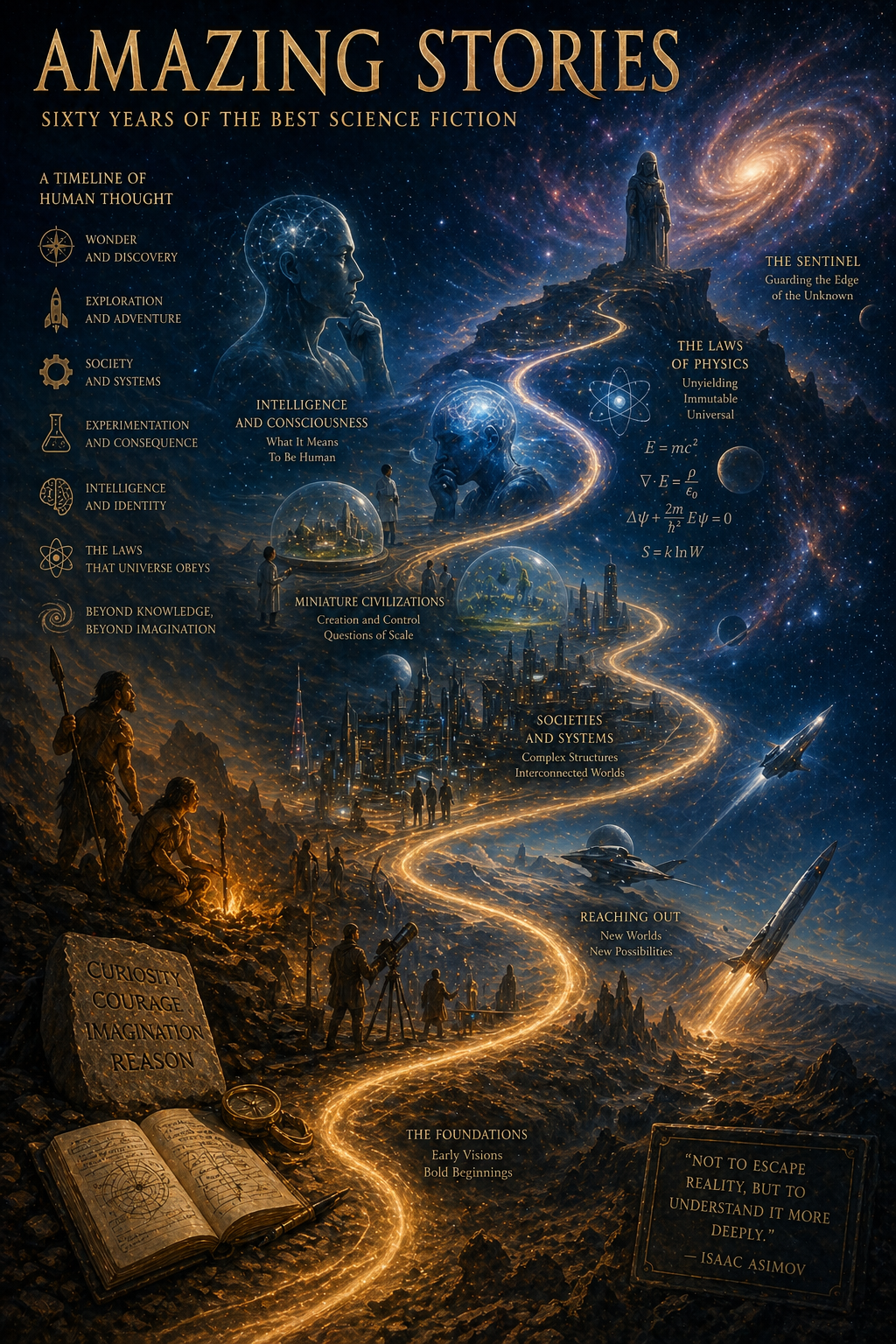
Amazing Stories Sixty Years of the Best Science Fiction is not merely an anthology; it is a timeline made visible, a careful unfolding of how a genre learned to think. In the hands of Isaac Asimov, such a collection becomes more than a gathering of tales. It becomes an argument quiet, methodical, and persistent that science fiction is a discipline of thought, advancing as surely as any science it seeks to imagine.
The story begins, appropriately, with The Beginning of Amazing Stories, where the reader is introduced not to a narrative, but to a condition. Early science fiction is not yet refined. It is bold, sometimes awkward, often more enthusiastic than precise. Yet, as Asimov would insist, this is not a weakness. It is the necessary starting point. The writers of this era are not building polished structures; they are laying foundations. Their stories may seem exaggerated, but they are guided by a simple principle: what if the known laws of science were extended just a little further?
In Armageddon 2419 A.D. by Philip Francis Nowlan, the future is presented in broad strokes. Civilization rises and falls, and the individual hero stands against overwhelming forces. The science is not always exact, but the impulse is clear. The story reaches outward, attempting to grasp the scale of time and change. Asimov includes it not for its precision, but for its ambition. It represents a first step toward thinking beyond the immediate present.
The tone shifts in The Skylark of Space by E. E. Smith. Here, the narrative becomes more structured, the science more central. Space is no longer a distant backdrop; it becomes an environment to be understood and navigated. The story unfolds with a sense of expansion. The universe is no longer a mystery to be admired from afar it is a place to be entered, explored, and, eventually, comprehended.
In When the Atoms Failed by Charles Cloukey, the focus turns inward, toward the fundamental structure of matter. The story imagines a failure at the most basic level, and from this premise builds a chain of consequences. The approach is still speculative, but it reflects a growing awareness. Science fiction is beginning to concern itself not only with grand adventures, but with underlying principles.
The development continues with The Martian Odyssey by Stanley G. Weinbaum. This story marks a quiet turning point. The alien is no longer a simple adversary or curiosity; it becomes something truly different. The encounter is not resolved through conflict, but through understanding partial, imperfect, but genuine. Asimov places this story carefully, for it demonstrates a maturation. Science fiction is learning to imagine not just new worlds, but new ways of thinking.
In Nightfall by Isaac Asimov, the pattern becomes clearer. A single scientific premise a world without night leads to a cascade of consequences. The story proceeds logically, each step following from the last. By the time the conclusion arrives, it feels inevitable. This is the method Asimov values most: not invention for its own sake, but reasoning carried to its conclusion.
The anthology deepens with Microcosmic God by Theodore Sturgeon, where the act of creation itself becomes the subject. A scientist accelerates the development of a miniature civilization, seeking solutions to human problems. The story raises questions about control, responsibility, and the limits of knowledge. It reflects a growing awareness that science is not neutral; it carries consequences that must be considered.
In The Roads Must Roll by Robert A. Heinlein, the focus shifts to systems. Society is imagined as a network of interdependent parts, each essential to the whole. When one part fails, the entire structure is threatened. The story is less about individuals and more about organization. It suggests that the future will not be shaped by isolated inventions, but by the integration of many.
The narrative continues with The Cold Equations by Tom Godwin, where the unyielding nature of physical law is brought into sharp focus. A situation arises in which there is no solution that satisfies both human desire and scientific necessity. The story does not attempt to resolve this tension; it reveals it. Asimov includes it to emphasize that science fiction, at its best, does not evade reality it confronts it.
In Flowers for Algernon by Daniel Keyes, the attention turns inward once more. The enhancement of intelligence becomes a lens through which to examine human experience. The story is deeply personal, yet it remains grounded in a scientific premise. It demonstrates that the genre is not limited to external exploration; it can also illuminate the inner world.
As the anthology progresses, a pattern emerges. Early stories reach outward, driven by curiosity and imagination. Later stories turn inward, examining consequences, limitations, and responsibilities. The progression is not abrupt, but gradual. Each story builds upon the last, not directly, but conceptually.
In The Sentinel by Arthur C. Clarke, the tone becomes almost meditative. A discovery hints at a larger reality, but does not fully reveal it. The story ends not with certainty, but with possibility. This restraint is characteristic of the later stages of the genre development. Science fiction no longer seeks to answer every question; it seeks to frame them more precisely.
The final portions of the book bring these threads together. The stories begin to echo one another. Themes of exploration, limitation, and consequence recur, each time with greater clarity. The reader is encouraged to see not just individual narratives, but a continuous development.
What distinguishes Amazing Stories Sixty Years of the Best Science Fiction is this sense of continuity. It is not a random collection, but a carefully arranged sequence. Asimov role is subtle but essential. Through selection and placement, he reveals the underlying structure of the genre.
By the end, the reader is left with a clear impression. Science fiction has grown not in spectacle, but in understanding. It has moved from broad speculation to precise reasoning, from simple adventure to complex inquiry. The change is not complete, nor is it final. It is ongoing.
The anthology closes, as it must, without a definitive conclusion. The future remains open, the questions unresolved. Yet, there is a sense of progress. The edge of understanding has moved, not dramatically, but steadily.
In this way, the book achieves something rare. It does not merely present stories; it demonstrates a process. It shows how imagination, guided by logic, can expand the boundaries of thought. And so, the reader is left where the genre itself now stands not at an end, but at a point along a path. The stories behind form a foundation. The possibilities ahead remain to be explored.