It's Such a Beautiful Day
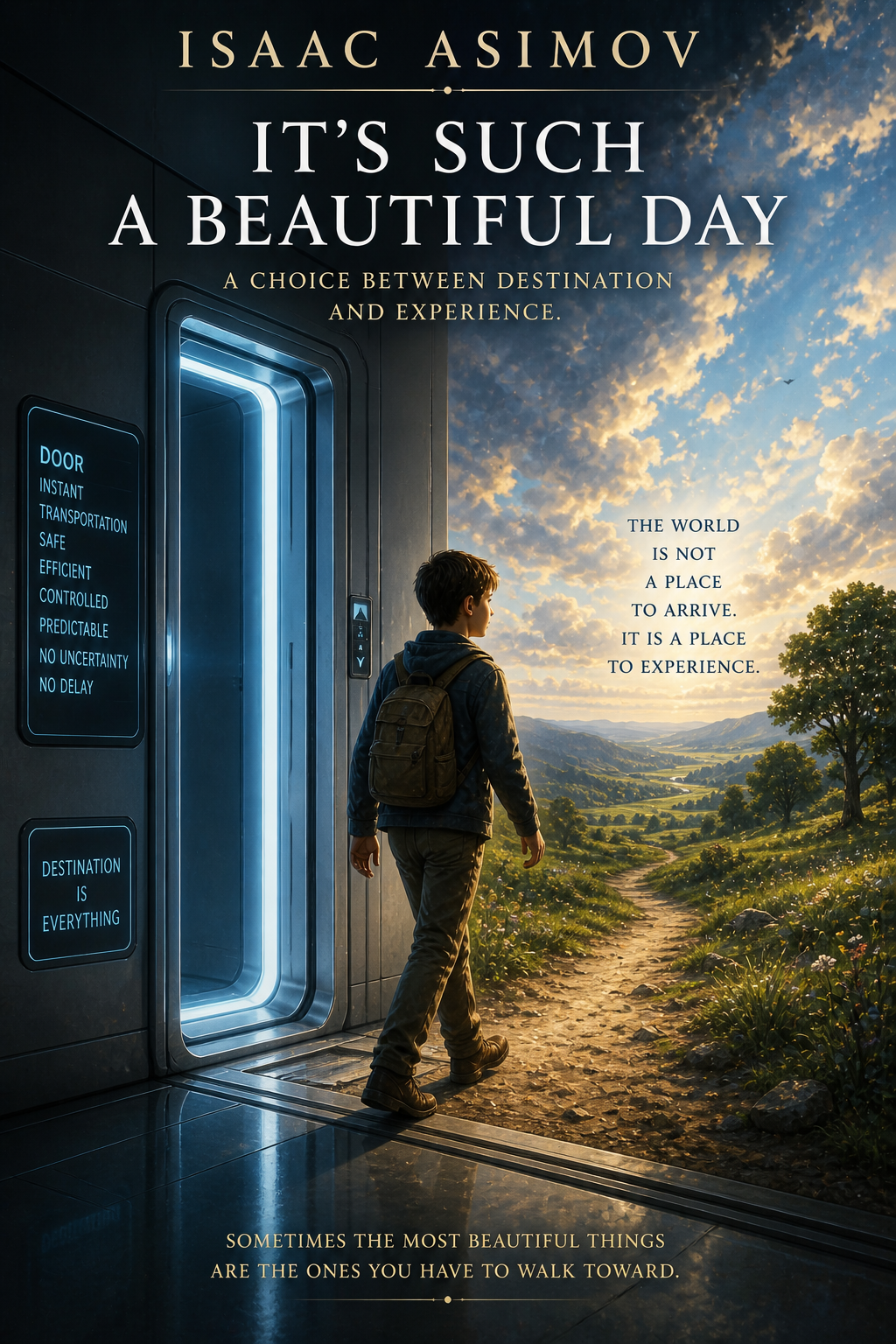
In a world of instant transportation, young Richard discovers the outdoors, choosing the physical experience of walking over the sterile convenience of his society's technology.
In the quiet landscape of Isaac Asimov’s shorter fiction, there is a world that looks very much like our own, yet it is governed by a single, profound change in how humans occupy space. This world is the setting for the story It's Such a Beautiful Day. It is not a book of many parts or a collection of different tales, but rather a single, distilled narrative that follows one central idea to its logical end. Asimov, as he so often does, begins with a family, specifically a boy named Richard, living in a home that feels familiar until you notice the one thing that has vanished: the distance between here and there.
In this future, the primary mode of movement is the Door. To an outsider, it might seem like a miracle, but to Richard and his society, it is a simple utility. It is a device for teleportation that allows a person to step from one room directly into another location, such as a school or a shop, without ever walking across a street or seeing the sky. Asimov presents this invention with his characteristic logic. He does not treat it as a marvel of science but as a tool of convenience that has become a necessity. If movement is instant, then the physical world that exists between two points becomes irrelevant. The journey is removed, leaving only the destination.
The story builds from Asimov’s long standing interest in how environment shapes environmental psychology. Just as his earlier works explored how people might become comfortable in enclosed underground cities, this story explores a society that has effectively boxed itself into a series of interconnected rooms. Richard is a product of this environment. He has grown up in a world where one does not experience the passage of time while moving. His life is structured by efficiency and safety, where the outdoors is not a place to be visited but a void to be bypassed. To the adults in his life, this is the height of civilization. It is a controlled, predictable system that removes the uncertainty and discomfort of weather, distance, and physical effort.
The tension begins with a very small, quiet act. Richard experiences the outdoors directly, stepping beyond the mediated safety of the Door. This is not a story of a boy fighting monsters or discovering a grand conspiracy. Instead, it is a story of a child discovering continuity. He discovers that the world does not end at the wall of one room and begin at the entrance of another. He realizes there is air, space, and a physical reality that connects everything. This discovery changes his internal logic as he begins to grapple with social conditioning that has taught him to fear the open air. He begins to prefer the experience of walking and feeling the distance over the instant results of the Door. He chooses the process of moving through the world over the convenience of arriving instantly.
This choice creates a disruption that the society around him cannot easily understand. From the perspective of the adults, Richard’s behavior is not a sign of curiosity or health, but a deviation from a perfect system. To them, the outdoors is unstructured and therefore undesirable. They view his preference for walking as a problem that needs to be addressed and corrected. The conflict is handled with Asimovian restraint; there are no villains, only people who have become so accustomed to convenience that they have lost the ability to value the direct experience of the world. They use reason and insistence to guide the boy back to the correct way of living, revealing that while their technology has expanded their reach, it has narrowed their understanding of what it means to be alive in a physical space.
As the narrative progresses, it highlights the cost of this total efficiency. The system offers safety and control, but it demands that the individual give up their connection to the natural world. Richard’s insistence on walking to school is a quiet rebellion against a world that values the result more than the experience. Asimov does not argue that technology is inherently evil, but he demonstrates how easily it can become a barrier between a human and their environment. The story leads the reader to a point of reflection rather than a dramatic showdown. It asks a fundamental question: when we remove all inconvenience, what else do we accidentally remove?.
The title itself, It's Such a Beautiful Day, is a masterclass in Asimov’s simple, logical style. It is a phrase so common it is usually ignored, yet in the context of this story, it becomes a profound observation. It represents an awareness of the world that the Door has made obsolete. To say the day is beautiful, one must first be in the day, experiencing the air and the light. The story suggests that there is a specific, quiet value in the path itself, the part of life that the Door tries to delete.
In reviewing this work, it is clear that Asimov is using Richard as a lens to examine our own tendencies toward efficiency. The world of the Door is not a fantasy but an extension of the human desire to reduce effort. By keeping the story small and focused on one family, Asimov makes the stakes feel personal. We see the tragedy not in a great explosion, but in the parents' inability to understand why their son would want to feel the sun on his face. The logic of the system has become their only reality.
There are no mini stories within this piece; the narrative is a singular, focused exploration of this one theme. It is effective precisely because of its brevity and its refusal to offer an easy resolution. The story ends without a clear victory for either side, leaving the reader to decide if the convenience of the Door is worth the loss of the journey. It is a reminder that the direct experience of reality holds a value that cannot be replaced by any machine, no matter how efficient.
Asimov’s clear and simple prose allows the weight of this idea to settle on the reader without distraction. He does not need complex metaphors when the simple image of a boy walking instead of teleporting says everything that needs to be said. The story remains a persistent observation of the human condition, suggesting that while the Door of technology may open instantly, the path it replaces might actually be the thing that matters most. It is a logical, patient, and deeply revealing look at the price we pay for the world we us build.