Azazel
George Bitternut summons a tiny, powerful demon to grant wishes for others, but each perfectly executed miracle humorously backfires due to unexpected, systemic human consequences.
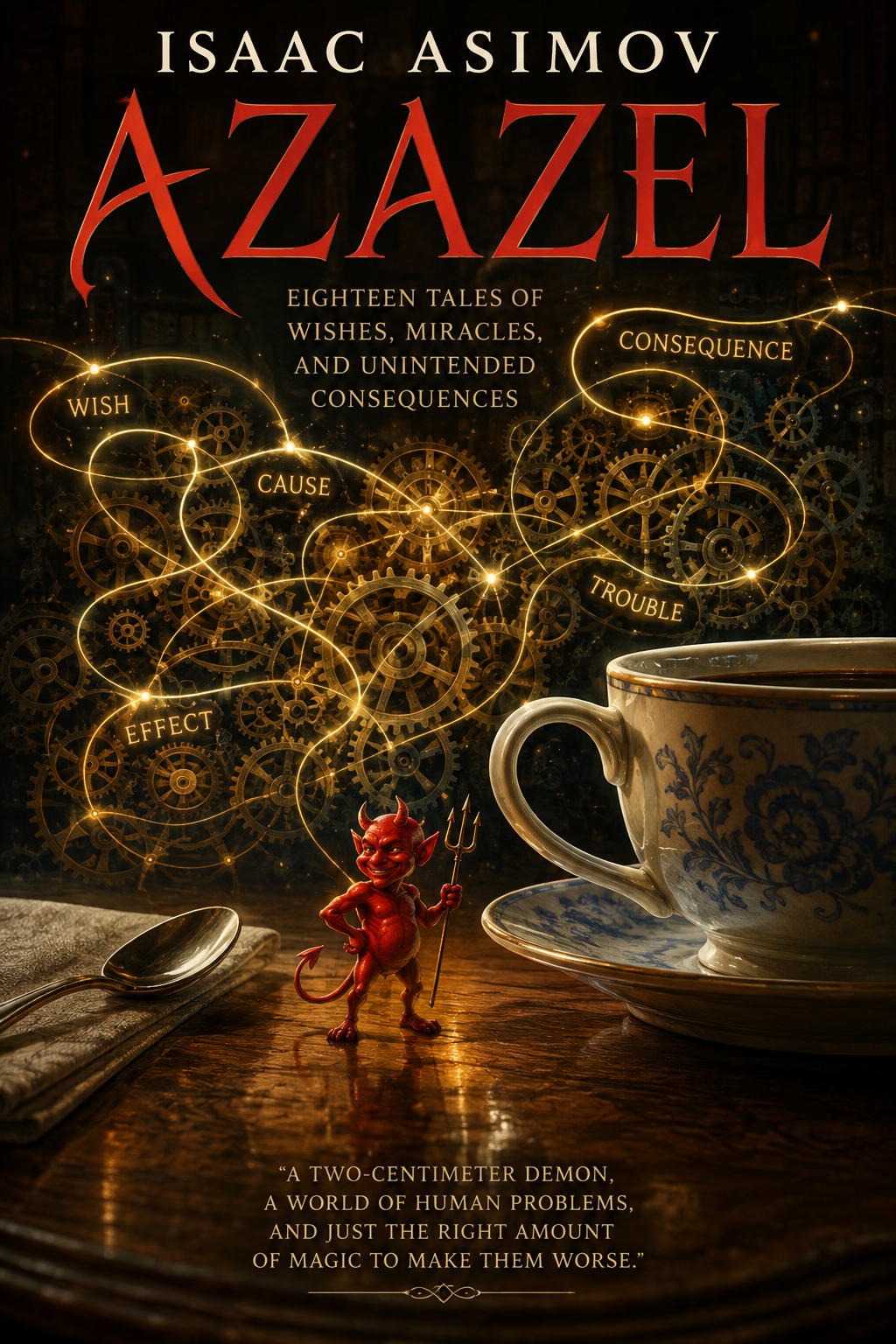
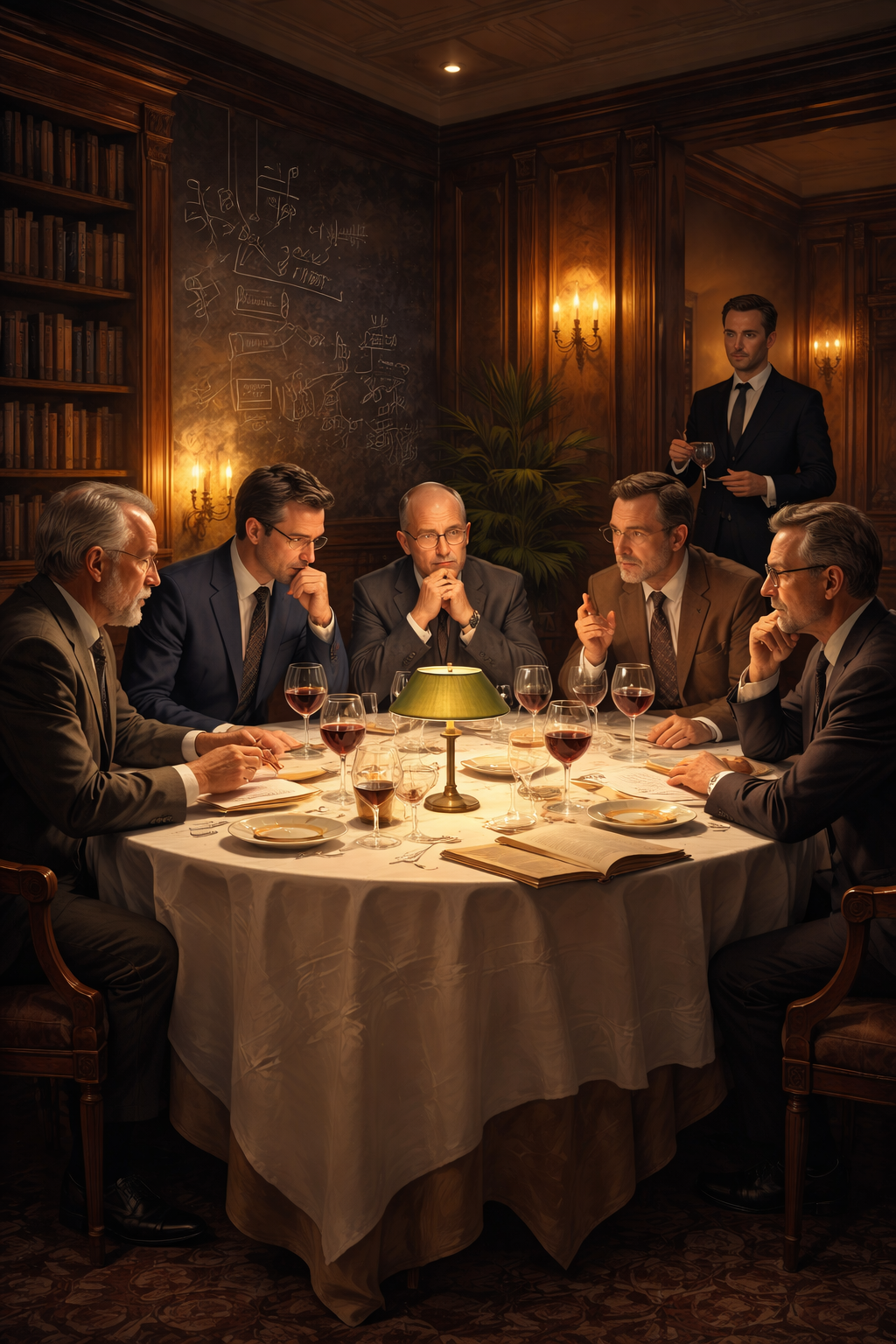
George Bitternut sat across from his companion at their usual table, eagerly eyeing the menu. The companion knew that the price of this narrative would be a substantial lunch on his tab, but George had promised a tale that would explain one of the most delightfully overlooked corners of science fiction history. George leaned back, adjusted his jacket, and began to speak of a remarkable collection of eighteen linked comic fantasy stories that Isaac Asimov brought together in 1988. This volume, simply titled Azazel, was framed as a series of conversations between George and a nameless narrator. George wanted his companion to understand that while many readers know Asimov for the grand intellectual sweep of the Foundation series, the deep moral seriousness of his robot novels, or the cosmic speculations of The Last Question, this work revealed a lighter, mischievous, and thoroughly logical side of the master of science fiction. It was, George insisted, a brilliant series of experiments in human cause and effect.
The core of the matter, as George explained between bites of his appetizer, lay in a very small creature and a very large amount of trouble. George had discovered the secret of summoning Azazel, a fiery red demon who stood a mere two centimeters tall but possessed immense, almost magical power. Because the rules of the summoning dictated that Azazel could not perform any magical feats for George's direct benefit, George was forced to exercise his primary talent, persuasion, by asking the demon to perform favors for other people. The humor and the logic of the stories always emerged from the gap between human intention and the actual physical and social consequences of the demon's magic. Azazel had the power to alter reality but lacked any real understanding of human emotions, social structures, or practical circumstances. George, while understanding human nature well enough, was far too impatient and shortsighted to foresee the ripples his requests would cause.
George detailed each of these encounters, starting with the very first, “The Two Centimeter Demon”. In this opening tale, the basic machinery of the entire collection is established as the narrator first learns of George’s access to the tiny supernatural being. George’s first attempt at matchmaking involves using Azazel to enhance the basketball skills of a mediocre player to win the affections of George's goddaughter. The magic is spectacularly effective, but it immediately establishes the central rule of the book: while the supernatural intervention works perfectly, human beings remain completely unable to control the complicated personal aftermath. In the second story, “One Night of Song,” romantic resentment and the desire for vengeance turn into comedy. A bitter man wants to punish a former lover who has cruelly rejected him, so George arranges for Azazel to grant the woman a magnificent, extraordinary singing voice for a single night. What is intended as a bizarre form of revenge quickly backfires, as the incredible gift opens up massive new opportunities for her, showing how difficult it is to control spite once it is unleashed into the world.
In “The Smile That Loses,” George tries to help a woman named Rosie capture a perfect photograph of her husband Kevin's cheerful expression. Azazel makes the photograph flawless, but the spell operates on a strict conservation of happiness. As long as the perfect smile exists on the photographic paper, Kevin himself becomes utterly miserable. George eventually realizes the magic has literally transferred the real man's joy into the image, creating a beautifully logical puzzle that can only be resolved by destroying the photograph, though Rosie refuses to believe his explanation. Next, “To the Victor” examines the mechanics of human attraction as if it were a biological engineering problem. A lonely man named Theophilus cannot seem to attract women, so George has Azazel alter his chemistry to emit an irresistible pheromone. The magic succeeds far too well, drawing women in such overwhelming numbers that any hope of an actual, individual romance is completely ruined. Theophilus gets the female attention he begged for, but loses all his personal freedom in the process.
A shift occurs in “The Dim Rumble,” a rare story that departs from pure comedy to offer something genuinely disturbing. George encounters a dangerous fanatic named Hannibal West, who claims to have discovered an underground mechanism capable of amplifying Earth's internal energy into a destructive sound to use against humanity. George asks Azazel to erase the man's memory of the invention, which the demon does perfectly, but George realizes too late that the physical machine is still buried somewhere, completely forgotten but still highly dangerous. It proves that removing the knowledge of a problem is not the same as eliminating the danger. The mood returns to comedy with “Saving Humanity,” where George tries to help Menander Block, a man convinced he is a walking jinx whose presence causes absurd disasters. George asks Azazel to cure Menander and give him a compensating, noble purpose to save humanity. Azazel cures his bad luck but turns him into a walking electromagnetic disruption, revealing that in the far future, this exact trait will allow him to stop a supercomputer from enslaving the human race. Yet the gift becomes a curse, as Menander must live with it for decades in constant anxiety, waiting for a heroic moment that might never arrive.
In “A Matter of Principle,” George admits he tried to turn a profit by helping an aspiring novelist named Gottlieb Jones who was suffering from creative writer's block. George arranges a contract to take a share of Gottlieb's future novel earnings, and Azazel removes the block. Gottlieb becomes extraordinarily creative, but because he applies this new talent strictly to writing highly successful commercial advertising rather than novels, the literal terms of the contract leave George with nothing, illustrating how easily greed can be defeated by excessive literalism. George then describes “The Evil Drink Does,” which begins with a beautiful and intimidating woman named Ishtar Mistik who cannot tolerate alcohol without falling ill. George believes that a little alcohol will loosen her social inhibitions, so Azazel modifies her metabolism to process spirits harmlessly. Ishtar indeed becomes incredibly popular and socially confident, but the hidden metabolic consequence is that her body converts the alcohol directly into fat, ultimately destroying the physical beauty that had defined her identity.
The ninth tale, “Writing Time,” is one of the cleverest logical puzzles in the collection, George notes. A writer named Mordecai Sims grows frustrated with wasting his days waiting for appointments, taxis, and meals, so George has Azazel eliminate all these trivial delays. Mordecai's schedule becomes highly efficient, but he soon discovered that those empty periods of waiting were the exact moments when his mind wandered, allowing him to imagine, plan, and develop his stories. Without any wasted time, his creativity vanishes entirely. In “Dashing Through the Snow,” George attempts to solve a friend's winter transportation issues by giving him the ability to travel effortlessly over snow. Once again, the demon fulfills the request literally, but the magic ignores the practical physical realities of moving safely at high speeds. The story highlights the comedic gap between possessing a physical capability and having the proper environment and wisdom to use it without getting hurt. In “Logic Is Logic,” George tries to help Alistair Tobago Crump, VI, an incredibly dull clubman, become popular. Azazel gives the man a brilliant ability to tell jokes in convincing accents, and Crump becomes a wild social success. However, this popularity leads to him accepting paid engagements, which violates his exclusive club's strict rules against earning money through work, resulting in his immediate expulsion from the very social circle he wanted to impress.
George then recalls “He Travels the Fastest,” which begins with his concern for a former lover who has married a wealthy but deeply miserly husband who refuses to leave his home. Azazel alters the husband's attitude toward traveling, but the cure is so powerful that the man develops an insatiable desire to constantly move, completely altering the structure of his marriage and proving that shifting a single desire can rewrite an entire life. A more thoughtful tone returns with “The Eye of the Beholder,” a story concerning Maggie and Octavius, two physically unattractive people who share a beautiful marriage based on their mutual appreciation of inner qualities. When George asks Azazel to transform Maggie into a stunning beauty, the physical change alters her self image and destroys their relationship, illustrating Asimov's point that beauty is not merely a physical fact but a fragile relationship between the observer and the observed. In “More Things in Heaven and Earth,” George brings Asimov's love for scientific and rational speculation into the magical framework. An economist investigating a series of strange coincidences surrounding a specific job position is aided by Azazel, turning a supernatural premise into a logical puzzle about probability, coincidence, and the limits of human knowledge.
In “The Mind's Construction,” George helps a young detective whose primary professional weakness is that he believes everything suspect witnesses tell him. Azazel alters his mind to make him deeply skeptical, but the outcome illustrates that what is perceived as a psychological weakness can sometimes serve a vital purpose, and altering one part of the mind can throw the entire personality off balance. In “The Fights of Spring,” George recounts helping a bookish, physically weak young student who was being tormented by a campus bully. George has Azazel grant him the physical strength to defeat the bully, but the victory proves to be a purely physical solution to a social problem, leaving the young man without the actual confidence or social wisdom needed to navigate the social consequences of his sudden power. George describes “Galatea,” a story that reverses the classic Pygmalion myth. A female sculptor named Elderberry Muggs falls in love with her perfect male statue, and Azazel brings the stone to life using George’s own physical body as the biological blueprint. This literal approach to creating a human being results in awkward biological complications and physical demands that leave George highly uncomfortable and completely uncompensated. Finally, George concludes his list with “Flight of Fancy,” which brings the entire experiment in human desire to a fitting end. An atheist named Baldur Anderson desperately wishes to fly like an angel, and Azazel provides a device that allows flight, but only as long as Baldur genuinely believes in his own ability. After surviving a fall from a plane, Baldur is caught between scientific skepticism and religious interpretations of his miracle, and as his doubt grows, he loses the very belief that made the device work.
As George finished his plate and prepared to slip away before the waiter arrived with the bill, his companion realized the brilliant pattern Asimov had woven through all eighteen of these stories. Azazel is ultimately not a book about demons or magic, but an elegant study of human desire and the folly of human planning. Humans think in terms of isolated problems, while the universe operates as a deeply connected system. When trying to change one single thing, it is inevitable to alter everything else around it. The little red demon is powerful enough to grant wishes, but he lacks the wisdom to understand human beings, while George has the human understanding but lacks the foresight to see beyond his immediate desires. In the end, Asimov's lighthearted collection delivers a profoundly clear and logical lesson: the universe may indeed give human beings exactly what they ask for, but it is under absolutely no obligation to give them what they actually meant.