Isaac Asimov Presents Tales of the Occult
Isaac Asimov's anthology curates twenty two supernatural stories, balancing eerie imagination with his rational, scientific commentary to explore the deepest aspects of our human psychology.
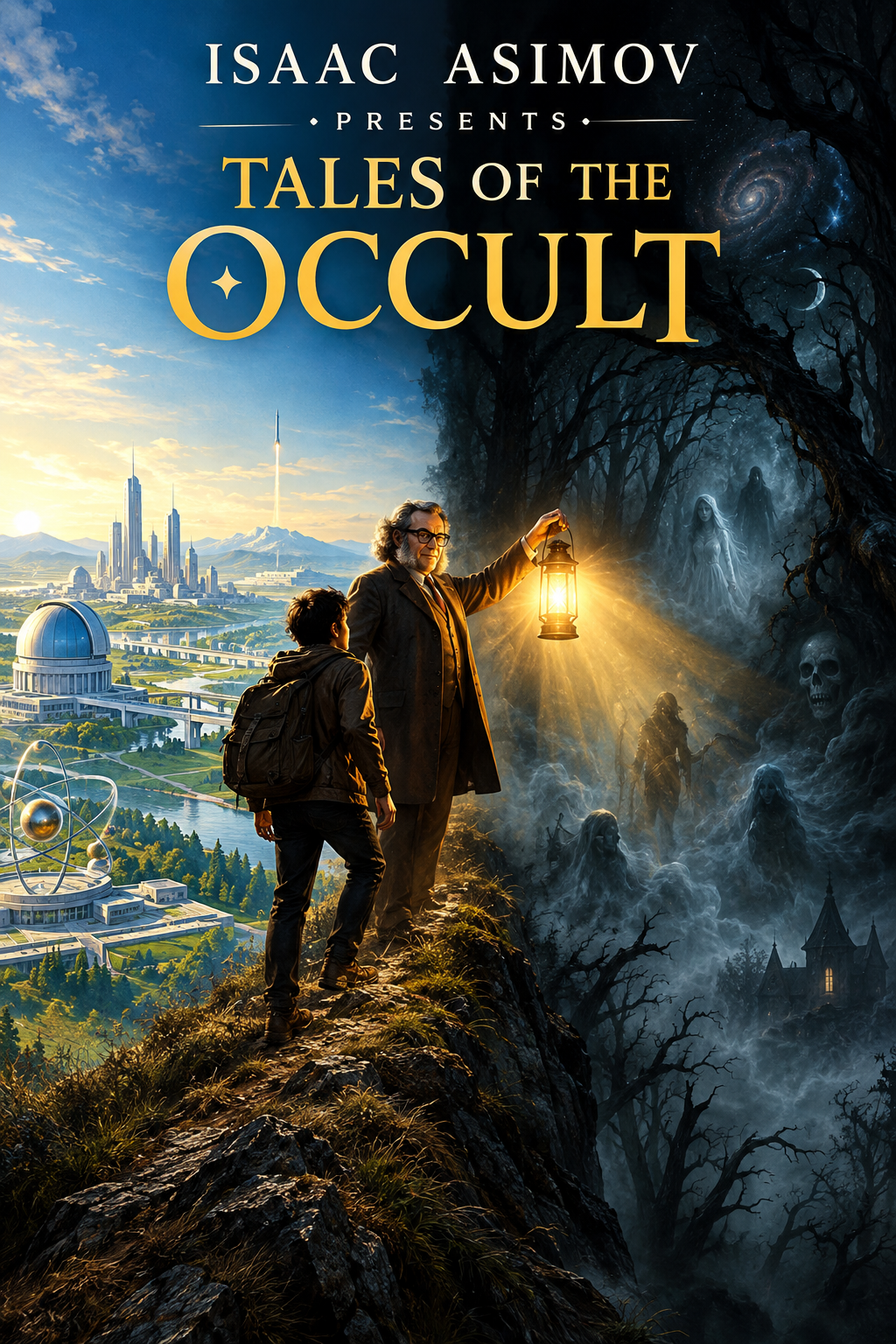
Imagine a great traveler standing on a narrow, windswept ridge. On one side lies the bright, orderly landscape of scientific reason, where every shadow is measured, and every event has a logical cause. On the other side lies a dark, dense forest where the trees whisper secrets, and the air is thick with mysterious forces. The traveler is hesitant to enter the forest alone, but beside him stands a guide. The guide is a tall, friendly man with thick sideburns and a quiet, reasonable voice, Isaac Asimov. He holds a bright lantern of rational thought. He does not tell the traveler to turn away from the forest; instead, he smiles, raises his lantern, and invites the traveler to walk together into the darkness, to enjoy the shivers of the unknown while keeping their feet firmly planted on the ground of reason.
This guide has collected twenty two tales from various travelers who ventured deep into the dark woods of the occult. Each tale is an experiment in the human imagination, exploring what happens when human beings face the limits of what they can explain. As the traveler and the guide take their first steps, they realize that these stories are not just about ghosts and magic, but about the deepest fears, hopes, and psychological needs of humanity. Each story represents a specific occult belief, building from a recognizable human situation and leading toward a profound mystery.
The first chamber they encounter in the forest is cold and sterile, smelling of ether. Here, they observe H. G. Wells’s “Under the Knife”. The story builds from the vulnerability of the human body as a patient prepares for a difficult surgical operation. From this ordinary fear of physical death and anesthesia, the narrative leads the mind into a terrifying exploration of consciousness existing beyond the physical body, suggesting that our awareness might not be entirely trapped within our flesh. The guide’s lantern reminds us that while medical science seeks to keep the mind anchored to the brain, the human imagination has always longed to slip past the surgeon's scalpel and drift into the cosmos.
Stepping out of the clinical chill, they enter a clearing where the night sky is filled with glowing, heavy stars. This is the realm of Rudyard Kipling’s “Children of the Zodiac”. The story builds from the ancient, comforting belief of astrology, where the enormous, cold stars are not just distant gas giants but personal celestial signs that shape human destiny. The narrative leads to an exploration of how mortal beings attempt to find meaning in a vast, uncaring universe by connecting their personal struggles to the movements of the sky. It is a reminder that astrology was humanity's first attempt to make the cold cosmos feel like a home that knows our names.
Further along the path, they meet a young woman who possesses an unsettling stillness. They are observing Henry Slesar’s “The Girl Who Found Things”. This tale builds from the quiet mystery of clairvoyance, where a person has the impossible ability to locate objects and secrets that ordinary human senses cannot perceive. Slesar leads the story toward a deep psychological question: when someone produces a result that defies common sense, should we immediately assume a supernatural power is at work, or should we look for a hidden, rational connection that we simply do not understand yet?
Suddenly, a mournful wail echoes through the trees, chilling the traveler to the bone. They are passing Gertrude Henderson’s “The Emigrant Banshee”. The story builds from the folklore of the death portent, a supernatural messenger that appears to announce an impending tragedy. Henderson leads the narrative through the landscape of grief, showing how the banshee becomes an embodiment of the inevitability of death. The guide's lantern softens the wail, showing that such legends are the human mind’s way of giving a voice and a shape to the sudden, silent terror of losing those we love.
The traveler and the guide then come upon a dark, twisting path that seems to lead back into seventeenth century New England. They are watching Nathaniel Hawthorne’s classic, “Young Goodman Brown”. This profound story builds from a young man’s decision to leave his safe village and walk into a shadowy forest to witness a meeting of devil worshippers. Hawthorne leads the story toward an overwhelming moral uncertainty, where the young man discovers that the most respected members of his community may possess hidden, dark lives. The deeper horror is not the devil himself, but the psychological rot of hypocrisy and suspicion that destroys the young man's faith in humanity.
Next, the traveler looks into a mirror but sees a figure that does not move when he does. They have entered the world of Helen McCloy’s “Through a Glass, Darkly”. This story builds from the chilling concept of the doppelgänger, the mysterious double of a living person. McCloy leads the narrative into a disturbing challenge to the nature of identity. If another person can look and act exactly like you, what is it that makes you uniquely yourself? The double represents the quiet, modern fear that our very sense of self may not be as stable or secure as we believe.
Deep in the woods, they find a silent, dimly lit cabin where a table is set for two, yet only one person is sitting. This is Kris Neville’s “Dumb Supper”. The story builds from a traditional occult ritual in which the living set a silent meal to invite the dead to join them. Neville leads the story through a thick atmosphere of grief, memory, and supernatural expectation, where the silence of the room becomes a canvas for the mind's deepest longings. It shows how easily the human heart can turn a ritual of remembrance into a haunting experience.
As they move onward, the sound of a steady, rhythmic beating begins to echo under their feet. They have stumbled into Edgar Allan Poe’s masterpiece, “The Tell Tale Heart”. The story builds from the narrator's irrational obsession with an old man’s pale, veiled eye, the "evil eye" of ancient superstition. Poe leads the narrative through a chilling descent into madness, where a senseless murder is committed to escape the eye, only for the narrator to be haunted by a beating sound. The guide's lantern illuminates the truth of the beating: it is not a supernatural heart, but the inescapable, thumping voice of a guilty conscience that refuses to be quieted.
The traveler and the guide now stand before a massive, crumbling estate that seems to hum with an unnatural energy. This is Edward Bulwer Lytton’s “The House and the Brain”. The story builds from a brave investigator's attempt to explore and exorcise a notoriously haunted house. Lytton leads the story toward a fascinating battle of wills, exploring whether spiritual forces can truly linger in physical spaces and whether a disciplined, rational mind can withstand the psychological pressure of a seemingly haunted environment.
Near the house, they find a small, curiously carved box containing a mummified human hand. This is Manly Wade Wellman’s “The Dead Man’s Hand”. The story builds from the grim folklore of the "hand of glory," a magical talisman made from the severed hand of a criminal. Wellman leads the narrative through a suspenseful exploration of how superstition can invest ordinary, physical objects with terrifying, imagined powers. It reveals our persistent human instinct to give magical agency to things to feel a sense of control over our environments.
The trees grow sparse as they enter a golden wheat field, where a man stands holding a sharp, gleaming tool. This is Ray Bradbury’s unforgettable story, “The Scythe”. The story builds from a desperate, impoverished family finding a house and a field of wheat that seems to hold an impossible opportunity for escape. Bradbury leads the narrative into a heavy, mythological meditation on death, where the man realizes that his scythe does not just cut wheat, but determines who lives and dies in the wider world. The occult tool becomes a devastating moral burden, showing that humanity is ultimately unprepared to wield the absolute power of fate.
They hear laughter from a nearby laboratory where a scientific experiment has gone strangely awry. They are watching Arthur Conan Doyle’s “The Great Keinplatz Experiment”. Famous for his logical detective, Doyle was also fascinated by spiritualism. This story builds from a professor's attempt to scientifically prove that the human soul can leave the body, leading to a humorous yet thought provoking swap of personalities between two very different men. It uses comedy to explore a serious philosophical question: does our consciousness exist independently of our physical brains?
But the laughter quickly fades as they encounter a shadowy figure that seems to have no face of its own. They are observing Fritz Leiber’s “Do You Know Dave Wenzel?”. This story builds from the terrifying concept of possession, where an external, supernatural force attempts to invade and occupy a human personality. Leiber leads the narrative to a chilling boundary where personal identity is completely challenged, leaving the victim and those around him to wonder where one's true self ends and the invading force begins.
They feel a sudden, suffocating warmth in the air, though it is the middle of the night. This is W. F. Harvey’s “August Heat”. The story builds from an artist who, on a stiflingly hot summer day, draws a picture of a criminal on trial, while a monument mason carves a tombstone with the artist’s name on it. Harvey leads the story toward a suffocating sense of precognition and fate, where two strangers are drawn together by a shared, disturbing vision. The narrative leaves us with the ultimate question of destiny: if we can see the future, are we powerless to change it?
The heat vanishes, replaced by a cold, gray fog of dread. They are observing Cornell Woolrich’s “Speak to Me of Death”. This story builds from a prophecy of death delivered to a wealthy man, turning his life into a prison of paranoia. Woolrich leads the narrative through a suspenseful trap of anxiety, showing how a prediction can become a self fulfilling prophecy, as the victim's own fear of the future drives him toward the very fate he is desperately trying to avoid.
Beside a dusty bookshelf, an old woman is examining a deck of cards. This is Avram Davidson’s “The Woman Who Thought She Could Read”. The story builds from the practice of fortune telling, where a woman attempts to decipher the future through simple readings. Davidson leads the story through a subtle examination of interpretation, demonstrating that human beings are naturally designed to search for patterns and meanings in random, ambiguous events. The true occult power here is not magic, but our desperate psychological need to make sense of the chaotic present by projecting order onto tomorrow.
They watch a couple whose eyes seem to look past each other, into different centuries. This is C. L. Moore’s romantic and haunting “Tryst in Time”. The story builds from the concept of reincarnation, tracing a love and a personality that survive across multiple lifetimes. Moore leads the narrative through a vast span of history, suggesting that human connections and relationships can transcend the physical limits of a single lifetime. Reincarnation is presented here not just as a belief, but as a beautiful hope that our love and identity are more permanent than our fragile bodies.
A low hum of voices draws them to a dark parlor where people sit in a circle, holding hands. This is John Hay’s “The Blood Seedling”. The story builds from a nineteenth century séance, where living people gather in the dark to establish communication with the deceased. Hay leads the story through a tension of faith and skepticism, showing how the séance represents a perfect symbol of the occult: our refusal to accept that death is a final, absolute silence, and our willingness to look into the dark for any sign of survival.
They see a detective examining a strange parchment covered in ancient letters. They are watching Robert W. Chambers’s “The Tracer of Lost Persons and the Seal of Solomon Cypher”. This story builds from the concept of soul travel, where consciousness is believed to leave the physical body to reach distant times or places. Chambers leads the story through a detective like investigation, demonstrating how occult fiction often mirrors science fiction by using clues, evidence, and logical deduction to explore things that lie beyond our immediate physical reach.
In a small garden, they observe an elderly woman casting a spell on a piece of wax that resembles her neighbor. This is August Derleth’s “Miss Esperson”. The story builds from sympathetic magic, the ancient belief that what is done to an imitation of a person will happen to the person themselves. Derleth leads the narrative through a quiet, localized conflict, showing how deeply rooted this primitive belief is in the human psyche, reflecting our instinct to believe in invisible, magical connections between unrelated things.
They feel a sudden, invasive pressure in their minds, as if someone is walking through their thoughts. This is Judith Merril’s “Peeping Tom”. The story builds from telepathy, the potential ability of one mind to read another’s thoughts directly. Merril leads the story through a psychological battleground, showing that the ultimate horror of mind reading is the total destruction of human privacy. If our private thoughts are no longer safe, then the very foundation of individual freedom and identity is lost.
Finally, they see a man sitting at a desk, his hand moving across a page as if guided by an invisible force. This is Edith Wharton’s “The Moving Finger”. The story builds from the concept of will control, where an external force influences or dictates a person's thoughts and actions. Wharton leads the story toward a quiet, devastating realization about human agency. If our minds can be controlled or influenced without our consent, then our choices, our guilt, and our free will become fragile illusions.
As the traveler and the guide reach the end of the dark forest, the guide, Isaac Asimov, raises his lantern high, casting a bright, clear light over the entire path they have walked. The traveler realizes that they have not just explored twenty two stories; they have mapped the entire geography of human belief, from our fear of the grave to our longing for the stars.
In reviewing this collection, "Isaac Asimov Presents Tales of the Occult" is strongest not because it proves the supernatural, but because of the wonderful, ongoing conversation it creates between the imagination and reason. Asimov, as the rational guide, never mocks the reader or the writers. He understands that knowing ghosts do not exist does not ruin the fun of a good ghost story; instead, it allows us to appreciate the stories as beautiful, creative experiments of the human mind. By pairing some of literature's greatest writers with his own clear, logical, and skeptical commentary, Asimov has created a book where darkness and reason live together in perfect balance, with the stories providing the mystery, and Asimov providing the light.