Isaac Asimov Presents the Great SF, Stories, 18
This 1956 science fiction anthology compiles mature stories exploring how future technologies, space travel, and computers ultimately test human nature and civilization.
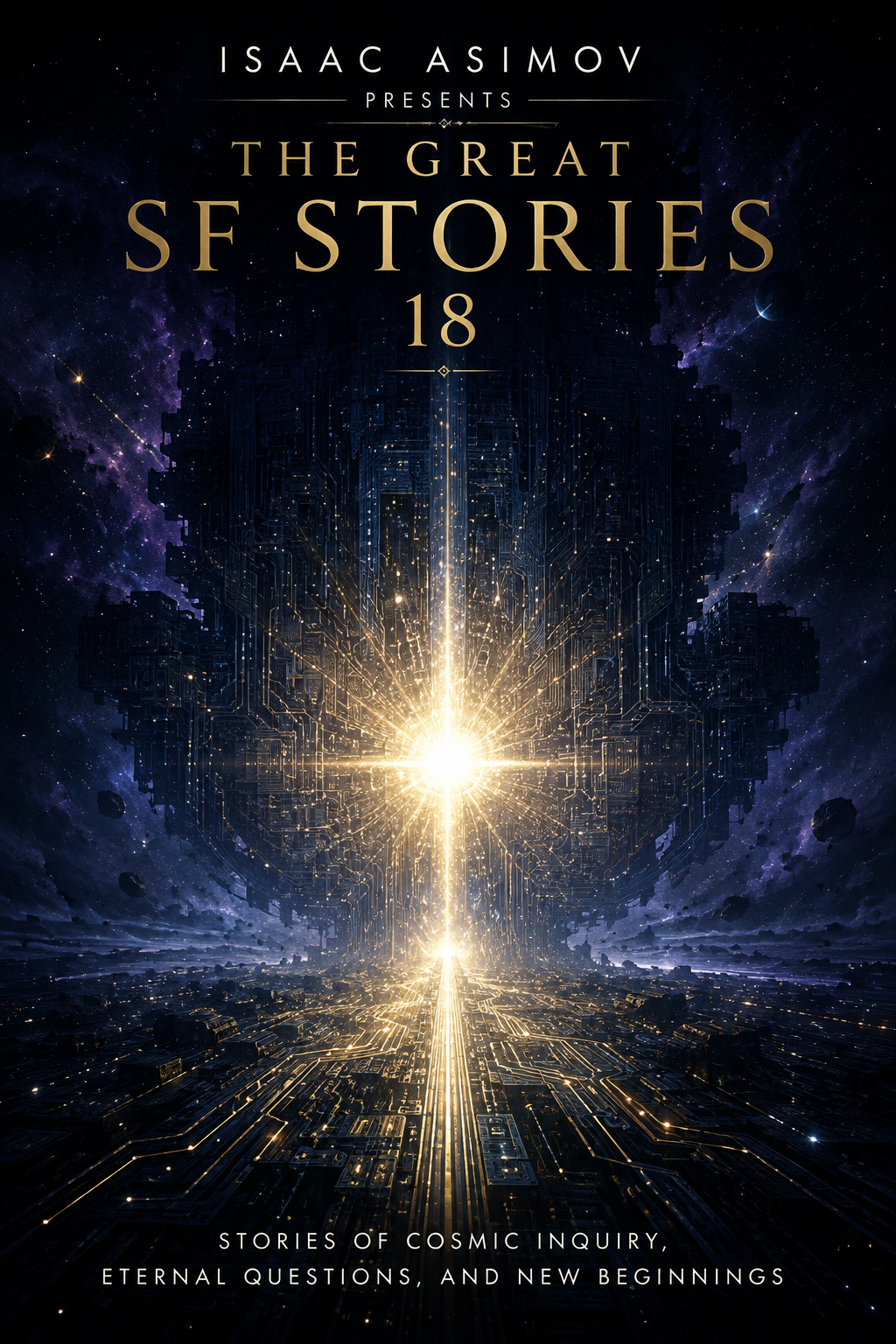
In 1956, science fiction reached a quiet turning point, becoming noticeably more mature as its writers shifted their gaze from simple gadgets to the complexities of human nature. The genre did not abandon its rockets, computers, or alien worlds, but it began to view them not as ends in themselves, but as mirrors for the human soul. This was the year captured in the eighteenth volume of Isaac Asimov’s famous anthology series, compiled to show how writers began asking what technology actually does to human beings. The machine became a test, the alien became a question, and the future became a place where our oldest weaknesses simply found new ways to express themselves. To read these stories is to walk through a gallery of human trials, beginning at the scorching edges of our own solar system and moving inward to the quietest corners of our minds.
Our journey begins with a desperate struggle against the physical reality of an unforgiving universe. In Brightside Crossing by Alan E. Nourse, we find ourselves on Mercury, where a group of explorers attempts to cross the sunward side of the planet under temperatures that defy human survival. The narrative does not merely chronicle an adventure; it sets up a profound conflict between human ambition and the cold indifference of nature. Nourse treats the planet itself as the primary antagonist, building the tension from a survivor's recollection of an earlier, failed attempt. The story is built on the classic explorer's drive to conquer the impossible, yet it leads us toward a sobering realization. It warns us that our grandest technological achievements do not repeal the laws of nature, and that courage, when divorced from humility and experience, quickly hardens into dangerous recklessness.
From the searing heat of Mercury, we are immediately plunged into the suffocating chill of human institutions. Mark Clifton’s Clerical Error shifts the danger from the physical hazards of space to the internal machinery of a highly classified government bureaucracy. A brilliant scientist, working on secret projects, begins to speak of revolutionary ideas that the authorities immediately interpret as madness. The story unfolds as a tense struggle between different doctors who represent opposing forces: one who demands a drastic, institutional solution and another who genuinely strives to comprehend the truth. Clifton builds this narrative around a deeper error, not a simple mistake of files, but the systemic failure of an institution that cannot recognize intelligence when it falls outside conventional categories. It forces us to ask whether our civilization is capable of accepting revolutionary truths, or if our systems will always destroy what they cannot control.
The struggle with institutional boundaries leads naturally to the personal costs of our grandest achievements. In Silent Brother by Algis Budrys, we meet a disabled pioneer of humanity’s first interstellar travel mission who sits in isolation, watching the triumphant return of his former comrades. While the world celebrates these spacefarers as mythic heroes, the protagonist is left behind, shrouded in secrecy and plagued by bizarre, inexplicable occurrences in his home. Budrys builds the story on a foundation of quiet psychological dread and physical vulnerability. He avoids simple space adventures to ask a deeply painful question about progress: when a civilization crowns its heroes, what becomes of the forgotten people who built the foundation of that success but never became part of the legend?
If progress threatens to leave the weak behind, it also threatens to isolate those who cannot conform. Damon Knight's The Country of the Kind takes us to a future that has seemingly solved the problem of violence and crime. In this clean world, we follow an antisocial protagonist who is granted extraordinary freedom because the society has developed a highly peculiar, non physical way of managing deviance. He can destroy and steal, but he must never cause physical harm. Knight achieves something remarkable by refusing to make this man sympathetic. Instead, he leads us to a disturbing truth: a society can eradicate criminal acts without ever truly cultivating goodness or ending cruelty. It is a story building from the promise of utopia and leading to a stark examination of loneliness, punishment, and the limits of behavioral control.
The collection then turns back to the frontier, testing human survival not through social engineering, but through raw adaptation. Murray Leinster's Exploration Team introduces us to a hostile alien planet declared too dangerous for colonization due to its native wildlife. Yet, a lone, unauthorized settler has established himself there, aided by an unusual partnership with specially bred Kodiak bears. When a colonial officer arrives to investigate a nearby silent colony, they must cross a treacherous wilderness together. Leinster’s tale works beautifully because the alien ecology operates by logical, consistent rules. The native creatures are not evil monsters; they are simply masters of their own environment. The story builds from a simple mission of discovery into a brilliant demonstration of teamwork, practical intelligence, and the necessity of working with nature rather than trying to crush it.
Yet, even as we colonize new worlds, our ancient, irrational shadows follow us. In Rite of Passage by Henry Kuttner and C. L. Moore, we encounter a future society so psychologically fragile that its people have reverted to a belief in magic. Corporations have adapted to this mass delusion, and we follow the Black President of one such firm who uses elaborate, artificial rituals to satisfy his clients. Seeking personal vengeance, he attempts to manipulate these fraudulent practices to destroy an enemy. The story is built upon a brilliant irony: the man who knows the magic is fake becomes utterly ensnared by the very superstitions he uses to control others. It leads to a profound observation about human nature, namely, that technological advancement can easily coexist with psychological regression when fear and social pressure take hold.
This theme of human limitation is pushed to its absolute limit in Poul Anderson's The Man Who Came Early. Here, time travel is stripped of its romantic illusions. A twentieth century American soldier is cast back to tenth century Iceland. Standard science fiction might suggest he would easily conquer the past with his superior modern knowledge, but Anderson systematically dismantles this fantasy. The soldier knows modern theories, but he lacks the practical skills, the tools, the raw materials, and the social standing to build anything useful. The story builds from his arrival as a stranger and leads to a tragic clash of cultures, showing us that the people of the past were not foolish; they understood their world perfectly, whereas the modern man is entirely helpless without his complex infrastructure.
If the modern man cannot survive in the past, can the past survive in the future? James Blish explores this reverse displacement in A Work of Art, where future science has perfected Mind Sculpting to recreate historical geniuses. We watch the reconstructed personality of composer Richard Strauss as he is brought back to life and encouraged to compose once more. However, Strauss finds himself in a musical landscape that has abandoned traditional melody for machines and structured randomness. The story builds from the wonder of resurrection and leads to a deep philosophical inquiry into the nature of art. Blish asks whether a genius can ever be separated from the specific cultural soil that nourished them, or if a reconstructed mind is merely a hollow imitation of a lost era.
A different sort of technological displacement occurs when our inventions are turned into simple novelties. Margaret St. Clair’s Horrer Howce injects a sense of dark playfulness into the anthology. It follows an inventor who tries to sell bizarre, highly advanced machines to a businessman running a chain of commercial horror attractions. These devices are meant to produce genuine terror, but the demonstration quickly spins out of control. St. Clair builds from a comedic premise and leads us into a deeper discomfort. Underneath the bizarre machines lies a critical question: what happens when our civilization gains the power to manufacture genuine, psychological terror and decides to package it as cheap commercial entertainment?
The commercialization of the future takes an even more logical, economic form in Compounded Interest by Mack Reynolds. A mysterious traveler journeys back to the early days of Venice, not to change history with weapons, but to deposit a sum of money with strict, multi century instructions. The story is built upon the simple, relentless mathematics of compound interest. Reynolds treats the financial system itself as a slow motion time machine, demonstrating how a tiny initial spark can grow over generations to consume the entire world's wealth. It is a marvelously logical narrative that shows how the most ordinary rules of economics can become the ultimate force of science fiction.
In contrast to these grand financial and artistic schemes, Reginald Bretnor’s The Doorstop reminds us that the extraordinary often enters our lives without any fanfare. A simple country doctor notices that an ordinary looking object used to hold a door open is actually a highly sophisticated alien artifact. The story builds from this quiet, domestic discovery as scientists and military men arrive to study the object. Bretnor avoids spectacular battles or grand alien invasions, focusing instead on the quiet, human reactions to the unknown. It leads us to realize that the mysteries of the universe do not always arrive with flashing lights; they are often resting quietly at our feet, waiting for us to pay attention.
This quiet contemplation of the cosmos prepares us for the intellectual peak of the volume: Asimov’s own masterpiece, The Last Question. The story begins in the year 2061, when two technicians casually ask the colossal supercomputer Multivac if the relentless progress of entropy can ever be reversed. The machine’s reply is simple: there is insufficient data for a meaningful answer. As the eras roll by, across thousands, millions, and trillions of years, humanity spreads across the stars, shedding its physical bodies and merging with its creations. In every epoch, a new generation asks the very same question, and every time, the computer gives the same silent response. Asimov builds his story on a scale that dwarfs all others, leading us past the death of stars and the end of time itself. When the universe is finally empty and dark, the ultimate intelligence, having finally found the answer, utters the words that begin creation all over again, transforming thermodynamics into a breathtaking myth of renewal.
After the cosmic warmth of Asimov's creation myth, Damon Knight's Stranger Station brings us back down to a cold, frightening reality. We find a lone human observer waiting on a remote space station for a periodic meeting with an alien entity whose sheer physical presence causes intense psychological agony to humans. Yet, humanity endures this torment because the alien secretes a substance that dramatically extends human life. The story builds from the observer's growing paranoia and his interactions with the station’s maternal artificial intelligence. It leads us into a dark, ambiguous space where the line between a biological gift and systematic manipulation becomes terrifyingly thin, asking if our fear of the alien is a warning of real danger or merely our own hatred of what we cannot comprehend.
Our journey returns to the familiar ground of Earth and governance in Michael Shaara’s 2066: Election Day. In a future America, the chaotic process of elections has been replaced by a massive, impartial computer called UNCLE SAM, which mathematically selects the single most qualified citizen to serve as president. The story builds from a breakdown in this perfect system, asking what happens when we try to reduce leadership to a purely technical calculation. Shaara’s satire leads us to understand that government is not a mere engineering problem, and that no machine can decide for us what human values truly matter in a leader.
Finally, the collection closes on an intimate, modern note with Theodore Sturgeon’s And Now the News.... We follow a man who is utterly obsessed with keeping up with every piece of news across the globe. When his wife attempts to cure him by stripping away his radios and newspapers, he flees into complete isolation, losing his grip on language and society. The story builds from his eventual capture and cure, but it leaves us with a quiet, lingering anxiety. Sturgeon’s work does not rely on lasers or starships; its focus is the psychological weight of information itself. It asks whether our obsession with every distant tragedy actually connects us to the world, or if it merely isolates us from the immediate reality of our own lives.
Looked at as a single, continuous work, The Great SF Stories 18 is not merely an anthology of different futures; it is a profound map of a genre growing up. Each story acts as a logical step, taking us from the physical limits of our bodies on Mercury, through the cages of our social and political institutions, and out into the vast, timeless architecture of the universe, before dropping us right back into the quiet room of our own minds. These writers of 1956 realized that the true subject of science fiction was never the machine itself, but how humanity would survive its own cleverness. Like the clear, logical prose of Isaac Asimov, the volume speaks in simple, direct language to deliver heavy truths. It remains a timeless reminder that as we change our world with our hands, we must never lose the wisdom to understand what we have made.