Isaac Asimov's Science Fiction and Fantasy Story a Month 1989 Calendar
This 1989 calendar edited by Asimov features twelve short speculative stories that use clever reversals to challenge human perspectives on the universe.
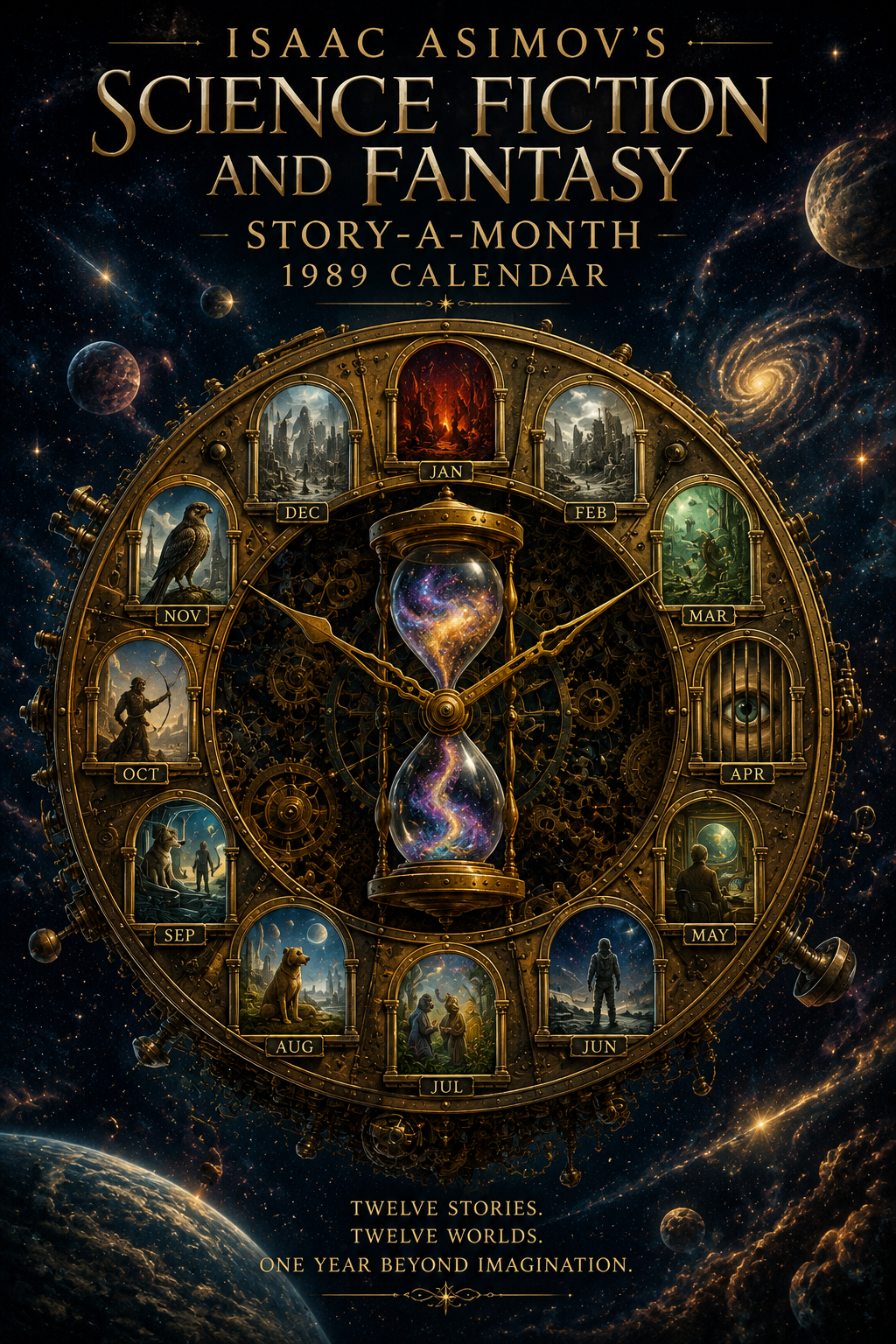
A strange artifact was delivered in 1988, bearing the title of Isaac Asimov’s Science Fiction and Fantasy Story a Month 1989 Calendar. It was not a conventional novel, nor was it even a simple anthology, but a calendar edited by Isaac Asimov and Martin H. Greenberg. Each of the twelve months was paired with a very short science fiction or fantasy story and a photograph of its author, turning the passage of time into an intellectual journey. Through these twelve small windows, the editors demonstrated that speculative fiction does not require massive volumes to capture the imagination; indeed, a whole universe can be contained in a few pages. Under Asimov’s editorial eye, the short short story operated like a scientific experiment, establishing a premise, introducing a single variable, and following the consequences to reveal some fundamental truth about humanity.
Our journey through this strange year begins in the cold of January with Robert Silverberg's “The Nature of the Place”. We follow Paul Dearborn, who has spent much of his life thinking about Hell. In his youth, the prospect of eternal punishment frightened him, but by middle age, Heaven began to seem so unbearably dull that the alternative grew almost attractive. Yet as old age creeps in, the dread of physical torment is replaced by a more troubling intellectual anxiety: the agony of not knowing what Hell is actually like. In his quest for clarity, Paul converses with a mysterious little man who seems to possess an intimate, first hand knowledge of the destination. Silverberg masterfully turns an ordinary philosophical question about what happens after death into a compact speculative joke, showing that Paul’s greatest fear is not Hell itself, but the dread of not understanding it.
As the calendar turns to February, the tone darkens considerably in Harlan Ellison's “The Voice in the Garden”. We step onto a ruined, post apocalyptic Earth where atomic war has destroyed civilization, and a surviving man eventually encounters the last surviving woman. The classic literary expectation is immediately clear, this is the moment for humanity to be given one final opportunity to begin again. Yet Ellison compresses this massive theme of human extinction into a few bleak paragraphs. Rather than offering a triumphant tale of rebuilding, the story acts as a parody of the old "last man on Earth" tale, quietly questioning whether humanity has learned anything from its destruction.
In March, Larry Niven presents us with “Mistake,” an exploration of how easily our perceptions can become reality when the mind is altered. We find ourselves tracking an astronaut on an isolated mission. Under the influence of drugs, the astronaut encounters what appears to be an alien demanding critical information about Earth's defenses. The encounter becomes increasingly threatening, until the astronaut takes a pill that clears his mind. Instantly, the alien disappears, revealing that it was never physically present. Niven turns a drug induced hallucination into an apparent first contact crisis, leaving us with the realization that while the astronaut believed in the illusion, it behaved exactly like a genuine external threat.
April brings one of the most elegant narrative reversals of the collection in Edward D. Hoch’s “Zoo”. A grand interstellar vessel carrying Professor Hugo's Interplanetary Zoo arrives on Earth, carrying strange creatures from the planet Kaan. Enthusiastic crowds of human beings gather to stare through the bars, fascinated by creatures that seem exotic, frightening, and wonderful. After a brief stay, the zoo departs and returns to Kaan. It is only when the ship lands on the alien world that we discover the situation looks exactly the same from the other side. To the creatures of Kaan, it was they who traveled to observe the strange humans in cages. Hoch brilliantly demonstrates that every observer believes he is the observer, until he discovers that someone else has been observing him.
The theme of the alien gaze takes a much darker and more biting turn in May with Philip José Farmer’s “The King of Beasts”. In this tale, we visit an alien laboratory where cloned animals are being displayed, recreating species that have disappeared. A visitor marvels at the advanced technology bringing these vanished creatures back to life. The scientist then reveals that he has secured special permission to preserve one particularly dangerous species. Expecting a terrifying animal, the visitor is shocked to discover that the cloned specimen is a human being. Farmer strips away human arrogance, transforming the self proclaimed "king of beasts" into an endangered or extinct creature worthy of preservation in an alien zoo.
In June, Lester del Rey guides us into a melancholy reflection on human limitation in “Earthbound”. We meet Clifton, a celebrated space traveler who has returned to Earth only to feel imprisoned by the planet. Clifton's path crosses with Ahasuerus, an old man who has devoted his life to making space boots but has never actually traveled into space. The contrast between the two men is painful; Clifton has experienced the stars and longs for escape from Earth, while Ahasuerus has spent a lifetime dreaming of the very journey Clifton takes for granted. When Clifton offers him a chance to accompany him to Rigel, Ahasuerus is caught in circumstances that keep him earthbound. Del Rey uses space travel as a poignant metaphor for frustrated human aspiration, questioning whether possessing the opportunity to escape is enough when a lifetime of circumstances has already shaped a person's destiny.
July lightens the mood with Charles Sheffield's “That Strain Again,” a story that examines the limits of scientific observation. Human visitors encounter aliens whose world has a different relationship with the changing seasons. When these aliens observe Earth's autumn foliage, they become alarmed, concluding that the changing colors are evidence that Earth has been infected by some biological agent. Sheffield builds his joke on a simple misunderstanding of biology and environment. The brilliance of the story is that neither side is irrational; rather, each interprets the unfamiliar evidence according to its own experience, reminding us that even scientifically trained beings can arrive at completely wrong conclusions when their frame of reference is incomplete.
Our journey moves into late summer as August brings Avram Davidson's “The Last Wizard”. This story, which originally appeared in Ellery Queen's Mystery Magazine in December 1972, shifts the calendar from science fiction into fantasy and mystery. Davidson crafts an extremely brief, carefully arranged literary trick that condenses the conventions of wizardry, mystery, and revelation into a few pages. Rather than building a sprawling world with hundreds of pages of history and mythology, Davidson proves that a writer needs only a few details, a mysterious figure, and a carefully timed revelation to create an entire imaginative world.
September returns us to the familiar theme of first contact in Mack Reynolds' humorous “Dog Star”. A human expedition makes contact with a superior alien civilization, and along for the ride is one of the few dogs remaining on Earth. When the aliens, who happen to physically resemble intelligent canine creatures, observe the expedition, they completely misunderstand the hierarchy. Seeing the humans care for the dog, they conclude that the dog must be the leader of the expedition and that the humans are merely its domesticated servants. Realizing the immense diplomatic usefulness of this misunderstanding, the humans choose to play along, though the final implication suggests that the dog might have understood far more than anyone realized.
In October, Harry Harrison delivers a powerful anti war message in “The Final Battle”. In a future civilization that is slowly recovering from a devastating global war, an older man tells children about the great conflict and the devastating weapon that finally ended warfare. The language of his story heavily suggests nuclear weapons, superweapons, or some unimaginable technology. However, the narrative pulls off a stunning historical reversal: the ultimate weapon turns out to be the bow and arrow. Harrison moves backward through history while pretending to move forward into the future, leaving the reader with a simple yet unmistakable anti war message in a world that has finally learned that warfare is too horrible to continue.
November ushers in a poetic, surreal fantasy with Jane Yolen's “The Tower Bird”. We follow a king who repeatedly turns to a mysterious bird for answers, expecting wisdom from a creature that seems to possess knowledge beyond ordinary understanding. Instead of clear answers, the bird responds in riddles, forcing the king to interpret rather than simply receive answers. When the bird delivers a response that changes the entire meaning of their relationship, Yolen beautifully undermines the expectation that wisdom will arrive in a form convenient for the powerful. The story is deliberately surreal, using a sudden shift of perspective to make the reader wonder whether the king was never the one asking questions of the universe, but rather the one being questioned by it.
Finally, the year draws to a close in December with Isaac Asimov's own contribution, “A Loint of Paw”. We meet Montie Stein, a clever fraudster who has stolen over $100,000. Seeking to escape the reach of the law, Montie boards a time machine and travels into the future, waiting out the statute of limitations on his crime. When he finally emerges, a highly unusual legal battle begins, with both sides arguing over whether the law can still punish him. True to his signature style, Asimov establishes an apparently impossible technical problem, examines its consequences with legal seriousness, and then resolves the entire courtroom drama with a brilliant pun.
Reflecting on this twelve month journey, Science Fiction and Fantasy Story a Month 1989 Calendar serves as a stunning showcase of the short short story form. What binds these twelve incredibly diverse pieces together is the art of the reversal. Across the year, we watch as humans who believe they are studying aliens discover they are the ones in cages; space travelers who seek freedom find Earth has become their prison; and a criminal who thinks he has outrun justice through time finds that the law can follow him through language. Asimov and Greenberg did not merely curate a collection of spaceships and monsters; they selected stories that act as elegant intellectual devices. Each story is a mechanism that can establish an idea quickly, develop it logically, and then overturn the reader's expectations with a final insight. It is a brilliant reminder that a writer does not need a massive volume to explore the cosmos; sometimes, twelve small windows are more than enough to show us that the universe is rarely what we assume it to be.