Curses
Isaac Asimov’s Curses compiles seventeen stories showing how mystical spells evolve into psychological burdens, social injustices, and the inescapable consequences of human choices
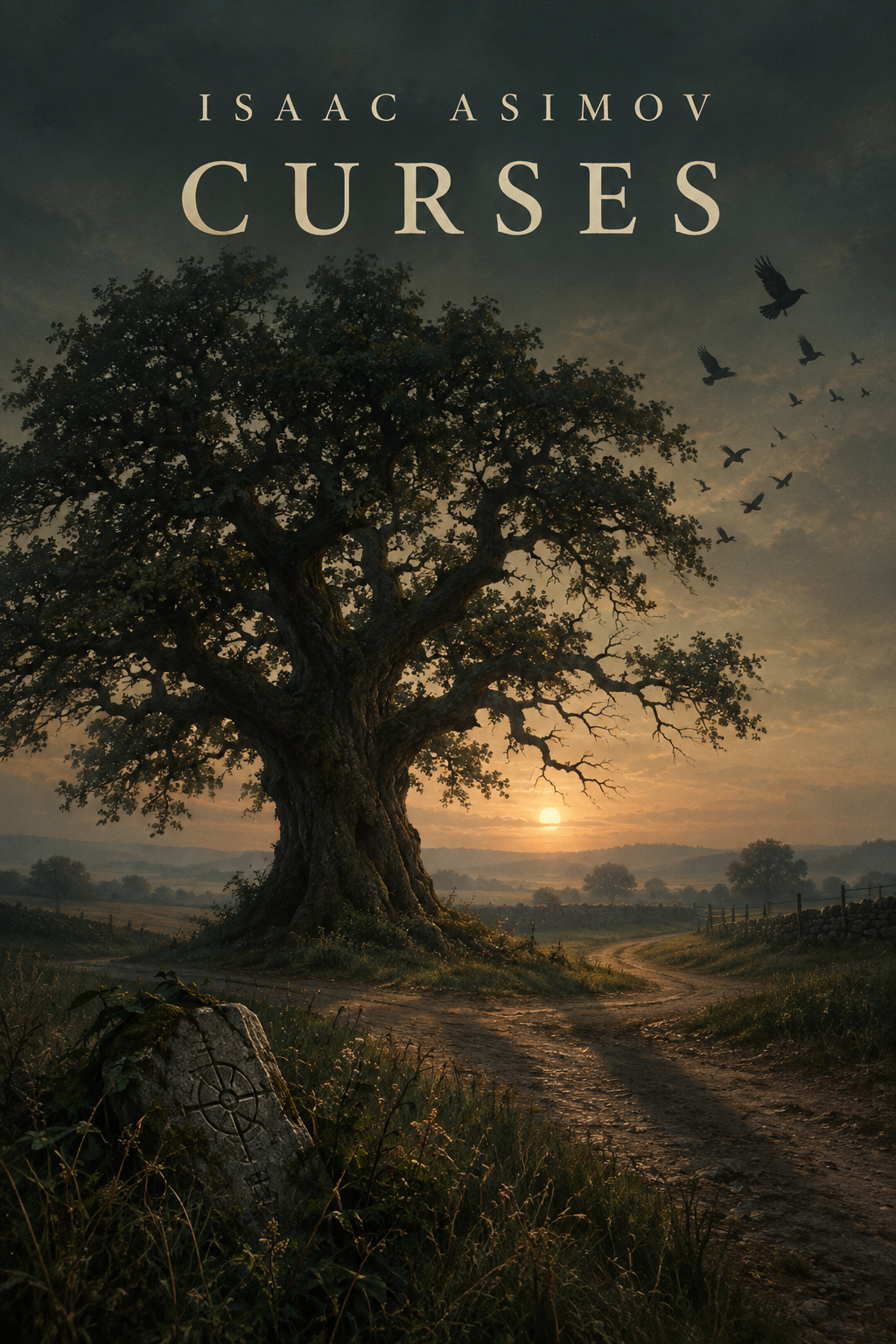
The collection titled Curses, published in 1989 as the eleventh volume of Isaac Asimov's Magical Worlds of Fantasy, was brought together by Isaac Asimov alongside co editors Martin H. Greenberg and Charles G. Waugh. The anthology begins as a literary journey through seventeen distinct tales that systematically explore how human beings understand misfortune. Isaac Asimov sets the frame for this narrative in his opening essay, "Malevolence". Writing with his customary clarity, humor, and logical skepticism, Asimov explains that long before humanity understood modern science, people invented curses to explain suffering. A curse gave bad luck a human face, someone to blame, and the comforting hope that a spell might one day be broken. From this rational starting point, the collection unfolds into a story of how superstition slowly gives way to the reality of human behavior.
The narrative journey moves first into Arthur C. Clarke's story, "The Curse," which takes us to a quiet, ruined landscape surrounding Shakespeare’s grave at Stratford upon Avon after a devastating nuclear catastrophe. Clarke avoids traditional monsters or heroic action, focusing instead on the silence left behind by modern weaponry. The plot leads the reader to realize that Shakespeare's ancient warning against disturbing his bones has taken on a grim modern meaning, where human technology itself acts as the ultimate curse. From this global tragedy, George Moore's "Julia Cahill's Curse" shifts the setting to a small Irish village ruled by strict social authority. The story builds around a young woman named Julia who refuses to submit to local expectations, prompting a priest to isolate her. As people leave the village, the narrative leads toward a tragic realization that social intolerance and forced isolation ruin a community far more effectively than any magic word.
Moving into high seas adventure, Robert Bloch's "The Red Swimmer" introduces Luke Treach, an English pirate who captures a Spanish ship and pretends to be its captain. Treach targets a wealthy father and daughter after learning the father holds the secret to immortality. The story builds from Treach's criminal greed and leads him into a confrontation with ocean vengeance, where a man who believes himself to be a predator slowly discovers he has become the prey. Elizabeth Gaskell's "The Doom of the Griffiths" transports us to Wales, where an ancient family feud originating from Rhys ap Gryfydd’s betrayal of Owen Glendower hangs over generations. The plot centers on young Owen Griffiths and his father, building upon a prophecy that foretells the son slaying the father. The narrative leads toward tragedy by showing how knowing a prophecy creates psychological fear, driving the characters to fulfill the very disaster they dread.
In Theodore R. Cogswell's "You Know Willie," the setting shifts to the American South during the 1950s. The plot builds around Willie McCracken, a racist murderer who believes the local legal system will protect him. The story leads toward a moral turning of tables, where supernatural forces reverse the victim's experience and force the culprit to face the horrors he inflicted on others. Taking a comedic turn, H. L. Gold's "Trouble with Water" tells the story of Herman Greenberg, a struggling businessman who catches a water gnome while fishing and insults the creature. The gnome places a curse on Greenberg that prevents water from touching him, leading to a logical series of funny disasters as Greenberg tries to bathe, shave, and drink without getting near water.
Wilkie Collins's Gothic mystery, "Mad Monkton," follows Alfred Monkton, a man engaged to be married who becomes consumed by an obsession with his dead uncle. Alfred believes that if his uncle’s unburied body is not brought home to the family tomb, his family line will perish. The story builds a tense atmospheric journey where the plot leads the reader along a thin line between inherited family madness and genuine supernatural destiny. Seumas MacManus's "Long Chromachy of the Crows" draws on Irish folklore to show how omens and crows herald coming misfortune, demonstrating how collective memory can haunt a place across generations. Manly Wade Wellman's "The Little Black Train" takes us into the Appalachian mountains with John the Balladeer, who meets a wealthy woman named Donie Carawan trying to escape a dead lover's curse. The narrative builds upon Donie's past greed and crime, leading toward an approaching black train that represents inescapable moral reckoning.
In F. Anstey's "The Curse of the Catafalques," a young man on a ship meets Augustus McFadden, who is caught in an awkward marriage arrangement with a wealthy family that harbors a literal hereditary curse. The plot builds around a terrifying supernatural entity that periodically arrives to audit the family's accounts, leading to a humorous clash between Gothic terror and social cowardice. Thomas F. Monteleone's "A Séance in Summer" explores the Victorian passion for communicating with the dead. The story builds from a simple summer gathering into an eerie encounter, leading toward the realization that crossing the boundary between life and death holds hidden dangers. Christopher Fahy's "Transformations" introduces a modern horror perspective where a curse alters a person's body and physical identity, showing that transformation itself can be a frightening punishment.
Sarah Orne Jewett's "In Dark New England Days" focuses on sisters Betsey and Hannah Knowles, who struggle to survive after the death of their domineering father. The plot shows how their father's harsh control continues to torment them, leading to the understanding that a lifetime of domination acts as a psychological curse. Robert W. Chambers's "The Messenger" leads us into Brittany, where the unearthing of an old mass grave reawakens ancient family guilt and ancestral land secrets. Avram Davidson's "Or the Grasses Grow" presents a political reality at the Tickisall Agency, where a Native American community faces land dispossession despite treaty promises. The narrative leads to the grim conclusion that legal language becomes a weapon when those in power choose to break their promises.
Morgan Robertson's "The Dollar" follows a sailor named Scotty Macpherson whose greed turns a simple dollar bill into an object of strange significance, leading the reader to question whether the coin is cursed or if human guilt creates its own hauntings. Finally, Talmage Powell's "A Hunger in the Blood" closes the collection by examining violent impulses that pass down through families, leading away from supernatural ghosts and toward modern psychological reality.
In reviewing Curses, the true success of the collection lies in how Asimov and his co editors gradually transform the definition of a curse. What begins as simple spells and supernatural punishments steadily evolves into a logical study of human choices and consequences. Whether exploring nuclear ruin, social prejudice, historical injustice, or family guilt, the anthology demonstrates that the most frightening curses do not require magic. They are created by human actions whose consequences survive long after those who committed them are gone.