The New Hugo Winners
Edited by Isaac Asimov, The New Hugo Winners compiles award-winning speculative short stories exploring human choices, technological transformation, and moral dilemmas across time.
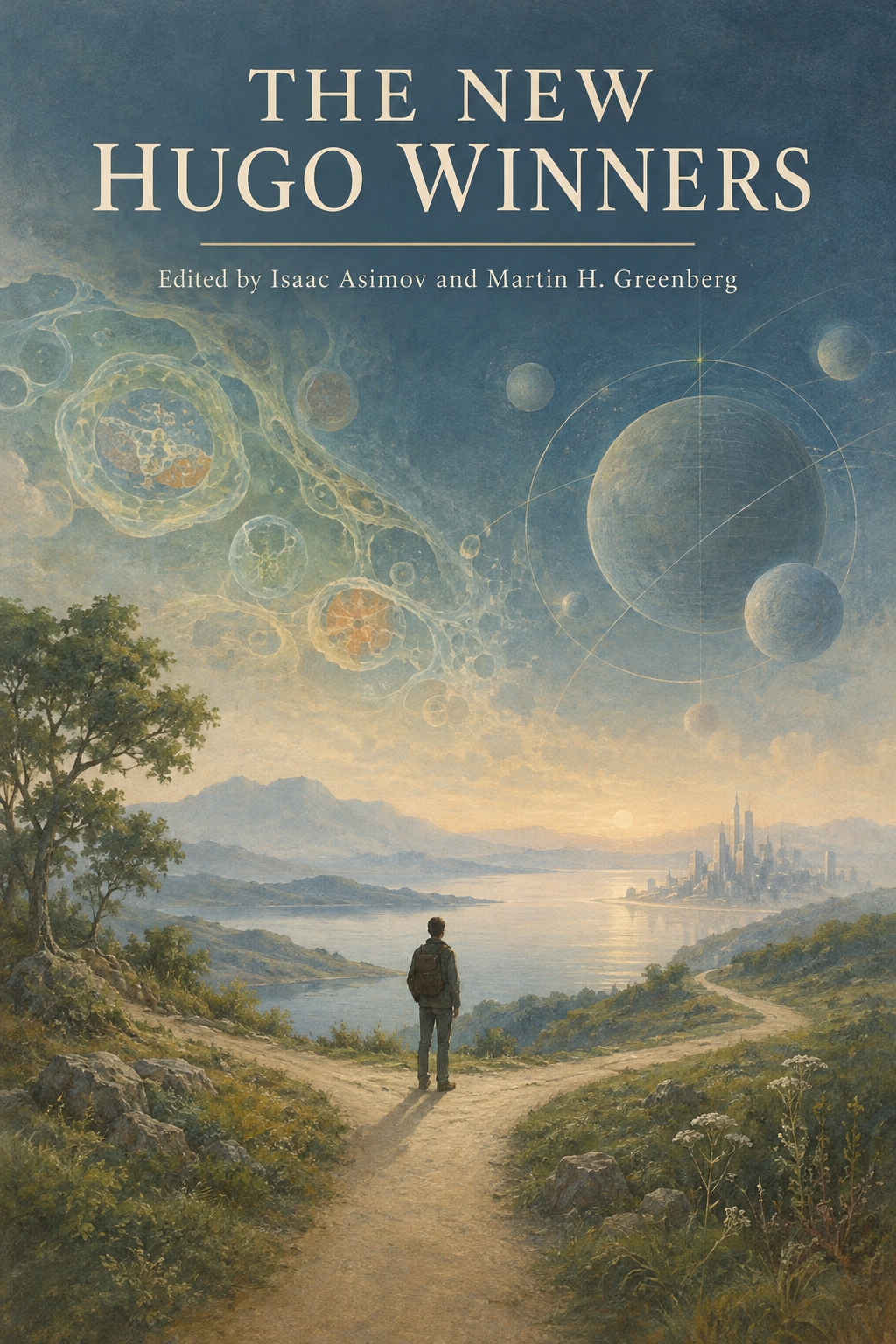
Science fiction begins with a simple question about what happens when the world changes in a fundamental way. In The New Hugo Winners, edited by Isaac Asimov and Martin H. Greenberg, nine award-winning works demonstrate how a single imaginative change can alter human existence. Asimov presents these tales not merely as adventures with machines or alien planets, but as logical investigations into human nature, society, and moral choices. Rather than following one single narrative line, the anthology functions as a tapestry of distinct stories that together build a larger picture of scientific possibility.
The journey opens with Souls by Joanna Russ, which moves backward into history rather than forward into the far future. Set in a medieval community under threat from Viking invaders, the story builds around an intelligent abbess whose wisdom and moral authority stand in sharp contrast to physical violence. Rather than giving in to panic, she uses psychological insight and deep understanding to protect her people, raising profound questions about gender, power, and the true meaning of civilization.
In Fire Watch by Connie Willis, the narrative shifts to the concept of time travel, sending a future historian directly into London during the heavy bombing of the Blitz. The story builds from the tension between studying past events in textbooks and actually living through the fear, uncertainty, and personal sacrifice of historical reality. It leads readers to realize that history is created by ordinary individuals making brave choices without knowing how the future will remember them.
Spider Robinson takes a legal and philosophical path in Melancholy Elephants, centering on a proposed expansion of copyright laws. The plot builds upon a debate over artistic property, showing how endless legal protections might actually prevent future generations from creating new art. Robinson logically demonstrates that culture relies on sharing common ideas, warning that overprotecting the past can accidentally strangle the creative future of humanity.
In Cascade Point by Timothy Zahn, humanity achieves faster-than-light spaceflight, but the mechanism introduces unsettling psychological side effects whenever a ship crosses the boundary. The narrative builds on the psychological tension experienced by passengers and crew, exploring how unfamiliar observations force people to question their own perceptions and judgment. Zahn shows that technological breakthroughs often produce mysteries that challenge human understanding rather than simply making travel easier.
Greg Bear brings biological speculation into focus in Blood Music, which centers on advanced genetic engineering where microscopic cells are transformed into computing structures. The story builds on the dangerous scientific assumption that creators can always maintain control over self-organizing biological systems. As the altered cells multiply and adapt, the narrative leads toward a sweeping transformation of life itself, asking what truly defines human consciousness and identity when biology evolves beyond our expectations.
Octavia Butler presents a stark vision of societal collapse in Speech Sounds, set after a sudden outbreak causes widespread aphasia and destroys the ability to speak, read, or write. The story builds through the daily struggles of its protagonist in a world where simple misunderstandings can trigger immediate violence. Butler shows that language is not just a minor convenience, but the essential foundation of trust and social order that holds civilization together.
In Press Enter by John Varley, the focus shifts to digital networks and electronic surveillance. The mystery builds from a series of disturbing occurrences involving interconnected computer systems, creating psychological suspense as characters realize how easily hidden technology can be turned against them. Varley logically examines the vulnerability of individuals in a world where complex digital infrastructure creates power imbalances that are difficult to see or defend against.
Octavia Butler returns with Bloodchild, exploring an intimate and complex relationship between human settlers and an extraterrestrial species that requires human hosts for reproduction. The story builds upon the quiet tensions of obligation, protection, and bodily autonomy, avoiding simple depictions of good or evil. It leads readers to think deeply about how power dynamics shape consent, love, and survival when two different species depend on each other to endure.
The collection concludes with The Crystal Spheres by David Brin, which addresses the Fermi paradox by proposing that stellar systems are enclosed within protective physical barriers. The narrative builds on humanity's search for cosmic companions, transforming the apparent silence of space into a puzzle about safety and galactic evolution. Brin leaves readers with a sense of wonder, suggesting that cosmic isolation might be the deliberate result of choices made by intelligent civilizations.
As a whole, The New Hugo Winners succeeds because it treats science fiction as a literature of ideas and human choices rather than gadgetry. Asimov's selection highlights how scientific progress does not guarantee moral wisdom, forcing readers to examine timeless questions of trust, responsibility, and freedom. By leading from historical reflection to biological transformation and cosmic speculation, the anthology provides a logical and deeply satisfying exploration of where human imagination can take us.