Visions of Fantasy Tales From the Masters
Edited by Isaac Asimov and Martin Greenberg, this fantasy anthology explores human character, courage, memory, and truth across twelve distinct, magical, and highly speculative stories.
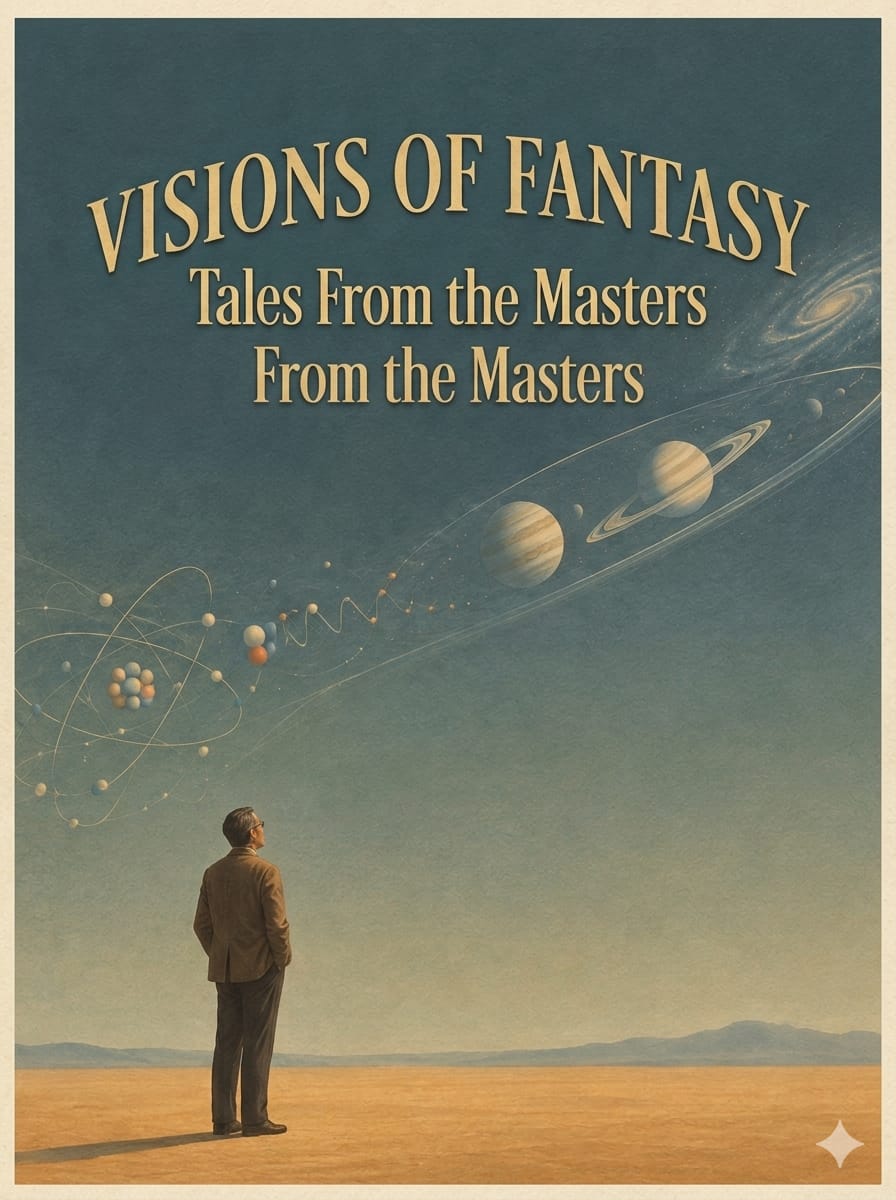
Imagine entering a grand literary hall curated by Isaac Asimov and Martin H. Greenberg, where fantasy is framed not as wild nonsense, but as a clear, logical exploration of human nature. Asimov, whose own science fiction established vast galactic empires on straightforward principles and rational deduction, approached fantasy with that same desire to organize, understand, and clarify. In Visions of Fantasy: Tales from the Masters, an anthology published in 1989 spanning about 180 pages, twelve distinct writers were brought together to construct a unified narrative journey. Rather than treating fantasy as a single rigid genre of swords and sorcery, the collection functions like a guided tour through twelve distinct realms of human experience, testing how character, loyalty, truth, and responsibility hold up when the ordinary rules of our world are quietly altered.
The story of the book begins in a world of high heroic effort where physical limitations are tested against inner resolve. In Anne McCaffrey’s “The Smallest Dragonboy,” the narrative builds from the plight of Keevan, the smallest and youngest boy on the planet Pern, who suffers constant ridicule from older boys while training to become a dragonrider. His journey leads through physical injury and mockery toward a critical trial at the Hatching Ground, where he discovers that a dragon values determination, courage, and character far more than sheer size. From there, the collection shifts toward the mental connections of William Lee’s “A Message from Charity.” Building from a telepathic link established across centuries between Peter Wood in the twentieth century and Charity Payne in colonial Massachusetts, the story leads into a tense historical dilemma. As Charity receives visions of the future, her strange knowledge exposes her to accusations of witchcraft, bringing supernatural wonder into direct, dangerous collision with historical prejudice.
Continuing along this narrative path, fantasy becomes a lens for exploring moral truth and eerie quietude. In Jane Yolen’s “The Seventh Mandarin,” the story builds from a dreamlike Eastern kingdom where the youngest mandarin is tasked with flying a ceremonial kite that carries the king's soul. When a sudden storm drives the kite beyond the protected palace walls, the story leads the mandarin into the impoverished countryside to discover real human suffering that official royal records ignored, forcing him to choose between blind obedience to authority and speaking truth to power. The tone then turns supernatural in Howard Goldsmith’s “The Voices of El Dorado.” Building from a child exploring an echoing canyon, the story leads into a chilling atmospheric mystery as the strange sounds gradually reveal themselves to be the voices of the dead, showing how an ordinary physical landscape can act as a thin boundary between life and death.
As the journey moves deeper, magic manifests through simple objects and emotional memory. Bruce Coville’s “The Box” builds from a deceptively simple event: a boy named Michael is handed a beautiful wooden box by an angel with instructions to guard it without opening it until the angel returns. The narrative leads through Michael's entire lifetime, across childhood, work, relationships, and old age, exploring how an unexplained responsibility becomes an anchor of trust and duty regardless of whether its contents are ever revealed. Ray Bradbury’s “The Lake” then introduces a darker emotional note. Building from a man's childhood memory of his friend Tally, who drowned in a lake years earlier, the narrative leads toward his return to the shore as an adult with his new wife, where the water acts as a repository for grief, loss, and the haunting persistence of childhood memory.
The anthology then demonstrates how fantasy can pivot toward sharp comedy and southern gothic atmosphere. Marion Zimmer Bradley’s “A Dozen of Everything” builds from a young bride to be named Marcie receiving a magical djinn and wishing for a dozen of everything to prepare for married life. The story leads into absurd chaos when the magic obeys her literal words rather than her practical intention, offering a witty and logical warning about the hazards of careless language. In contrast, Madeleine L’Engle’s “Poor Little Saturday” builds from a malaria stricken youth wandering into a deserted southern plantation house. The narrative leads through a fevered blurring of illness, imagination, and real enchantment as the boy encounters a timeless witch and a mysterious girl, showing how fantasy can exist on the ambiguous edge of human perception.
At the center of the collection stands Isaac Asimov’s own story, “The Fable of the Three Princes,” which logically deconstructs the classic fairy tale framework. Building from King Hilderic’s search for an heir among his three sons, the physically powerful Primus, the martial Secundus, and the intellectual Tertius, the narrative leads through a trial set by Princess Meliversa, where failure turns suitors into stone. While the elder brothers rely on conventional physical prowess and fail, Asimov leads the story toward Tertius, who uses moral perception to look past outward beauty and recognize true character, demonstrating Asimov's signature belief that clear thinking and moral intelligence triumph over brute force. Next, Al Sarrantonio’s “Letters from Camp” turns toward science fictional fantasy. Building from letters written home by a child at summer camp, the story leads beneath its ordinary, humorous surface to reveal a strange science fictional reality hidden within an everyday setting.
As the collection approaches its conclusion, it embraces playfulness before settling into quiet wonder. Lewis and Edith Shiner’s “Things That Go Quack in the Night” builds from comic absurdity, leading the reader to appreciate that fantasy can be delightfully humorous rather than solemn. Finally, Elizabeth S. Helfman’s “Voices in the Wind” brings the voyage to a peaceful close. Building from an elderly retired fisherman named Tom sitting by a window listening to the storm, the story leads toward a shared experience with his wife Sarah as they both hear voices in the wind. Though ignored by the surrounding village, their experience leads to a quiet appreciation of subtle magic, demonstrating that fantasy does not require grand dragons or dark spells to exist.
Reviewing Visions of Fantasy: Tales from the Masters as a complete work reveals why Asimov's logical editorial approach is so effective. Instead of forcing twelve different authors into a uniform mold, Asimov and Greenberg arranged their distinct voices into a clear, progressive structure. The book moves logically from heroic action to historical drama, from moral allegory to ghostly memory, and from absurd comedy to quiet psychological observation. By keeping the language simple, clear, and direct, the anthology mirrors Asimov’s own literary philosophy: complex ideas and magical possibilities are best understood when expressed with logical clarity. In the end, the anthology teaches us that fantasy is not merely an escape into the impossible, but a powerful tool that helps us see ordinary life, moral duty, and human character with greater clarity.