Asimov's Chronology of Science and Discovery
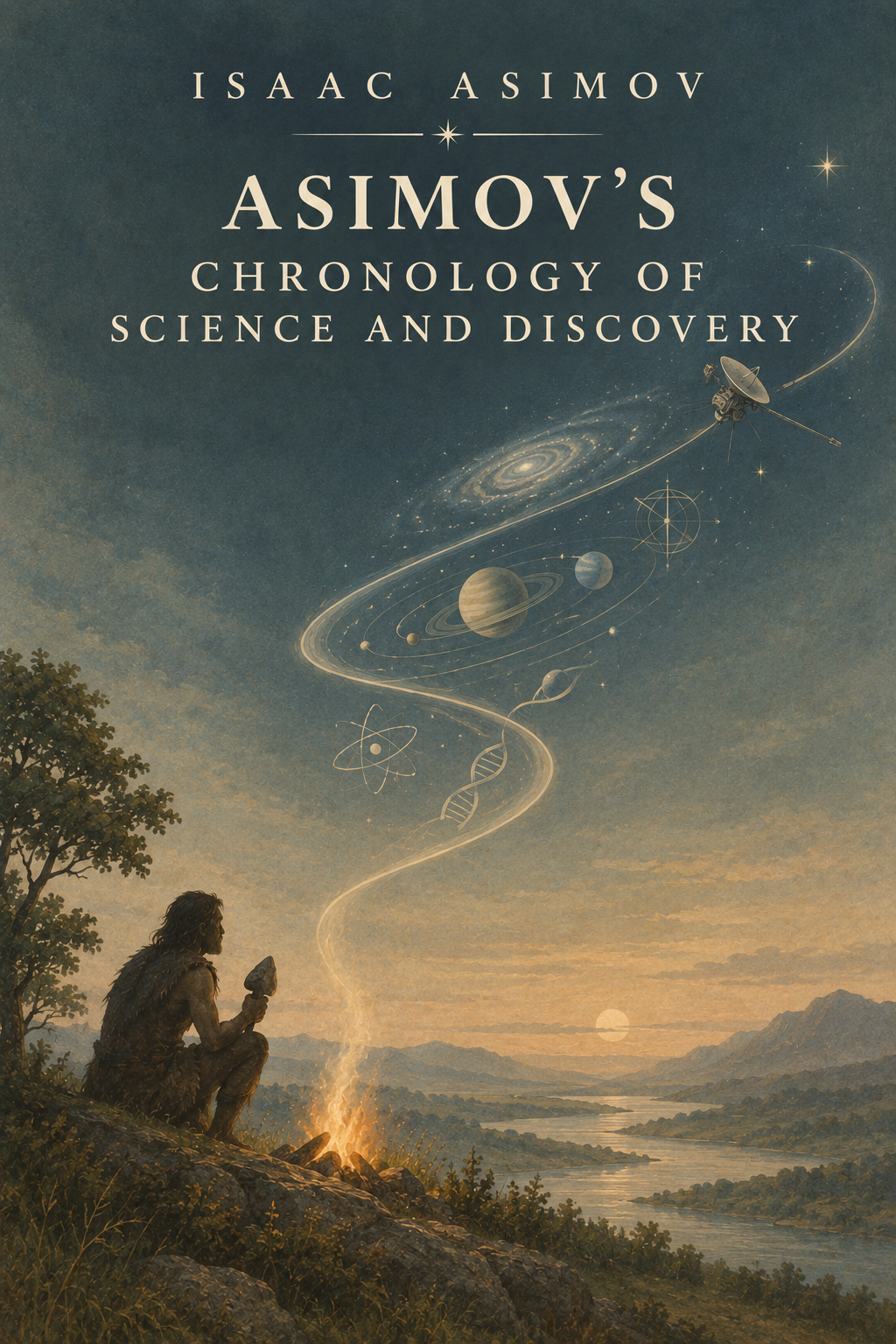
Asimov traces humanity's total scientific progress as a continuous chain, showing how primitive tools evolved into space exploration while every discovery endlessly expanded human knowledge.
The Master Narrative: Humanity as Protagonist
Isaac Asimov's Chronology of Science and Discovery tells an epic story without relying on a conventional fictional plot. In this grand narrative, humanity itself serves as the central protagonist, and its setting encompasses the entire history of human civilization. Rather than treating scientific progress as a series of random accidents or disconnected leaps, the book arranges thousands of years of observation, invention, and experiment into a continuous, logical chain. Every discovery sets the stage for the next, showing how human knowledge steadily accumulates across generations.
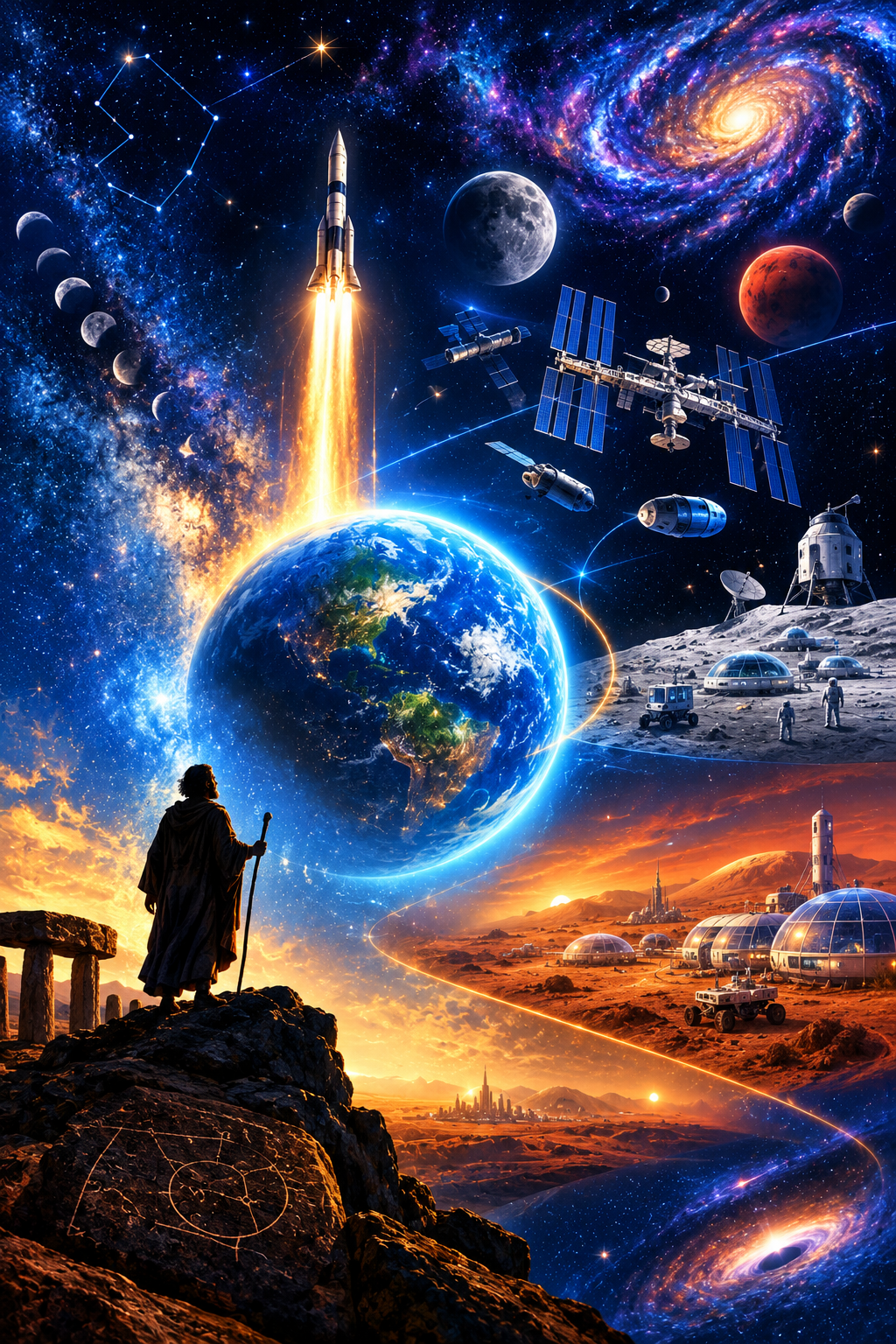
The narrative arc originates in deep prehistory and expands continuously outward. It traces a journey that moves from a human holding a primitive stone tool to modern scientists sending sophisticated instruments into the farthest reaches of space. Along the way, Asimov demonstrates that science does not develop in isolation from society; instead, a new discovery transforms civilization, and civilization in turn creates the necessary conditions for further discovery.
The Epochs of Discovery: Summaries of the Interconnected Stories
The Spark of Prehistory: Tools, Fire, and Agriculture
The narrative begins long before written records exist, when early humans were first distinguishing themselves from animals. The earliest technological strides appear simple, shaping stone tools, controlling fire, building shelters, hunting, and eventually farming, yet Asimov reveals their immense conceptual weight. A simple stone tool represents a monumental intellectual shift: the moment a creature deliberately alters its surroundings according to an internal plan. Controlled fire provides protection and warmth, transforms food, and eventually serves as the bedrock for metallurgy. The agricultural revolution then shifts human life away from nomadic hunting toward settled villages. With crop cultivation and animal domestication come surplus food, specialized occupations, trade, government, and eventually writing, establishing the unbreakable bond between scientific innovation and human society.
The Dawn of Civilization: Mathematics and the Sky
With the emergence of writing, human knowledge gains the ability to endure beyond the lifetime of a single individual. Early mathematical systems arise directly from practical human needs, such as counting livestock, trading goods, measuring land, constructing buildings, and tracking time. Egyptian architects and surveyors apply geometric principles, while Mesopotamian societies build sophisticated numerical and astronomical frameworks. Early observers look to the night sky because the movements of the Sun, Moon, and stars offer a reliable calendar for planting crops and managing state administration. Astronomy thus becomes one of humanity's first formal sciences, providing a permanent celestial clockwork against which people can measure time and seek order in nature.
The Greek Synthesis and Global Inheritance
The thinkers of ancient Greece fundamentally alter the nature of scientific thought by moving beyond practical application to ask why natural phenomena occur as they do. They transform geometry into a rigorous system of logical proof and attempt to explain matter, motion, life, and the structure of the cosmos through natural reasoning. However, Asimov highlights a vital lesson: intelligence does not guarantee correctness, as the Greeks created brilliant theories alongside ideas that were fundamentally wrong. When ancient classical authority faltered, scientific knowledge was preserved, translated, criticized, and expanded within the Hellenistic world and Islamic civilization, where scholars advanced optics, mathematics, medicine, and astronomy through vibrant cross cultural exchanges.
The Renaissance and the Scientific Revolution
In Europe, centuries of relying strictly on ancient authorities eventually yield to a new intellectual attitude that favors direct observation and experiment over inherited dogma. The Renaissance accelerates this movement through the invention of printing, anatomical investigations by artists, and navigational demands driven by oceanic exploration. This momentum culminates in the Scientific Revolution. Copernicus repositioned Earth by proposing a heliocentric model of the solar system, Kepler derived mathematical laws of planetary motion, and Galileo deployed the telescope to challenge long held cosmological assumptions. Newton then unified terrestrial and celestial motion within a single, elegant mathematical system, establishing that the physical universe operates according to discoverable natural laws.
The Enlightenment and the Industrial Revolution
During the Enlightenment, chemical science systematically separates itself from alchemy, electricity becomes an object of structured investigation, and biological classification becomes disciplined. The Industrial Revolution subsequently proves that theoretical understanding can be converted into immense technological power. Steam engines revolutionize transportation and manufacturing, coal becomes a major energy source, iron production skyrockets, factories reshape economic structures, and telegraphy separates long distance communication from physical travel. Through these interconnected innovations, scientific knowledge begins directly altering everyday human life.
The Nineteenth Century Breakthroughs: Matter, Life, and Microbes
The nineteenth century deepens human understanding across chemistry, biology, and physics. Dalton introduces atomic theory to explain chemical combinations, while Mendeleev constructs the periodic table, providing a predictive framework for the chemical elements. In biology, geological evidence challenges traditional timelines of Earth's age, setting the stage for Charles Darwin and Alfred Russel Wallace to propose evolution by natural selection. Meanwhile, medicine shifts toward experimental science as Pasteur and Koch establish the germ theory of disease, leading to antiseptic surgery, widespread vaccination, sanitation, and life saving antibiotics. In physics, Maxwell unifies electricity, magnetism, and light into mathematical equations, and experiments reveal that the atom contains subatomic components like the electron.
The Twentieth Century Frontiers: Quantum, Relativity, and Space
The twentieth century opens with radical shifts in physical reality. Einstein's relativity redefines concepts of space, time, gravity, and motion, while quantum theory reveals the strange subatomic behavior of radiation and matter. The discovery of the neutron and the atomic nucleus unleashes nuclear physics, offering both immense energy and catastrophic destructive power. Under the intense pressure of two world wars, technological development accelerates rapidly, giving rise to radar, aviation, advanced electronics, and modern medicine. Soon after, mechanical calculators evolve into electronic computers, transforming information into a fundamental resource. Finally, rocketry enables humanity to escape Earth's atmosphere, land on the Moon, send probes across the solar system, and turn astronomy into an experimental spacefaring science.
Critical Review and Literary Analysis
The primary strength of Asimov's Chronology of Science and Discovery lies in its powerful sense of continuity. Rather than framing the history of science as a disconnected sequence of isolated geniuses making sudden leaps, Asimov presents an unbroken chain of intellectual inheritance. One thinker measures a phenomenon, another identifies a pattern, a third challenges the existing explanation, a new tool provides clearer data, and a unifying theory emerges to restart the cycle. By placing figures like Galileo, Newton, and Einstein within their specific historical contexts, Asimov demonstrates that great breakthroughs are built upon the mathematical, observational, and technological groundwork laid by earlier generations.
Furthermore, Asimov presents science as an inherently human enterprise. He acknowledges that scientists make errors, flawed theories gain widespread acceptance before collapsing, new ideas face resistance, and technological progress is frequently driven by commercial, military, or accidental motives. By illustrating how diverse civilizations have contributed to a shared body of knowledge, the book functions as a compelling narrative of collective human curiosity. The vast chronological scale serves as an effective literary device; tracking humanity's trajectory from rudimentary stone tools to subatomic research and interstellar probes creates an inspiring sense of cumulative progress.
Ultimately, Asimov's underlying message is that science does not seek to close the book on nature, but rather to open new chapters. Every breakthrough resolves an existing question while simultaneously introducing deeper mysteries. Investigating the atom leads to nuclear physics, which prompts questions about subatomic particles; studying planets leads to galaxies, which expands into modern cosmology. Asimov demonstrates that knowledge does not shrink the unknown, but expands our awareness of how much remains to be discovered. The chronology concludes with the profound understanding that the horizon of truth is constantly moving, driven by humanity's enduring ability to wonder and its relentless determination to find out.