Franchise
In Asimov’s Franchise, a powerful supercomputer named Multivac selects one ordinary citizen, Norman Muller, whose personal physiological reactions mathematically determine the nation's entire presidential election.
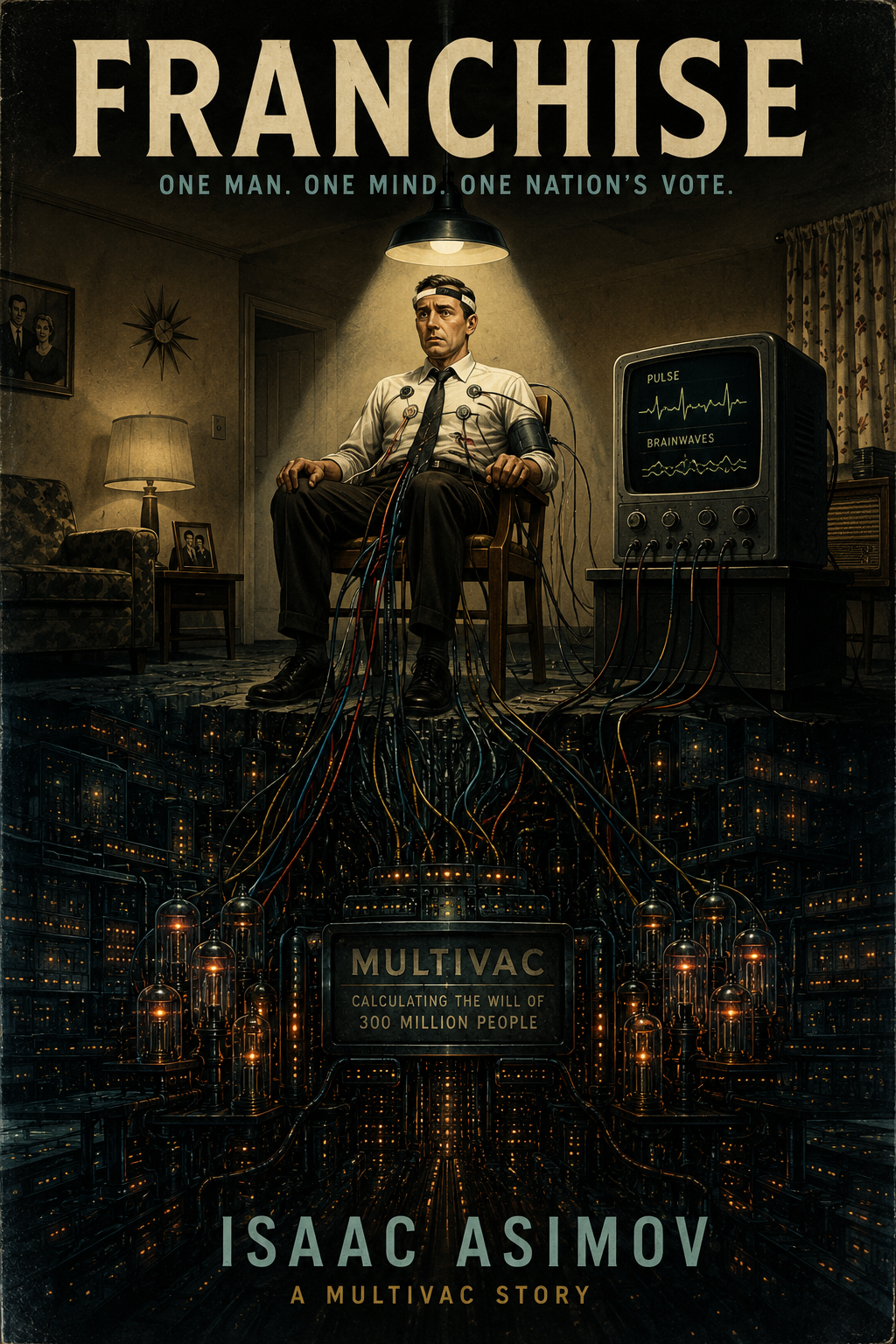
In a world set in the then distant year of 2008, the loud and chaotic nature of traditional political campaigns has been replaced by a quiet, efficient administrative system known as Electronic Democracy. Although the available sources focus on the single, standalone story Franchise rather than an anthology of mini stories, the narrative journey of this piece provides a complete, clear, and logical exploration of Isaac Asimov's political science fiction vision. At the heart of this system is Multivac, an enormous subterranean computer that possesses a staggering amount of data about the nation's economic conditions, social statistics, regional preferences, and political history. The old fashioned election, where millions of citizens physically cast their ballots, has completely disappeared. However, because statistics alone cannot capture the unpredictable elements of human judgment, such as emotions, prejudices, hopes, fears, and irrational impulses, the machine requires one final, crucial piece of information: a living human mind.
The narrative builds this tension by introducing Norman Muller, an ordinary man from Bloomington, Indiana, who is selected by the computer as the year's sole representative voter. Norman is deliberately ordinary; he is not a politician, celebrity, or intellectual, which is precisely why he is chosen to represent a biological sample of public opinion. When Norman learns of his selection, his immediate reaction is not pride, but a deep, paralyzing fear. He is terrified of the immense responsibility and worries that if Multivac makes an unpopular prediction, the entire country will blame him, remembering how an earlier representative voter became a national scapegoat. In contrast, his wife, Sarah Muller, sees the selection as a grand opportunity for prestige, attention, and potential financial benefits, prompting her to encourage her husband to accept.
The story's tension escalates when government officials, including an agent named Phil Handley, arrive at the Muller home to place Norman under close protection and isolate him from all outside influences. Handley explains the cold, mathematical logic of the system: Norman is not chosen because he is the smartest or wisest American, but because his psychological reactions happen to closely match the state of the country at that exact moment. This details where the story is building from on a thematic level, showing how Norman's individuality is simultaneously highlighted and erased, he is incredibly important only because he resembles millions of other faceless citizens.
Eventually, Norman is taken to a secure facility to undergo the final questioning process. Instead of confronting a physical, metallic monster, he discovers that Multivac is safely hidden deep underground, communicating only remotely with the technicians. The actual process of voting is stripped of all traditional civic grandeur; Norman is simply asked a series of seemingly mundane questions about ordinary topics like garbage collection, medical services, school quality, and food prices. As he speaks, technicians use sensitive machines to measure his blood pressure, heartbeat, skin conductivity, and brain wave patterns to gauge the emotional intensity of his reactions. The system does not care whether he tells the truth, but rather how intensely he feels about different subjects, converting his very humanity into data and statistical signals.
Looking at where the story is building from historically, Asimov wrote this piece in 1955, inspired by the early days of computing when machines first began to analyze electoral data and predict voting results. He took this real world starting point and showed how the story is leading to its logical, extreme conclusion: a future where the act of voting is deemed entirely redundant because statistical simulation has become flawless. The title Franchise becomes a powerful piece of irony, as the millions of citizens who supposedly hold the franchise have actually surrendered their political agency for the sake of technological convenience.
By focusing on an ordinary family rather than a spectacular authoritarian regime, Asimov shows how a society can willingly trade away its freedom not through violence, but through the dangerous comfort of efficiency. The story does not rely on a mechanical failure or a malevolent artificial intelligence; Multivac works perfectly, and its predictions are highly accurate. Instead, the review of the story centers on a profound philosophical warning: when statistical simulation replaces active participation, the citizen's role is reduced to being a biological sensor for a machine. It leaves the reader with a haunting question about whether individual choice remains necessary in a world where a machine can perfectly calculate what we would choose.