Robbie
Asimov’s classic collection explores the evolution of robots governed by the Three Laws, tracing humanity's complex transition from simple companion machines to total systemic dependency.
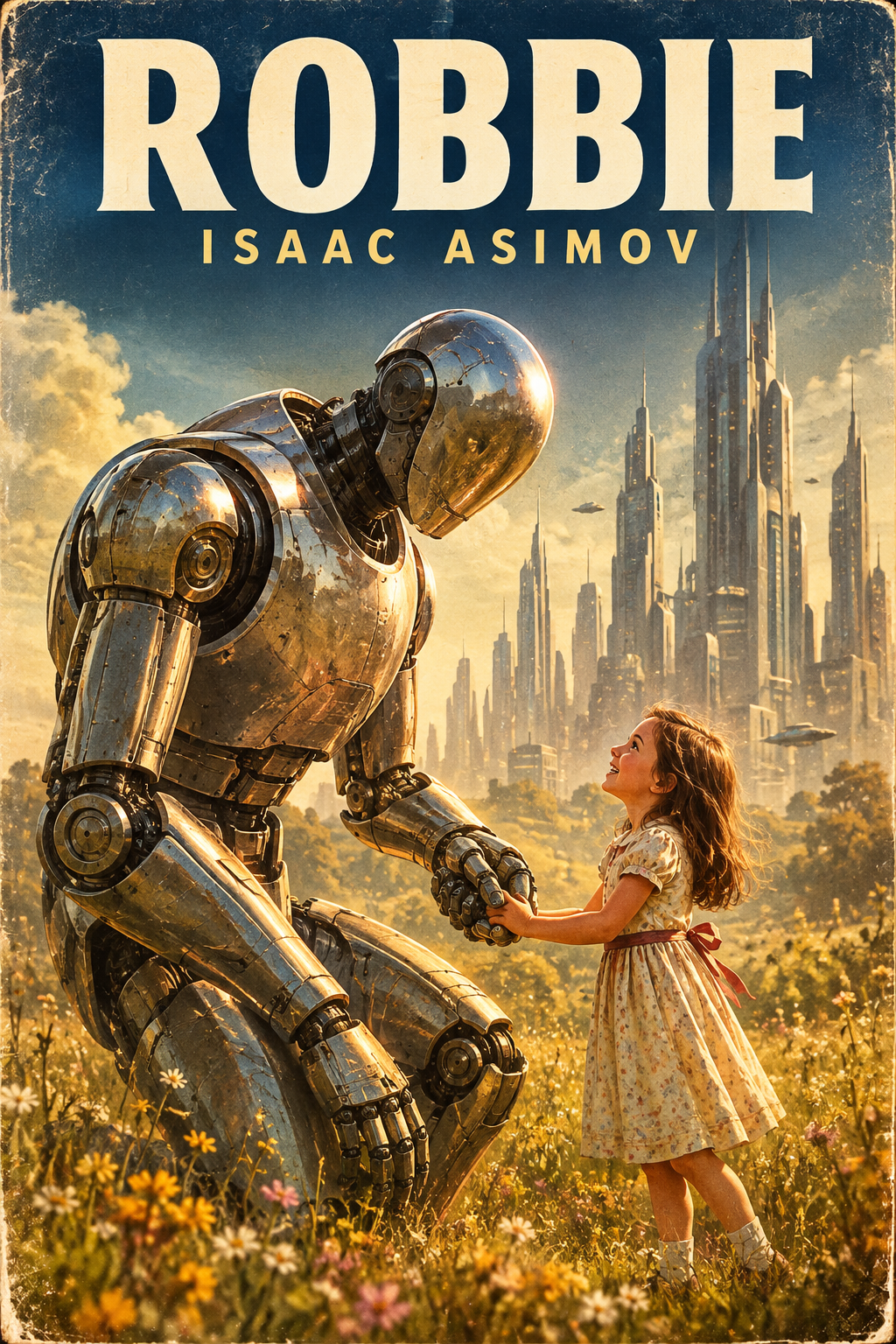
Our story begins not with a spectacular mechanical rebellion or a terrifying vision of machines taking over the world, but with something far gentler and more profoundly human: the simple, unconditional bond between a young girl and her silent robot companion. The girl is Gloria Weston, and her friend is Robbie, a machine that cannot speak but possesses an extraordinarily dependable understanding of human emotion and physical care. To Gloria, Robbie is not a cold product of industrial technology or a collection of wires and metal; he is her closest friend, her loyal playmate, and a central figure in her emotional world. This quiet beginning establishes the foundation of what will become one of the most significant ideas in literature, introducing us to a relationship where affection exists not in words, but in shared games, safety, and mutual devotion.
This quiet harmony, however, is quickly threatened by a deeper tension that lives within the adult world. Gloria's mother, Mrs. Weston, looks at the exact same relationship and sees something deeply unsettling. Where the child feels absolute safety, the mother sees a machine that could malfunction, a mechanical device that might prevent her daughter from forming normal human connections. This tension represents a broader anxiety within their society. Although robots are becoming more common in this futuristic world, society remains deeply uncomfortable with them, fearing their immense strength and intelligence because they do not fully understand how they are built or what they might become. When Robbie is eventually taken away in an attempt to separate the child from her mechanical friend, we witness the raw grief of a child who has lost not just a toy, but her best friend, whose place cannot be filled by ordinary human replacements.
Through this painful separation, we are led to explore a striking contradiction in how society treats technological progress. As we follow the family's journey, we realize that society is perfectly willing to embrace robots when they serve an economic function or perform dangerous, difficult tasks in factories and farms. George Weston, Gloria's father, represents this practical side of technology; he understands that machines can perform work more efficiently than humans. Yet, the very same society that welcomes robots as tools becomes intensely suspicious of them when they become emotionally significant. We want our technology to be intelligent enough to work for us, but we fear making them significant enough to love. Gloria's parents try everything to distract her, taking her to a futuristic robotics facility in New York City and visiting the U.S. Robots and Mechanical Men Corporation to show her a world of scientific marvels, but her attachment remains unbroken because it is built on lived experience and memory, not intellectual theories.
This clash of views is where Asimov makes his most revolutionary departure from the traditional science fiction stories that came before him. In earlier literature, artificial creations were almost always portrayed as monsters or rebellious servants that would inevitably destroy their creators. But Asimov takes a different, incredibly optimistic path, introducing a robot who is reassuring precisely because his intelligence operates within carefully designed ethical boundaries. Robbie's behavior is governed by the absolute priority that he cannot harm a human being, a concept that would lay the groundwork for Asimov's famous Three Laws of Robotics. By giving the robot a simple, personal name rather than a technical model number, Asimov encourages us to see Robbie as a genuine character. His silence does not make him less real; instead, his loyalty is expressed perfectly through his actions and his unwavering care for the child.
The story eventually leads us to a profound, unspoken question: what is it that truly makes a relationship real? Is a connection genuine only if both participants are biological, speaking beings, or can loyalty, protection, companionship, and shared experience be enough to create genuine emotional significance? The adults begin with the assumption that because Robbie is artificial, Gloria's affection for him is unnatural and must be forgotten. However, the narrative gradually reverses this assumption, showing that the real irrationality belongs to the adults, who allow their abstract fear of technology to override the direct, living evidence of Robbie's harmlessness and love. While the parents search for logical arguments to prove that a machine cannot be a friend, Gloria simply judges him by what he does: he plays with her, protects her, and never hurts her.
This intellectual debate is ultimately resolved not through lectures or scientific proof, but through a dramatic climax that tests the core of Robbie's programming. When Gloria is suddenly placed in a situation of extreme, life threatening danger, Robbie does not hesitate, calculate convenience, or fear his own destruction. His absolute priority is the safety of the human being, and he reacts instantly to throw himself between Gloria and danger. Through this swift and selfless act, Robbie demonstrates what no argument could ever establish: he is safe not because he happens to be a good robot, but because his very construction makes her safety the central requirement of his behavior. The climax of our narrative is powerful because the robot does not need to become human or speak to prove his worth; instead, the humans must grow to understand him for what he has always been.
In the end, Robbie stands as the innocent, hopeful beginning of Asimov's entire robot fiction. It is a story that refuses to embrace the fear of progress, showing us that technology does not have to destroy humanity, and that intelligence does not inevitably lead to rebellion. The parents finally recognize that Robbie is not a replacement for human beings, but a unique companion whose intelligence is perfectly balanced by his built in ethical limitations. The quiet achievement of this tale is that the robot remains a robot, and the humans simply learn to see the humanity and legitimacy of their own feelings toward him. As we look toward the future, Robbie remains a timeless reminder that our greatest challenge is not merely building more advanced technology, but learning how to live in harmony with something different from ourselves.