How Did We Find Out About Blood
Asimov chronicles humanity’s logical journey from ancient myths to discovering the circulatory system, blood cells, and types, revealing how in reason transformed mysterious liquid into science.
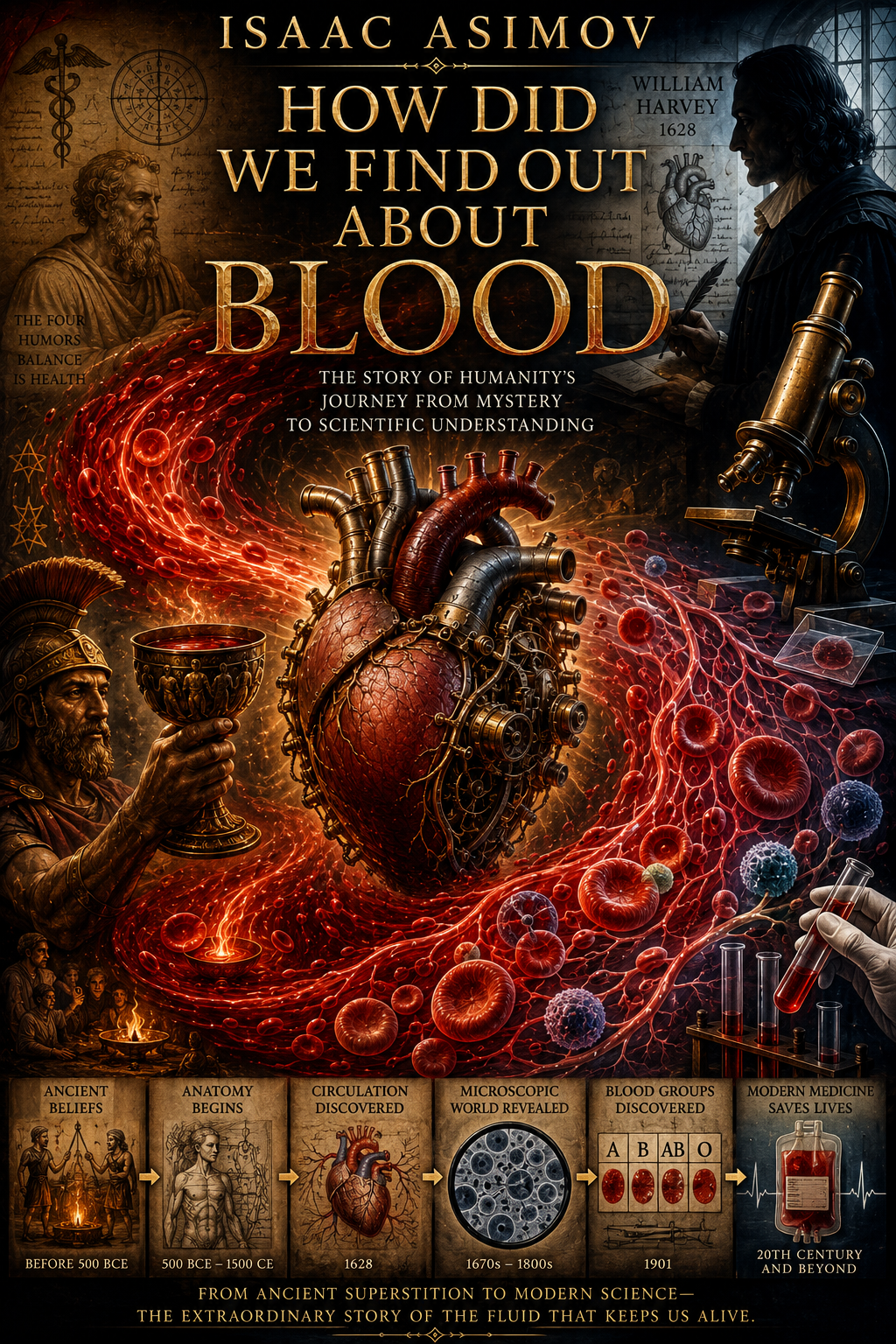
How Did We Find Out About Blood
The book How Did We Find Out About Blood is a late entry in a famous series by Isaac Asimov. It does not just list facts about biology. It tells the story of how human beings slowly learned the truth about themselves. Asimov starts with a very basic question. Since blood is found everywhere in the human body, how did we come to understand what it is and why we cannot live without it? The answer is found in a long detective story that spans many hundreds of years. It involves the work of many different people like philosophers and doctors who studied the body to solve the mystery of life. The book follows this path from the ancient world all the way to the medicine we use today.
Blood Is Life
Asimov begins this journey at the very start of human history. Long ago, people could not look inside the body to see how organs worked, but they could see blood. They noticed a very simple pattern. When a person was wounded and blood flowed out, that person became weak. If they lost a great deal of blood, they died very quickly. Because of this, it seemed very obvious to early humans that blood was the same thing as life itself. For thousands of years, blood was seen as something mystical. Soldiers might drink the blood of their enemies because they thought it would give them strength. Priests used blood in religious ceremonies as a sign of life and sacrifice. Even though everyone knew blood was important, no one really knew what it was doing inside the body. The Greeks tried to use logic and philosophy to find an answer. A famous thinker named Hippocrates thought that health depended on keeping four different fluids in balance. These fluids were called humors, and blood was one of them. This idea lasted for a very long time because it seemed to explain why people got sick and how they got better, even though the idea was actually wrong.
Galens Authority
The story moves forward to a man named Galen who lived in the Roman Empire nearly two thousand years ago. He studied the body and created theories about blood that people believed for more than a thousand years. Galen thought that the liver was like a factory that constantly made blood from the food a person ate. He believed this blood then traveled out to the rest of the body where it was used up by the tissues. In Galens view, blood did not move in a circle. It was made, used, and then replaced by new blood. Asimov explains that this idea sounds very strange to us now, but it made sense back then. People did not have microscopes to see tiny blood vessels, and they had no way to measure how much blood was moving. Galen was so respected that for many centuries, other doctors simply accepted what he said without trying to prove him wrong. This shows a common theme in science where progress stops when people stop questioning those in power.
The Hearts Secret
Eventually, the focus of the story shifts to the heart. People always knew the heart was vital because they could feel it beating and knew that a heart injury was deadly, but its purpose was still a mystery. Asimov explains how some people began to study the heart by looking at its physical structure. They found that it had chambers and valves. This made the heart look more like a mechanical pump and less like a mystical center of life. A few doctors began to doubt what Galen had taught. A thinker named Ibn al Nafis correctly described how blood moves through the lungs a long time before this became common knowledge. Other researchers also began to find similar clues. Their work started to build a new way of understanding how blood moves through the living body.
William Harvey and Circulation
The most important part of this story involves a man named William Harvey. He did not just read old books; he used math and experiments to find the truth. Harvey looked at living animals and measured how much blood the heart could pump in one hour. When he looked at the numbers, he realized that Galen could not be right. If the body used up blood the way Galen said, it would have to make an unbelievable amount of blood every single day. Harvey saw there was only one logical answer. The blood must be moving in a continuous loop. He proposed that the heart acts as a pump that pushes blood out through the arteries and brings it back through the veins. This meant the heart and the vessels were all part of one single circulatory system. This was a massive change in how people thought about medicine. Asimov sees Harveys work as a great example of logic because Harvey followed the evidence even when it went against what everyone else believed for centuries.
The Missing Link
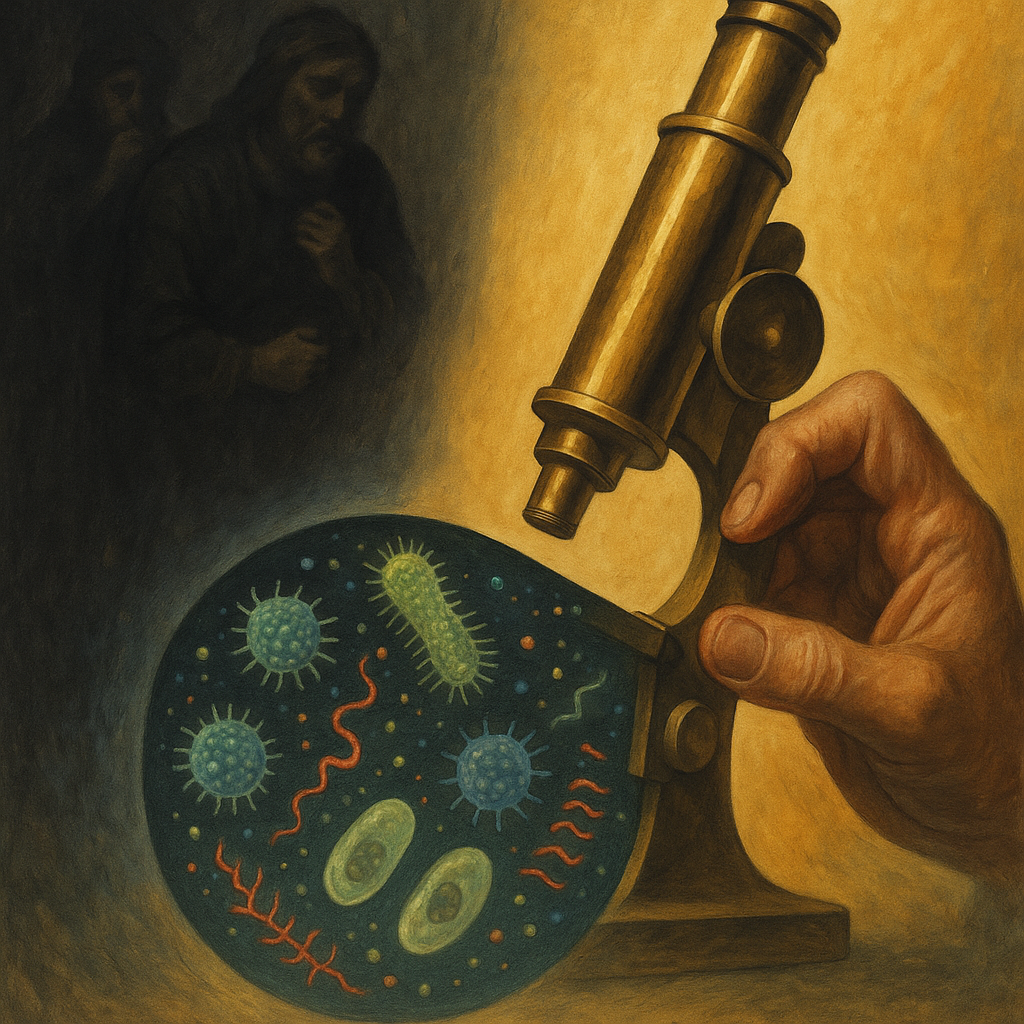
Even with Harveys great discovery, there was still a problem. He could not explain how the blood actually moved from the tiny arteries into the veins to get back to the heart. The answer to this mystery had to wait until a new tool was invented. When scientists began using the microscope, they were able to see things that were too small for the human eye. A man named Antonie van Leeuwenhoek looked at living tissue and finally saw the capillaries. These are very tiny vessels that connect the two sides of the system. This discovery proved that Harveys logic was perfect. It showed that sometimes a scientific theory is right even before we have the tools to see every single piece of evidence.
The Components of Blood
Once the path of the blood was clear, scientists began to look at the blood itself. To the naked eye, it just looks like a red liquid. However, the microscope revealed that it is actually very complex. It is not just a fluid but a network of many different parts. They found red blood cells that carry oxygen and white blood cells that protect the body from germs. They also found plasma, which is the liquid that carries food and waste, and platelets, which help fix injuries. Each of these discoveries changed blood from a mystery into a complex biological system that keeps the body running.
Why Blood Is Red
Asimov likes to ask simple questions to explain big ideas. He asks why blood is red. The answer takes the reader into the world of chemistry. Blood contains something called hemoglobin, which has iron atoms inside it. These atoms can grab onto oxygen. When they are holding oxygen, the blood turns a bright red color. When the oxygen is let go, the blood becomes darker. This simple observation about color is actually a way to understand how the body gets the energy it needs to stay alive. It is a perfect example of how Asimov takes something everyone sees and explains the science behind it.
Clotting and Healing
One of the most interesting things about blood is that it must stay liquid to move, but it must turn into a solid very quickly if there is a cut. This seems like a contradiction, but it is a vital part of staying alive. Asimov explains that this happens through a complex chain reaction called coagulation. When a person gets a cut, proteins and platelets work together to create a plug or a clot. This stops the bleeding and allows the body to start healing itself. Scientists learned a lot about this by studying diseases like hemophilia, where this system does not work correctly. By seeing what happens when things go wrong, they were able to understand how the system works when it is healthy.
Blood Types and Transfusions
For a long time, doctors tried to give blood from one person to another to save lives, but it was a very dangerous gamble. Sometimes it worked, but often the patient died for no clear reason. The mystery was finally solved when Karl Landsteiner discovered that there are different blood types. He showed that blood is not the same in every person and that certain types cannot be mixed together. This discovery made transfusions safe and routine. It turned a life threatening risk into a standard way to save people who have lost blood. This was one of the biggest steps forward in the history of medicine.
Blood and Modern Medicine
In the last part of the book, the story enters the twentieth century. Scientists began to learn how blood could tell them about a persons health. They discovered how blood is involved in immunity and how it can show signs of diseases like diabetes or anemia. Today, a doctor can take a tiny sample of blood and learn a huge amount about what is happening inside a persons body. Blood is no longer just a fluid that keeps us alive; it is also a source of information. The journey that started with people making guesses about red liquid ended with precise scientific knowledge.
Review
This book is a perfect example of how Isaac Asimov teaches. He does not just give a list of facts. He tells a story about how we discovered those facts. The heroes of this book are the people who looked closely at the world and used their minds to solve puzzles. The structure of the book is very logical. It moves from ancient myths to anatomy, then to the discovery of circulation, and finally to the chemistry of the cells. Each step makes the next one easier to understand. By the end, the reader sees that blood is not just a simple liquid. It is a living river that carries everything the body needs to survive. The story of how we learned this is a great adventure that shows the power of human reason and the desire to understand life.