Past, Present, and Future
Bridging history and future possibilities, Asimov asserts that curiosity and reason form a continuous chain of progress where scientific evidence triumphs over superstition and fear.
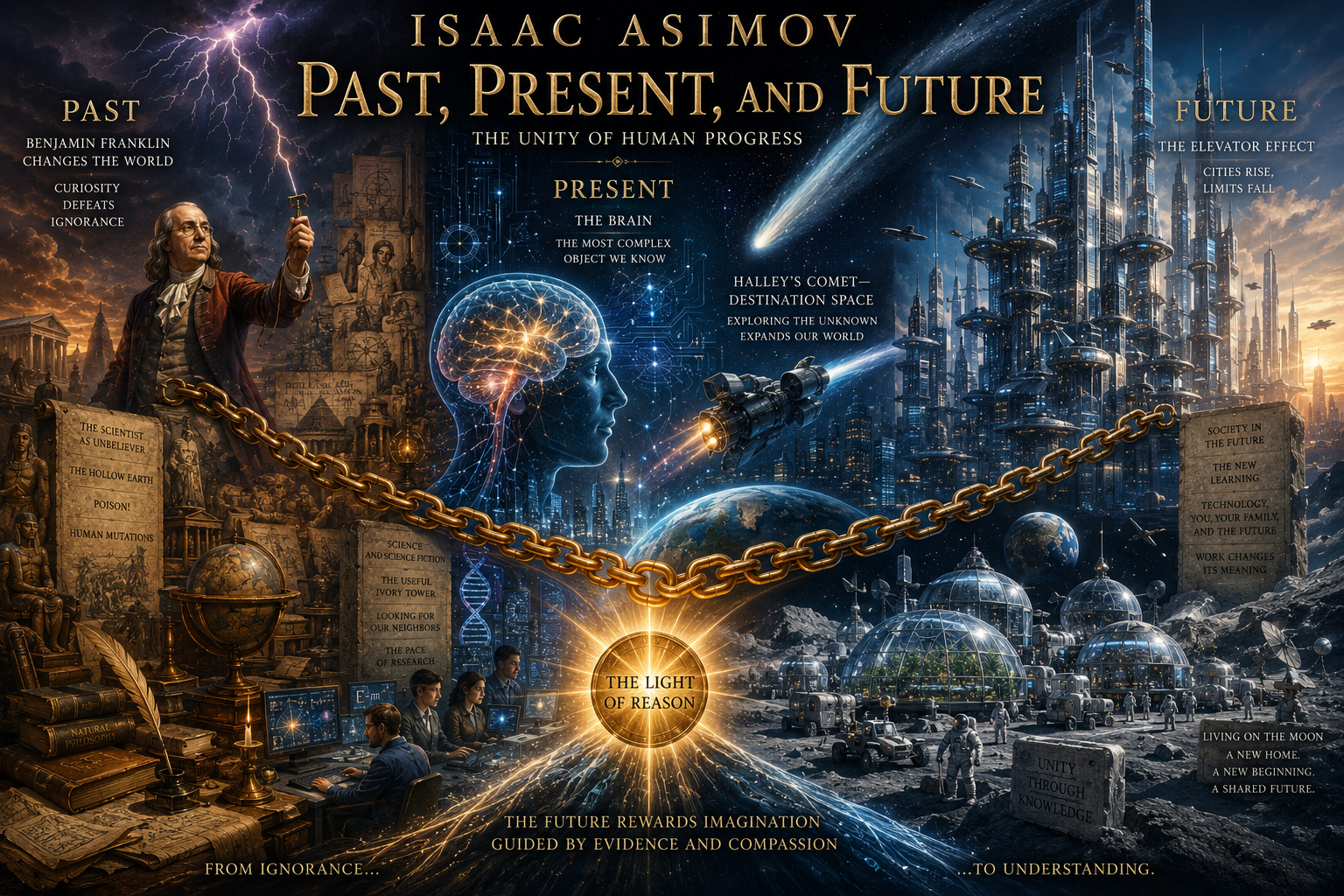
The journey of human progress is often viewed as a series of disconnected events, but in this collection, it is revealed as an unbroken chain of discovery. To understand where we are going, we must first look at how we began. The story starts with the concept of Unity, suggesting that history is not a collection of accidents but a single, continuous narrative where every civilization builds upon the one that came before it. This creates a foundation where curiosity is the primary tool for overcoming ignorance.
In the early chapters of our history, the figure of the Scientist as Unbeliever emerges. Here, skepticism is not a weapon of destruction but a creative force; by questioning accepted authority and demanding evidence, the scientist clears the path for every major advance. However, this progress brings its own challenges. The Choking Grip describes how our success as a species through population growth and resource consumption has created environmental pressures that threaten our future. We are faced with the paradox of needing to manage the very abundance we worked so hard to create.
Nature itself provides a model for this ongoing story through Human Mutations, where small genetic variations are seen not as frightening abnormalities but as the engine of change that allows a species to adapt over generations. Even our mistakes, like the myth of The Hollow Earth, serve a purpose. By examining why such ideas once seemed reasonable and how they were eventually disproved by gravity and geology, we see the triumph of evidence over imagination. This theme continues in the study of Poison!, where we learn that complexity is hidden in simple labels; a substance that kills in one dosage can become a life saving medicine in another.
As human society developed, Competition! became a driving force in evolution and economics, yet it is argued that progress truly emerges only when rivalry exists within a larger framework of cooperation and shared knowledge. A perfect example of this is seen when Benjamin Franklin Changes the World. Franklin is presented as the embodiment of the Enlightenment, a man whose curiosity about electricity unlocked secrets that improved society as a whole. This curiosity eventually reached toward the stars, as shown in Fifty Years of Astronomy, which chronicles the shift from distant telescope observations to the direct exploration of other worlds. Yet, as we built more complex tools, The Myth of the Machine reminds us that technology does not have intentions of its own; it merely amplifies human choices and responsibilities.
In the present era, the story shifts to the struggle between reason and superstition. The Perennial Fringe explains why pseudoscience repeatedly returns despite evidence: rational thinking requires constant effort, while certainties even false ones are comforting. This lack of wisdom is dangerous when applied to global security, as seen in The Case Against Star Wars, where it is argued that technology cannot replace political wisdom. We are often tempted by Short Term; Long Term thinking, sacrificing our survival for immediate convenience, yet the Useful Ivory Tower of academic research continues to quietly shape our lives through discoveries that seemed impractical at first.
The call to action in the present is to Do It First!, taking calculated risks rather than falling into the paralysis of caution. This requires Popularizing Science so that knowledge is not trapped with specialists but becomes a tool for all citizens in a democracy. As The Pace of Research accelerates, we find ourselves using the most complex object in the known universe the Brain to investigate itself. We see the beauty of organizing principles like Darwin and Natural Selection, which unite biological observations into a coherent whole, and even the simple progress of Cool Light, which reflects decades of engineering advances.
Our current chapter also looks outward. Halley’s Comet Destination Space serves as a symbol of our transition from observers to explorers. We find Ice in Orbit, suggesting that life may be common in the universe, and we continue Looking for Our Neighbors to better understand our own place in the cosmos. The story asserts that Life Is Wherever It Lands, possessing an extraordinary ability to flourish in suitable conditions. Even the most difficult concepts, like Einstein’s Theory of Relativity, show that our common sense must expand as we ask deeper questions about What Is the Universe Made Of?, uncovering layers of matter more strange than we once imagined.
In this era, Science and Science Fiction act as a laboratory for the imagination, helping us think beyond our current limits. Even our darker interests, explored in The Dark Vision and The Lure of Horror, help us encounter our anxieties about technology and mortality in a safe environment. Through reflections on Movie Science and the author's own Hollywood Non Career, we see the relationship between accuracy and entertainment. The section concludes with a personal look at the storyteller himself, from his love for I Love New York to the logic of The Immortal Sherlock Holmes, and finally the vulnerability of his own life in Write, Write, Write and Triple Bypass.
Looking toward the future, the story envisions a transformation of how we live. The Elevator Effect and 2084 describes cities growing vertically and societies reshaped by automation. This is not a fixed destiny but a landscape of choice. Society in the Future will see institutions like family and education adapt to new technologies, and Feminism for Survival will become a practical necessity because we cannot afford to waste half of humanity's intellectual potential.
The role of media becomes critical in TV and the Race with Doom, as it can either educate or distract us from the challenges ahead. Our legal systems will face The Next Seventy Years in the Courts, struggling to apply old principles to new scientific realities. While the Future of Costume and The Immortal Word will preserve our cultural continuity, Liberty in the Next Century will only survive if citizens are informed and think critically.
Shadows remain, such as The Villain in the Atmosphere, where environmental changes that seem invisible today will become the crises of tomorrow. Education must evolve into The New Learning, a lifelong process of adaptation rather than static memorization. As technology enters the home, transforming it into a center for information, we are asked: Should We Fear the Future? and Should We Fear the Computer?. The answer is that fear should be reserved for ignorance, not the tools we create.
As Work Changes Its Meaning, automation will replace repetitive labor with creative and analytical roles. We must manage the Nuclear Dreams and Nightmares by matching our power with wisdom. The ultimate extension of our story is found in The New Tools in Space and Living on the Moon, where permanent settlements and lunar industries become the logical next steps for civilization. Finally, the story moves into the very building blocks of life. Through the Clinical Lab of the Future and Fiddling with Genes, we gain the power to reshape ourselves and our environment.
In review, this collection is an intellectual autobiography that serves as a guide for the human species. It teaches us that while the past gives us humility and the present requires rational thought, the future rewards imagination guided by evidence. The central message is clear: the future is not something that simply happens to us; it is something we create through the questions we are brave enough to ask today.