The Twelve Frights of Christmas
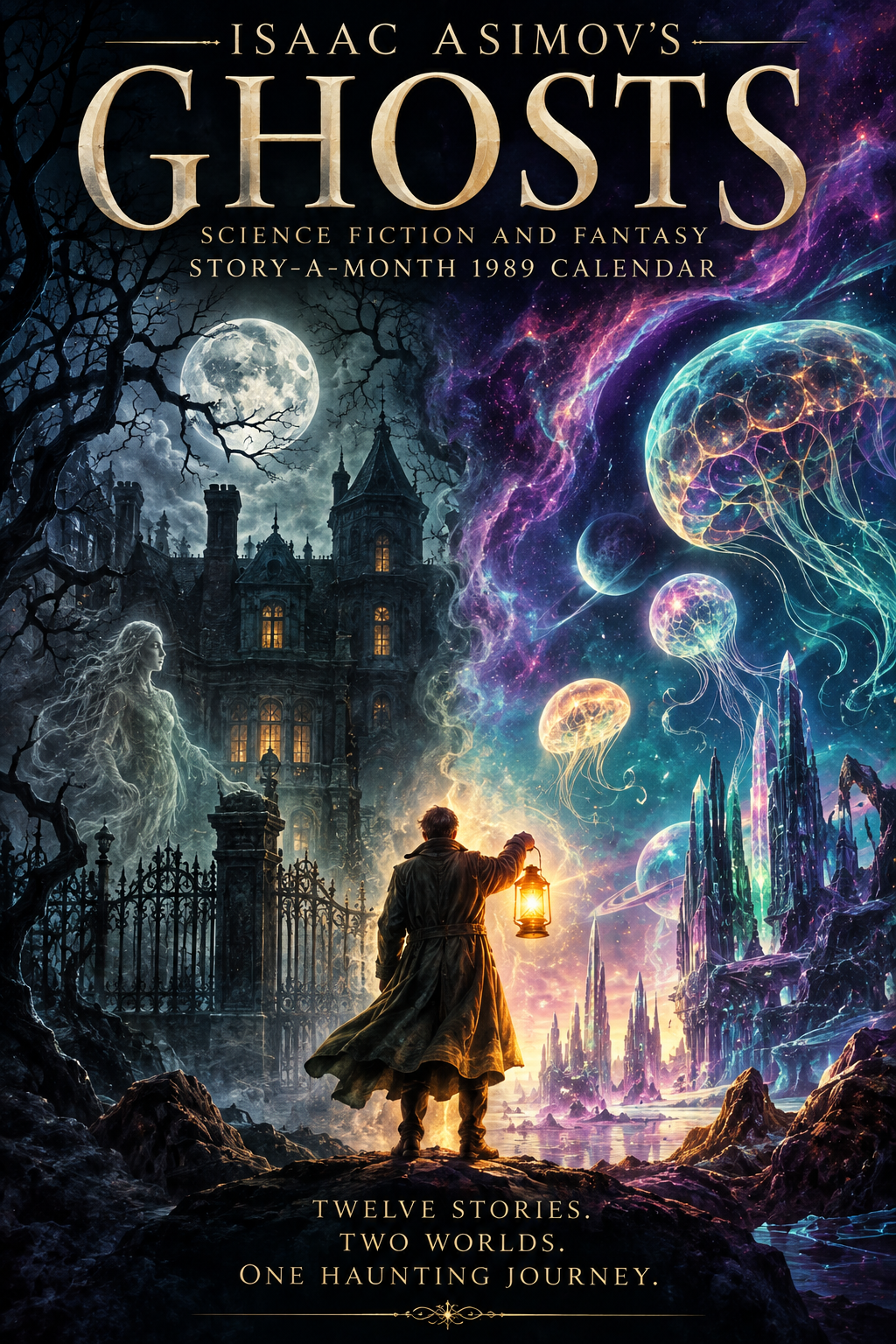
Isaac Asimov’s anthology collects thirteen tales ranging from Gothic ghosts to cosmic science fiction, exploring supernatural dread and chilling mysteries within the dark winter solstice.
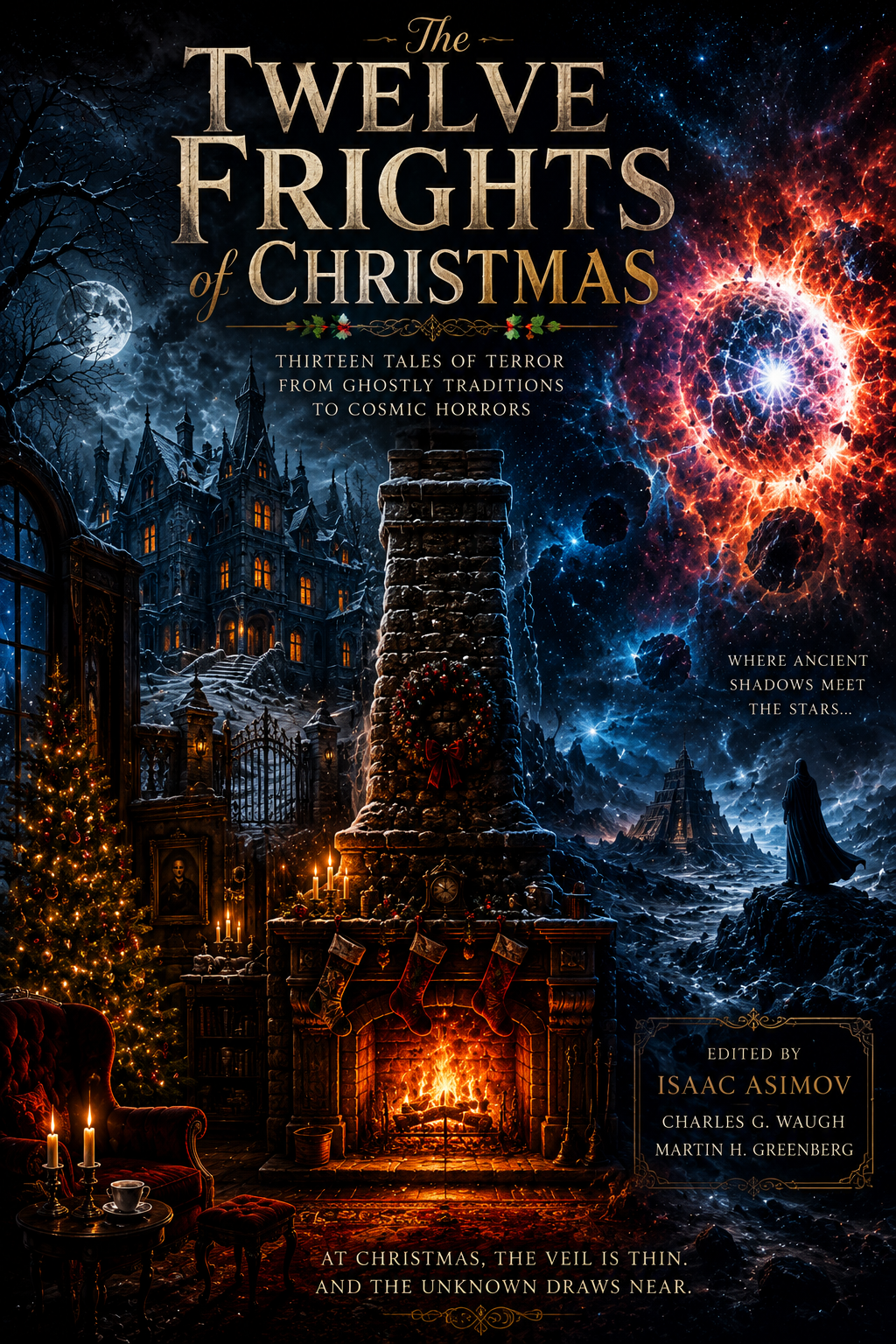
The winter wind howls outside the window, much like the cold vacuums of space that Isaac Asimov often explored in his own fiction. It is a fitting night to discuss a collection that seems, at first glance, a departure for a man who dedicated his life to the rational and the scientific. Yet, as Asimov explains in his opening to The Twelve Frights of Christmas, the logic of the season demands a look into the shadows. He reminds us that before the modern comforts of electricity and central heating, the winter solstice was a time of genuine dread, where the encroaching darkness required stories and firelight for protection. This anthology, curated with Charles G. Waugh and Martin H. Greenberg, serves as a journey from the flickering hearths of the past to the cold, distant stars of the future.
The journey begins in the most domestic of settings with The Chimney by Ramsey Campbell. We follow a young boy whose innocent anticipation of a holiday visitor begins to warp as strange sounds echo from the hearth. The story builds upon the primal fear of what might be lurking in the dark, narrow spaces of our own homes, suggesting that the path designed for a gift giver might also be a doorway for something ancient and far less benevolent than a saint. This leads naturally into Robert Louis Stevenson’s Markheim, where the setting moves from the chimney to the cluttered interior of an antique shop. Here, the horror is internal. After a moment of terrible violence, a man must confront a mysterious visitor who may be a reflection of his own fractured soul. It is a logical exploration of guilt and the heavy weight of moral choice, rooted in the deep psychology of the human condition and the possibility of redemption.
As we move deeper into the night, Robert Bloch provides a sharp, unsettling transition in The Night Before Christmas. Bloch, who always understood the thin line between a joke and a scream, takes the most cheerful symbols of the holiday and turns them into instruments of suspense. He shows us that when the familiar is inverted, the resulting madness is far more disturbing than any alien monster, as holiday imagery gradually descends into murder. This sense of ancient, hidden things continues in H. P. Lovecraft’s The Festival. A man returns to his ancestral home for a tradition that predates the holiday itself, finding a town frozen in time. The story builds toward a realization that human history is merely a thin crust over a deep well of cosmic indifference and forgotten gods linked to ceremonies beyond human understanding.
The tone shifts to the emotional and the Gothic with Elizabeth Gaskell’s The Old Nurse’s Story. In an isolated manor, an elderly woman recounts the echoes of a family’s past sins and hidden tragedies. The story demonstrates that some ghosts are not mere apparitions but are manifestations of unresolved grief and cruelty that cannot be buried by the snow. This is followed by the more physical dread of Glámr, an adaptation of Norse legend by Sabine Baring Gould. In the harsh landscape of the north, the death of a shepherd does not bring peace. Instead, it introduces a malevolent undead presence that reminds us why ancient people feared the long nights of the winter season.
The transition to the modern age begins with H. G. Wells in Pollock and the Porroh Man. Wells explores the tension between Western skepticism and the unexplained powers of the colonial world, asking if our modern knowledge is truly a shield against the unknown. The Victorian atmosphere remains in The Weird Woman, an anonymous tale where the arrival of a mysterious figure disrupts the peace of a community. The story builds a sense of unease through small coincidences and glances, showing how superstition and reality can slowly become intertwined until fear grows unchecked.
As we move into the twentieth century, the source of our fears changes. In Ron Goulart’s The Hellhound Project, the monster is a product of the laboratory rather than the graveyard. It is a cautionary tale about human ambition outstripping human wisdom, particularly regarding the development of artificial intelligence and advanced technological systems. This modern anxiety continues in Wolverden Tower by Grant Allen, where an ancient structure exerts a psychological grip on those who enter it, suggesting that even in a scientific age, the stones of the past can still haunt the present.
The collection then leaps into the realm of science fiction, where the shadows are cast by the light of other suns. J. T. McIntosh’s Planet of Fakers presents a world of absolute paranoia where identity is fluid and no one can be trusted. It is a logical progression of horror into the space age, where the fear is not of the dark, but of the person standing next to you. James McConnell’s Life Sentence takes this a step further by examining a punishment that utilizes the nature of time and memory. It forces the reader to consider the philosophical horror of an existence that goes on far longer than the human mind was designed to endure, asking if eternity can ever be a blessing.
The anthology reaches its logical conclusion with The Star by Arthur C. Clarke. This story serves as the ultimate bridge between the religious origins of the season and the cold, mathematical reality of the universe. A Jesuit priest on a scientific expedition uses astrophysics to discover the truth behind the star of Bethlehem. The priest finds evidence of a supernova that destroyed an entire civilization, leaving him with a profound sense of spiritual unease as he questions why such a destruction was necessary for a sign. The story does not rely on monsters, but leaves the reader questioning the nature of a universe where destruction and hope are so closely linked.
In review, The Twelve Frights of Christmas is a masterfully structured journey. It begins with the simple, local fears of a child at the chimney and expands until it encompasses the entire galaxy. By treating horror as a facet of human mystery rather than just a collection of scares, Asimov and his colleagues have created a work that appeals to the rational mind. It recognizes that while we have traded the campfire for the computer, the shadows at the edge of the light remain just as deep. The collection ultimately celebrates the human tradition of storytelling, our primary tool for making sense of the vast, cold unknown that surrounds us.