How Did We Find Out About Microwaves
Isaac Asimov traces how humanity discovered invisible electromagnetic radiation, progressing from early light theories to the practical applications of radar, ovens, and cosmic microwave astronomy.
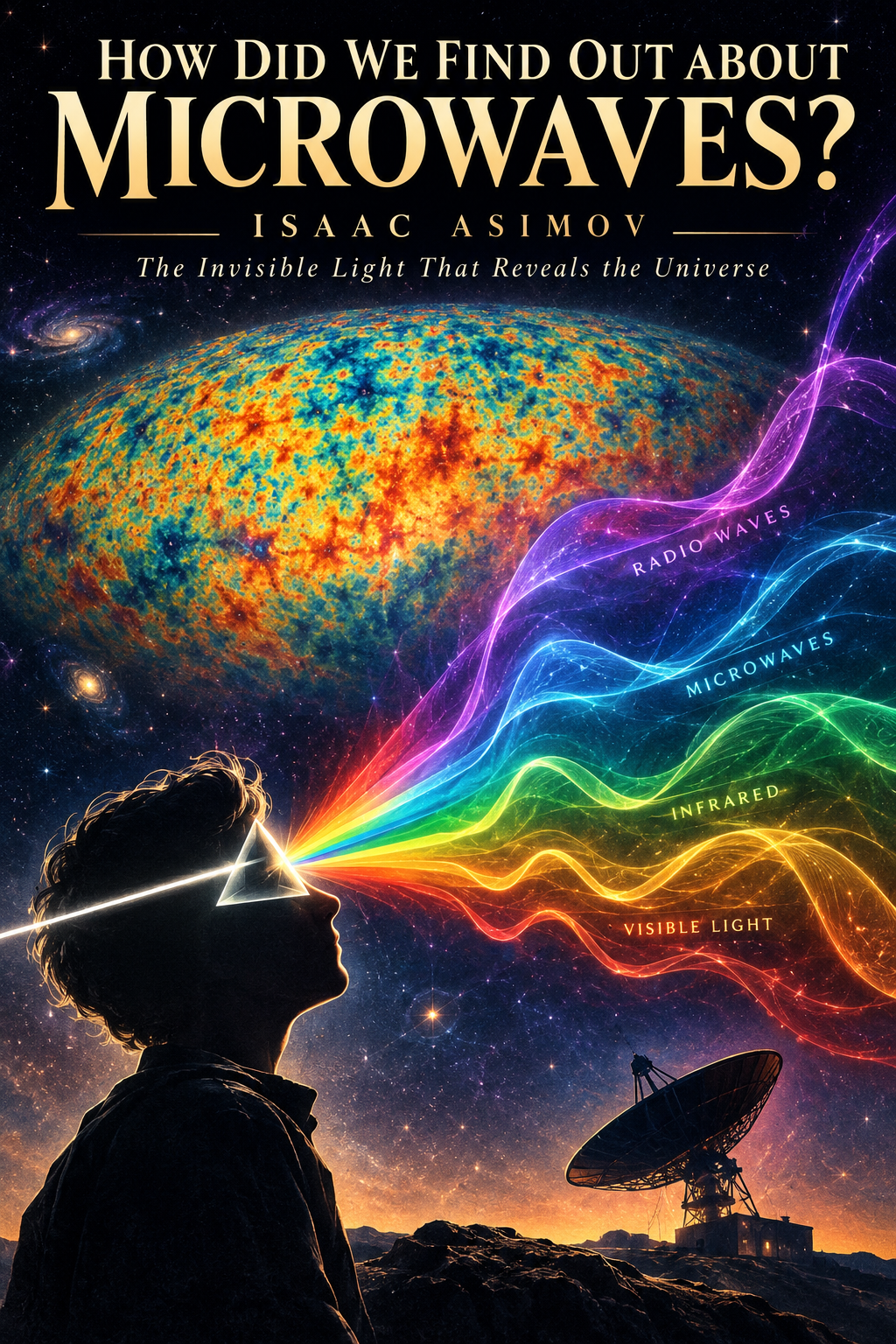
Every great mystery begins with a clue so common that we often forget to ask questions about it. For humanity, that clue was the simple light that fills our eyes every morning. In his book How Did We Find Out About Microwaves?, published in 1989 and illustrated by Erika Kors, Isaac Asimov crafts an intellectual detective story about how human beings slowly discovered that the familiar light we see is merely a tiny window into a vast, invisible electromagnetic universe. Asimov, known for his signature clear, logical, and accessible style, presents this history not as a dry list of facts, but as a grand journey of scientific continuity where every breakthrough naturally paves the way for the next.
What makes this book so compelling is how Asimov frames scientific discovery as an ongoing relay race. He shows that nature does not suddenly stop producing waves just because our limited biological senses cannot perceive them. Instead of focusing heavily on commercial appliances like the microwave oven, which actually receives very little focus in the text, Asimov directs our attention to the profound implications of physics and astronomy. He shows us that by building tools to detect invisible wavelengths, we have essentially constructed a new kind of eye that can see through cosmic dust and witness cold gas clouds, distant stars, and ancient cosmic radiation. It is a philosophical reminder that through curiosity, mathematics, and experiment, humanity has managed to transcend its biological limitations and listen to the whispers of the universe. By following this logical progression, the book leaves the reader with a deep appreciation for the unseen forces that shape our modern world and our understanding of existence.
The Nature of the Ripple
Our journey begins in the distant past with a simple yet profound question: what exactly is light? While human beings had always lived in its presence, understanding its true nature proved to be an elusive challenge. For centuries, brilliant minds argued over whether light was a stream of tiny particles or a series of waves traveling through space. The first major breakthrough in this story belongs to Christian Huygens, who proposed that light behaves like a wave, much like the familiar ripples that travel across a quiet pond. However, this idea immediately ran into a difficult logical hurdle: water waves need water to travel, and sound waves need air, but light from the sun crosses the massive, empty vacuum of space to reach Earth. The question of what was actually waving remained an unsolved mystery, but Huygens had successfully introduced the wave concept, setting the stage for the next great leap in our understanding of the universe.
The Splitting of the Beam
The mystery deepened when scientists realized that light was far more complex than it appeared to the naked eye. Isaac Newton famously used a glass prism to split white light into a vibrant rainbow of colors, showing that visible light is composed of a spectrum stretching from red to violet. But the real twist in this mini story came when experiments revealed that the spectrum did not end where human sight failed. Just beyond the red end of the rainbow, researchers detected an invisible form of radiation that carried heat, which they named infrared. Similarly, beyond the violet end lay ultraviolet radiation, which had shorter wavelengths. This was a revolutionary concept: human eyes are only sensitive to a very narrow band of natures emissions, and the visible spectrum is just a small neighborhood in a vast, invisible country of electromagnetic waves. By measuring the distance from one wave crest to the next, the wavelength, scientists finally found a way to classify and understand these different forms of radiation.
The Unseen Connection
The next chapter of this scientific adventure is a triumph of pure mathematical reasoning. For a long time, electricity, magnetism, and light were studied as completely separate and unrelated phenomena. However, the brilliant physicist James Clerk Maxwell realized that these forces were intimately connected. Through his elegant mathematical theory of electromagnetism, Maxwell demonstrated that changing electric and magnetic fields could travel outward together as waves. Even more astonishingly, his mathematical equations predicted that electromagnetic waves should exist at wavelengths far longer than anyone had ever observed. This was a moment where theory outpaced observation; Maxwell had predicted the existence of an entire unseen spectrum of long wavelength radiation, leaving it as a challenge for future experimentalists to prove that his mathematical vision was real.
The Spark Across the Room
The experimental challenge left by Maxwell was finally answered in 1888 by Heinrich Hertz. In his laboratory, Hertz set up a clever apparatus designed to produce and detect these predicted invisible waves. By creating an electric spark in one part of the room, he was able to detect its invisible effects at a distance, proving that electromagnetic waves were indeed traveling through the air. Hertz did not stop there; he demonstrated that these invisible waves behaved exactly like visible light. They could be reflected off surfaces and manipulated in the same ways, proving beyond a doubt that light and these new waves were part of the exact same family. Hertzs spark gap experiment turned Maxwells mathematical equations into an undeniable physical reality, opening up a whole new world of possibilities.
The Whisper Over the Waves
Once Hertz proved that these invisible waves could travel through space, other minds began to wonder if they could be used to carry human messages. This spark of curiosity led to the birth of radio communication and the pioneering work of inventors like Guglielmo Marconi. By learning how to generate, control, and detect these longer electromagnetic wavelengths, engineers found a way to superimpose information onto the waves. What had begun as an abstract mathematical theory about the relationship between electricity and magnetism was transformed into a revolutionary technology that could carry voices and signals across oceans and continents. The world was suddenly connected by invisible whispers traveling at the speed of light.
The Invisible Bounce
As scientists and engineers pushed the boundaries of the electromagnetic spectrum, they began to explore the region of wavelengths that lay between long radio waves and short infrared waves. This region became known as the microwave spectrum. During the twentieth century, the ability to generate and detect these short, precise wavelengths became a matter of global importance. Engineers discovered that microwaves could be directed into very narrow, focused beams. When these beams hit an object, they would bounce back like an echo. By measuring this reflected signal, scientists created radar, an invaluable tool that allowed human beings to see through thick clouds, heavy rain, and the pitch black darkness of night. Developed further during the Second World War with the invention of the cavity magnetron, radar became a crucial technology that saved countless lives and reshaped modern transportation.
The Sweet Melting Point
Sometimes, the most practical household inventions come from completely unexpected observations. While working on military radar equipment during the war, an engineer named Percy Spencer noticed something strange while standing near an operating cavity magnetron. A chocolate candy bar in his pocket had completely melted. Rather than ignoring this curiosity, Spencer investigated further. He placed an egg near the equipment and watched it cook, and then experimented with popcorn kernels, watching them swell and pop. Spencer realized that the powerful microwave radiation generated by the magnetron was interacting directly with the molecules in the food to produce rapid heat. This accidental discovery led to the development of the microwave oven, transforming a high tech military detection system into one of the most common and convenient kitchen appliances in human history.
The Echo of the Beginning
The final mini story in Asimovs narrative takes us far beyond the kitchen and out into the depths of space. While microwaves are incredibly useful for cooking and communication, their greatest contribution to humanity is in the field of astronomy. Because the universe produces radiation across the entire electromagnetic spectrum, relying only on visible light limits our understanding of the cosmos. Microwaves have the unique ability to pass through thick cosmic dust clouds that block ordinary light, allowing astronomers to observe cold gas clouds, molecule formations, and distant galaxies. Most incredibly of all, scientists realized that the early universe was once an extremely hot, radiation filled place. As the universe expanded over billions of years, that ancient light cooled and stretched, turning into weak microwave radiation that still fills the cosmos today. By building microwave telescopes, human beings have detected this cosmic microwave background, allowing us to listen to the very first echoes of creation and study the universe when it was extremely young.