Little Treasury of Armored Dinosaurs (vol. 2)
Armored plant eating dinosaurs evolved bony plates, spikes, and tail clubs to defend against predators, revealing evolutionary compromises through fossil evidence.
Long before human beings appeared on Earth, our planet was inhabited by extraordinary animals that seem almost impossible when judged by modern standards. Among these ancient reptiles, plant eating dinosaurs faced a continuous and deadly struggle for existence. Unlike meat eating predators, herbivores could not spend their lives hiding, because they were forced to move about constantly in search of vegetation. Predators were always searching for vulnerable prey, creating a simple yet profound problem of survival. Evolution offered only a few potential solutions to this dilemma: an animal could attempt to run away, it could seek safety in groups, it could grow to an enormous size, or it could make itself exceptionally difficult to attack. The armored dinosaurs selected the last of these strategies, initiating an extraordinary biological arms race between attack and defense that unfolded across millions of years.
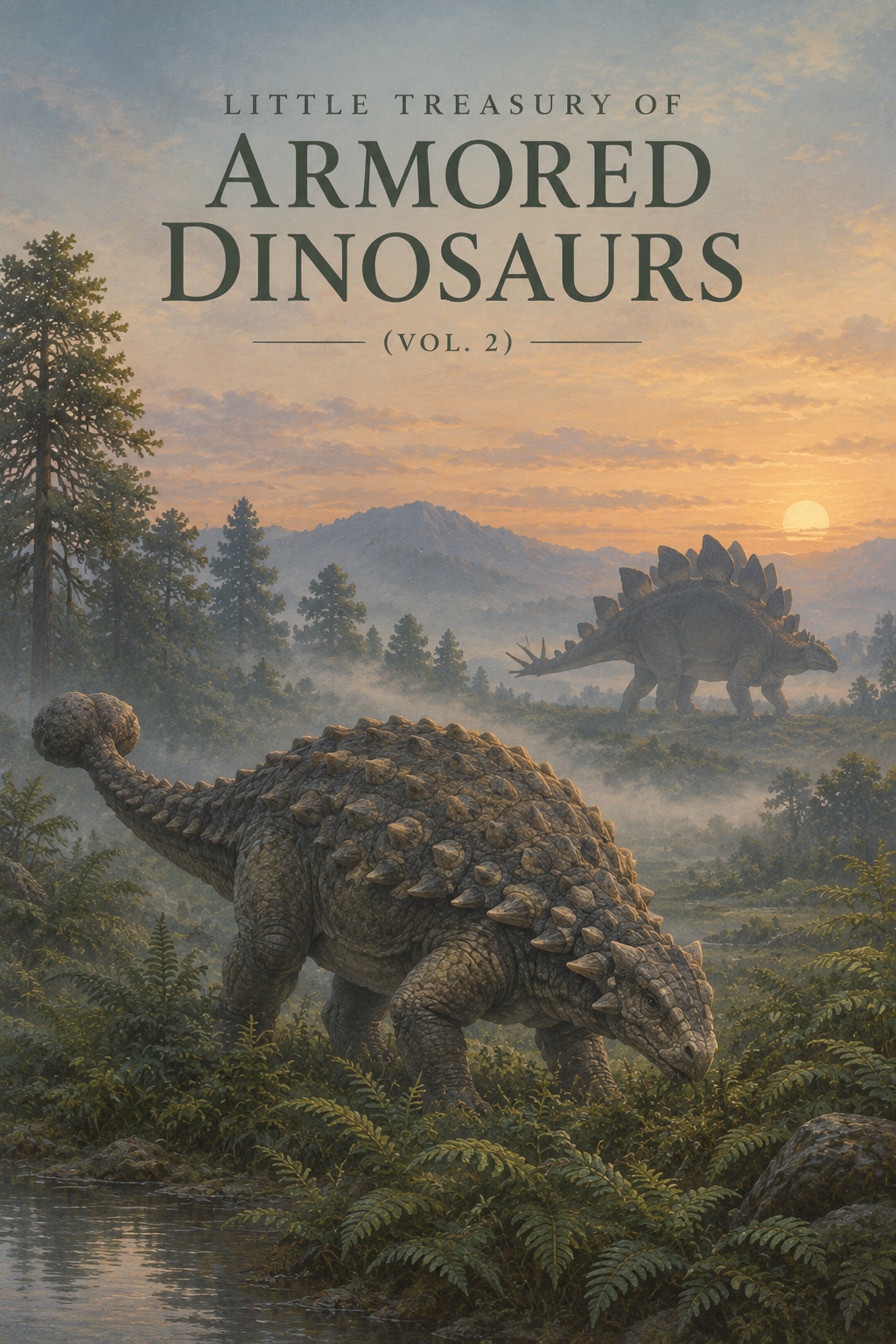
The story of these prehistoric shield bearers begins with the famous Stegosaurus, often referred to as the roof lizard. Its name arose from early paleontological efforts, where scientists initially imagined that its large, flat bony plates lay flat across its back like tiles on a roof. Later research corrected this picture, proving that the plates actually stood upright along the creature's spine. This historical correction highlights an essential aspect of studying the past: fossils do not arrive with explanatory labels, and scientists must reconstruct living creatures from incomplete evidence. Stegosaurus possessed a relatively small head, a massive body, four sturdy legs, and rows of upright back plates. At the end of its tail stood a set of formidable bony spikes. While the back plates may have served multiple purposes, such as regulating body temperature, intimidating rivals, or displaying visual signals, the tail spikes provided a direct counterweapon. A swing of its spiked tail could transform a plant eater into a dangerous opponent, turning passive defense into active resistance.
As time progressed, evolution produced another remarkable approach to protection in the form of Ankylosaurus, whose name means fused lizard. While Stegosaurus relied on distinct upright plates and tail spikes, Ankylosaurus developed a far more complete system of body armor. Its low, broad body was heavily reinforced, its skull was protected by thick bone, and its back was covered in extensive armor plates. To complete this defensive design, some members of the ankylosaur group possessed a massive bony club at the tip of the tail. Ankylosaurus was not built for speed, nor did it attempt to flee from predators. Instead, it functioned like a living armored tank, capable of staying in place and delivering devastating defensive blows against any carnivore that dared to attack.
Both Stegosaurus and Ankylosaurus belong to a broader group of armored dinosaurs known as Thyreophora, or shield bearers. Their contrasting structures illustrate how nature can discover multiple solutions to the very same problem. To understand why these different designs succeeded, one must look at the dynamics between predators and prey. A meat eating dinosaur did not need to defeat every herbivore it encountered; it needed only to find one individual that was young, injured, or separated from its herd. Consequently, an armored dinosaur did not need to evolve an impenetrable body. It only needed to make an attack sufficiently difficult or dangerous that a predator would hesitate, thereby improving the plant eater's odds of survival. This same defensive logic is seen in other dinosaur groups, such as Triceratops, which protected itself using a massive skull, a protective bony frill, and three sharp horns to deter giant predators like Tyrannosaurus.
Yet, the narrative emphasizes that bodily protection was never without its costs. Developing and carrying heavy armor required significant evolutionary compromises. The extra weight of plates, armor studs, and tail clubs demanded powerful limbs and sturdy skeletons. Furthermore, carrying this heavy equipment consumed extra metabolic energy, making armored dinosaurs slower than lightly built runners. Their teeth and jaw structures demonstrate that they were strictly herbivores, adapted for processing plant material rather than hunting. Thus, an intriguing paradox emerged: the more harmless an animal's diet was, the more formidable its outward appearance could become. Every armored dinosaur existed as a delicate biological balance between defense, movement, nutrition, and reproduction.
Eventually, this grand evolutionary narrative leads toward the unavoidable reality of environmental transformation and extinction. The stegosaurs experienced a substantial decline after the Jurassic period, whereas the ankylosaurs proved more resilient, persisting throughout the Late Cretaceous period and surviving until near the very end of the dinosaur era. Their eventual disappearance underlines a fundamental lesson of biology: successful physical adaptation is never permanent insurance. An animal may become perfectly adapted to its immediate surroundings, but if the climate, plant life, or global environment undergoes drastic shifts, even the most heavily protected creatures can vanish.
Following their extinction, the final chapter of the armored dinosaurs began as their living bodies decayed and their defensive structures became buried in rock. Millions of years later, human beings began excavating these fossilized remains, transforming biological shields into scientific evidence. Paleontologists analyze every plate, spike, tooth, and vertebra like clues in a grand scientific puzzle. By comparing related species, studying muscle attachments, and examining the surrounding geological layers, researchers reconstruct how these animals lived and moved. This ongoing investigation demonstrates that science is a living process where ideas change as new fossils are uncovered and old assumptions are re-examined.
In reviewing Little Treasury of Armored Dinosaurs (Vol. 2), published in 1989, the work fits seamlessly into Isaac Asimov's celebrated tradition of making science clear and accessible. Serving as Volume 2 of a five volume series and expanding on concepts from his earlier 1973 book How Did We Find Out About Dinosaurs?, this volume functions as an ideal companion to Giant Dinosaurs. Rather than merely listing exotic names or focusing solely on physical size, the book builds a logical, step by step narrative around evolutionary adaptation and scientific reasoning. It presents armor not as a random collection of spikes and plates, but as a series of calculated evolutionary compromises shaped by survival. By transforming fossil bones into meaningful questions, the text provides a clear, compelling exploration of how life adapts and how science unravels the mysteries of Earth's distant past.