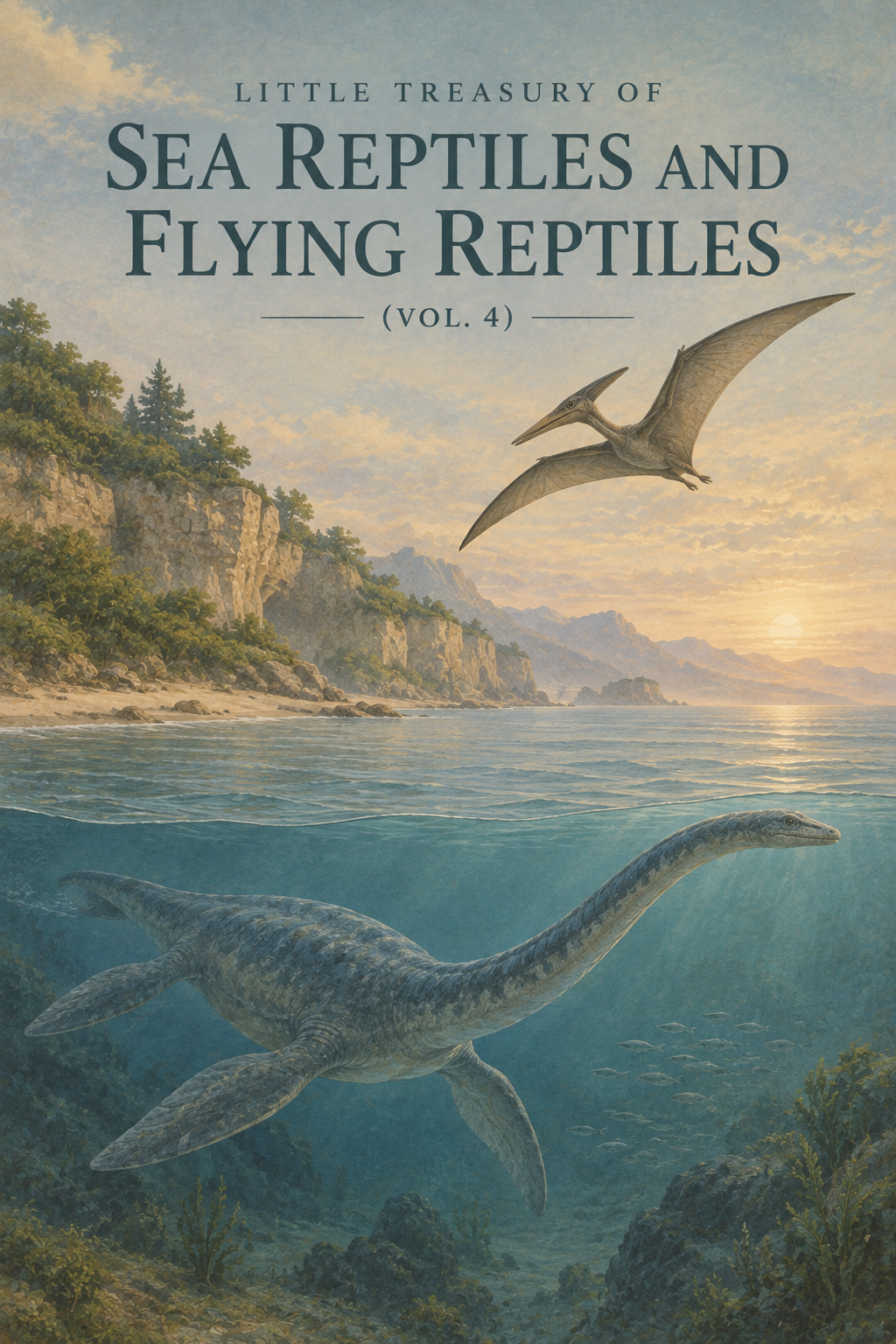
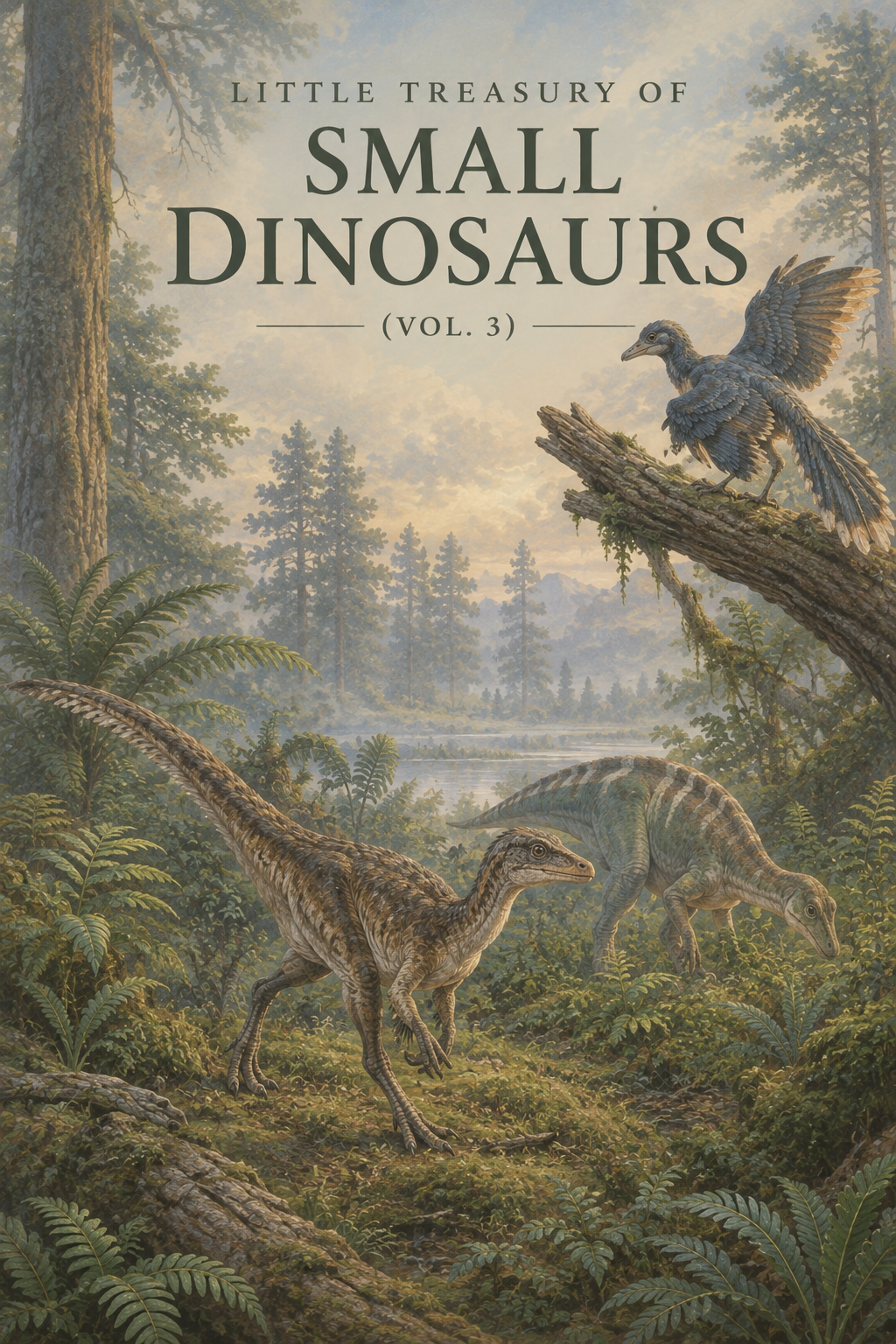
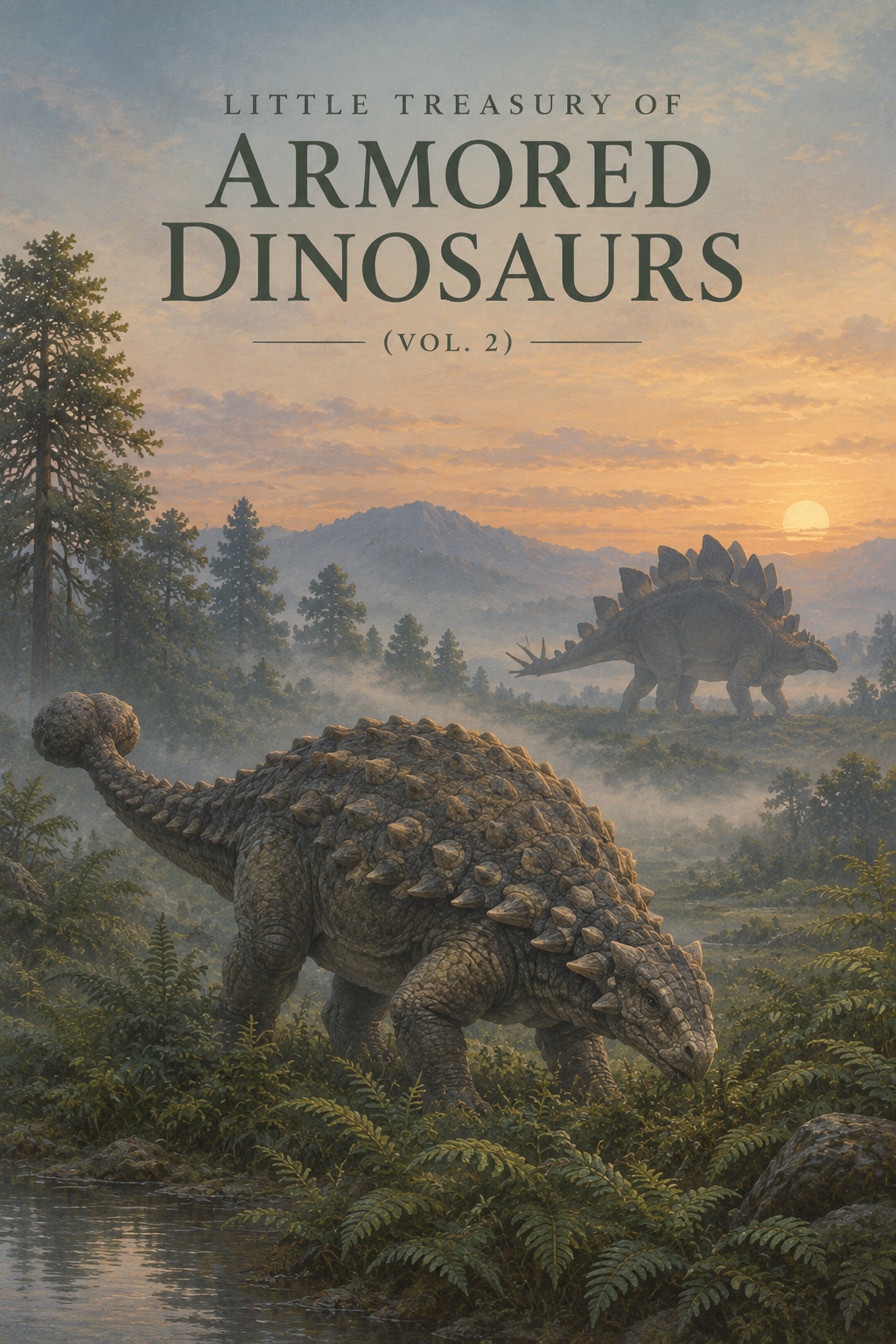
Little Treasury of Meat-Eating Dinosaurs and Horned Dinosaurs (vol. 5)
Carnivorous theropods and horned ceratopsians show how evolutionary adaptations shaped ancient ecosystems and modern birds.
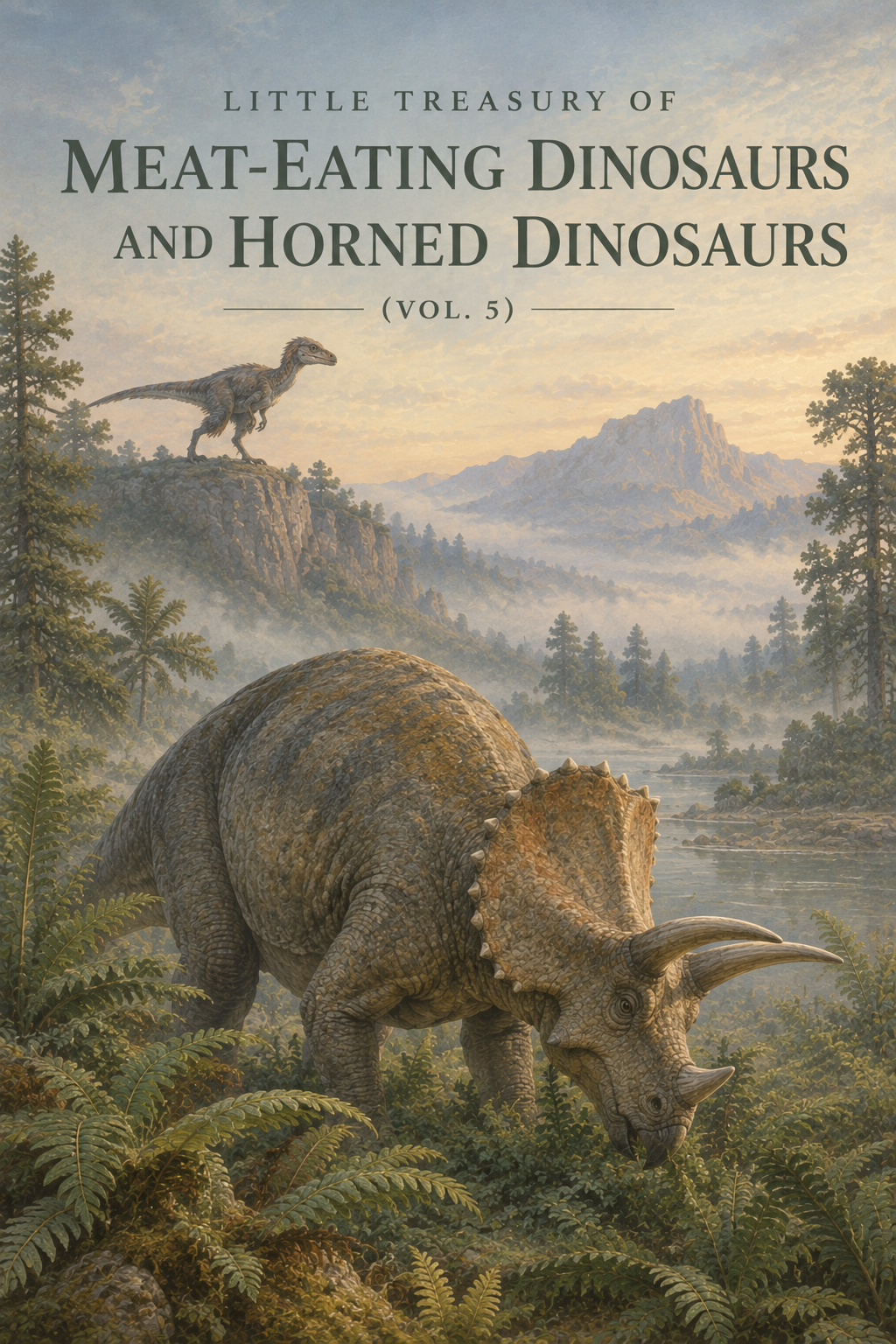
The story of prehistoric life unfolds through two contrasting ways of living: the pursuer searching for flesh and the herbivore standing its ground. One strategy relies on hunting and capturing other creatures, while the other depends on consuming vegetation while defending against threats. This volume in the series builds its narrative around these two opposing strategies, guiding the reader through the evolutionary forces that shaped ancient ecosystems and the methods scientists use to decode fossil evidence. Rather than treating these animals as simple monsters, the presentation builds a clear and logical path showing how living bodies adapted to meet the demands of their environments.
The narrative journey begins among the carnivorous theropods, creatures that held the predatory roles in ancient habitats. These meat-eaters spanned a wide range of sizes, from small and lightly built hunters to massive predators, but all shared a fundamental dependence on other animals for nourishment. Their anatomical features, including teeth, jaws, claws, and limbs, served as specialized adaptations for capturing and processing flesh. By tracing this group, the story builds from basic predatory adaptations toward complex questions about how ancient animals moved, hunted, and interacted.
The story focuses first on Tyrannosaurus rex, an iconic predator equipped with a massive skull, powerful jaws, and sturdy hind limbs designed to deliver immense biting forces. Its surprisingly small forelimbs present a distinctive anatomical feature, prompting scientists to examine how the whole organism functioned rather than viewing short arms as evidence of imperfection. The narrative explores how fossil evidence reveals the mechanics of feeding and movement while highlighting the vital distinction between established facts and unproven speculation. While skull structure and bone damage offer evidence of strong bites and ancient encounters, bones alone cannot definitively prove whether an animal was strictly a hunter, a scavenger, or both.
Moving further back in time to the Late Jurassic Period, the book introduces Allosaurus, a predator that possessed sharp teeth, strong limbs, and grasping forelimbs equipped with claws. Though lighter in build than Tyrannosaurus, Allosaurus occupied a similar predatory role millions of years earlier. Comparing these two distinct theropod branches reveals that large predators evolved repeatedly across dinosaur history. Their structural differences demonstrate that evolution did not simply repeat a single successful design, but generated varied solutions to the challenges of finding food, moving efficiently, and surviving competition.
The narrative then shifts to smaller, lighter predators, beginning with Deinonychus, whose large curved claw on each hind foot transformed scientific ideas about dinosaur activity. The discovery of such agile creatures challenged the older view of dinosaurs as universally slow and lumbering reptiles. Similarly, Velociraptor represents a small, quick hunter whose fossil relatives belong to a broader theropod group that included feathered species. Fossil evidence indicates that feathers served several functions, such as insulation and visual display, while laying the structural groundwork for flight in certain lineages. However, the presence of feathers does not imply that every feathered dinosaur was capable of flying.
This exploration of small theropods leads directly to one of paleontology's most significant insights: the close evolutionary relationship between dinosaurs and modern birds. Detailed studies of skeletons, forelimbs, and feathers demonstrate that birds are not creatures that merely arrived after dinosaurs vanished, but represent a surviving branch of dinosaur evolution. Through this logical progression, the ancient story extends directly into the familiar birds of the modern world.
Having established the world of pursuit, the narrative turns to plant-eating horned dinosaurs and their remarkable defensive adaptations. These herbivores possessed beaked mouths and teeth adapted to processing vegetation, alongside elaborate skull features such as horns, facial projections, and broad bony frills. Scientists carefully consider how these structures functioned, noting they may have served multiple roles including physical defense, display, species recognition, or social competition.
At the center of this group stands Triceratops, a large plant-eater equipped with a nose horn, two long brow horns, a broad frill, and tooth batteries capable of grinding tough plant material. The classic image of Triceratops facing Tyrannosaurus illustrates the dramatic contrast between predator and herbivore within ancient ecosystems. While such confrontations were possible where both species coexisted, fossil evidence of injuries and healing must be interpreted cautiously rather than mistaking imagined battles for documented events.
To show how these head structures varied, the story presents Styracosaurus, a horned dinosaur with a distinct nasal horn and a frill bordered by long bony spikes. To understand how such impressive weapons developed, the narrative compares them to Protoceratops, a smaller relative from Mongolia that possessed a modest frill but lacked prominent brow horns. This comparison demonstrates that elaborate horns did not emerge suddenly, but developed through a long history of changing skull shapes and feeding adaptations.
These anatomical details lead to the realization that each dinosaur functioned as an integrated organism, balancing body size, vegetation intake, sensory awareness, and defensive structures. Together, predators and plant-eaters formed interconnected ecosystems where each group depended on food availability and influenced the survival pressures faced by others.
The narrative explains that scientists uncover these vanished worlds by examining diverse fossil clues: teeth reveal diet, joints indicate movement, skulls show senses, footprints track travel, and bone injuries record past encounters. Value comes from testing hypotheses against new discoveries rather than relying on a single clue alone.
In review, this final volume succeeds by replacing simplified images of monsters and victims with a thoughtful, clear account of evolutionary history. By synthesizing themes of diversity, adaptation, and scientific methodology, the book logically connects individual fossil bones to the larger story of prehistoric do ecosystems.