Little Treasury of Small Dinosaurs (vol. 3)
Small dinosaurs prove evolutionary success depends on adaptation, not physical size, filling unique ecological niches and establishing the crucial connection between ancient theropods and birds.
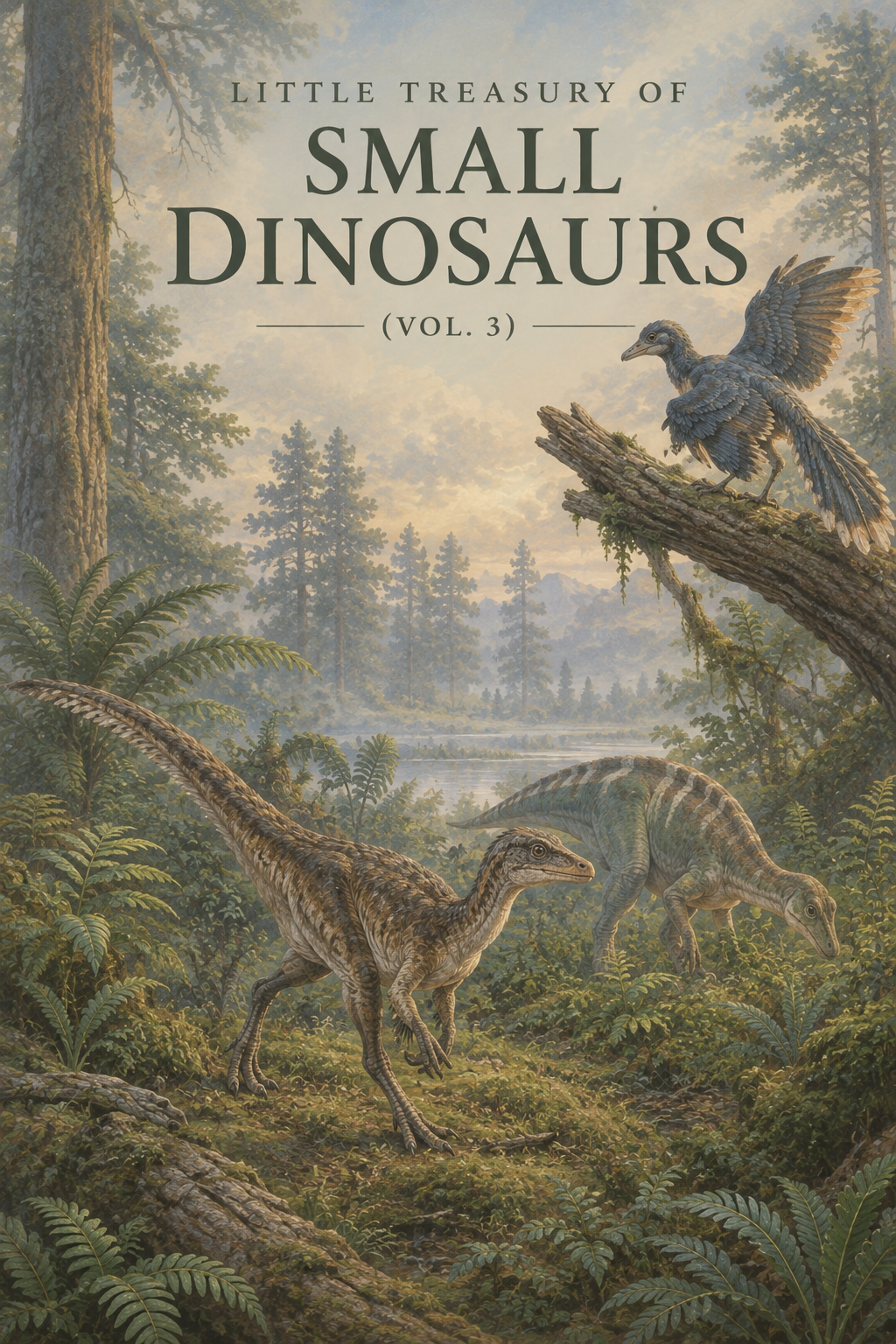
When most people envision the world of dinosaurs, their minds immediately picture towering giants, heavily armored beasts, or massive, sharp jawed predators. Isaac Asimov’s Little Treasury of Small Dinosaurs (Vol. 3), published in 1989 as part of a five volume series alongside Giant Dinosaurs, Armored Dinosaurs, Sea Reptiles and Flying Reptiles, and Meat Eating Dinosaurs and Horned Dinosaurs, deliberately shifts our perspective. Instead of forcing us to look upward in awe, the volume invites us to look downward and closely. It establishes a fundamental truth of paleontology and evolution: physical size does not determine evolutionary success. Enormous creatures required immense quantities of food and vast open spaces, whereas small dinosaurs could move through dense forest undergrowth, maneuver around narrow spaces, hide effortlessly, reproduce quickly under varied conditions, and consume food sources that giants could never reach. Thus, the overarching narrative begins not with dramatic power, but with subtle, adaptable survival.
The presentation moves logically from physical scale to scientific deduction, demonstrating how paleontology actually operates. We cannot observe living dinosaurs directly; instead, scientists act as detectives working backward from buried fossil bones. A skeleton becomes a puzzle where bone proportions reveal movement, teeth reveal diet, and limb structures indicate how an animal navigated its environment. Smaller fossils, though delicate and easily overlooked, frequently carry far more scientific weight than massive leg bones. The volume lays out how tiny creatures allowed researchers to overturn the old, flawed stereotype of dinosaurs as sluggish, slow moving reptiles, replacing it with a dynamic picture of agile, energetic animals occupying every layer of ancient ecosystems.
The first story features Compsognathus, whose name translates to dainty jaw. Tiny when placed alongside famous giant dinosaurs, this slender carnivore from Germany proved to be scientifically monumental. Its small, delicate skeleton, long neck, and birdlike proportions caught the attention of historical researchers like Thomas Huxley. By comparing the bones of Compsognathus with early bird fossils, scientists unlocked one of the most vital clues in evolutionary history, demonstrating that small theropod dinosaurs shared a direct anatomical foundation with birds.
The narrative then turns to the story of Hypsilophodon, a modest herbivore that demonstrated small stature was not restricted to hunters. Hypsilophodon lived in the shadows of gigantic plant eaters, consuming low lying vegetation and occupying a completely different ecological role. Furthermore, its scientific history highlights how interpretations in paleontology evolve over time. Early researchers mistakenly imagined that Hypsilophodon climbed trees or possessed body armor, but careful re examination rejected those ideas, illustrating that scientific truth improves as fresh evidence accumulates.
To explain where carnivorous dinosaurs truly began, the volume introduces the story of Coelophysis, a small predator from the Late Triassic period. Long before famous giants like Tyrannosaurus appeared, Coelophysis was already thriving. The discovery of an extraordinary collection of skeletons at Ghost Ranch in New Mexico made Coelophysis one of the best understood early theropods. It revealed that meat eating dinosaurs began small, developing the core evolutionary blueprint, including lightweight skeletons, grasping forelimbs, fast hind legs, and predatory jaws, that later predators would inherit and enlarge.
The next narrative continues with the story of Ornitholestes, whose name means bird robber. Although its fossils are relatively rare, this slender, lightly built theropod played a crucial role in altering public and scientific perceptions of dinosaur movement. Rather than being a heavy, lumbering reptile, Ornitholestes exhibited active proportions and a lightweight frame built for quick, energetic maneuvers. It showed that small theropods were fast, nimble creatures capable of darting through ancient forests to catch swift prey.
The final profile brings the central theme into focus through the story of Archaeopteryx, an extraordinary transitional fossil that bridges the gap between reptilian dinosaurs and early birds. Combining clear reptilian features with distinct feather impressions, Archaeopteryx provided key evidence Thomas Huxley needed to prove the evolutionary link between small theropods and birds. This reveals the book's ultimate destination: the world of dinosaurs never truly vanished, as their descendants live on today as modern birds.
As a review of Asimov's third volume, the book achieves a brilliant reversal of perspective. While giant dinosaurs inspire awe through size and armored dinosaurs demonstrate defensive structures, small dinosaurs demand that we look closely. Asimov's signature style, using simple words, crystal clear logic, and structured explanations, makes complex evolutionary concepts and ecological networks immediately accessible. By examining the smallest creatures, the book reveals the biggest story: that evolution rewards adaptability and suitability rather than sheer strength. Ultimately, every sparrow resting on a branch today connects us directly to these small, ancient this survivors.