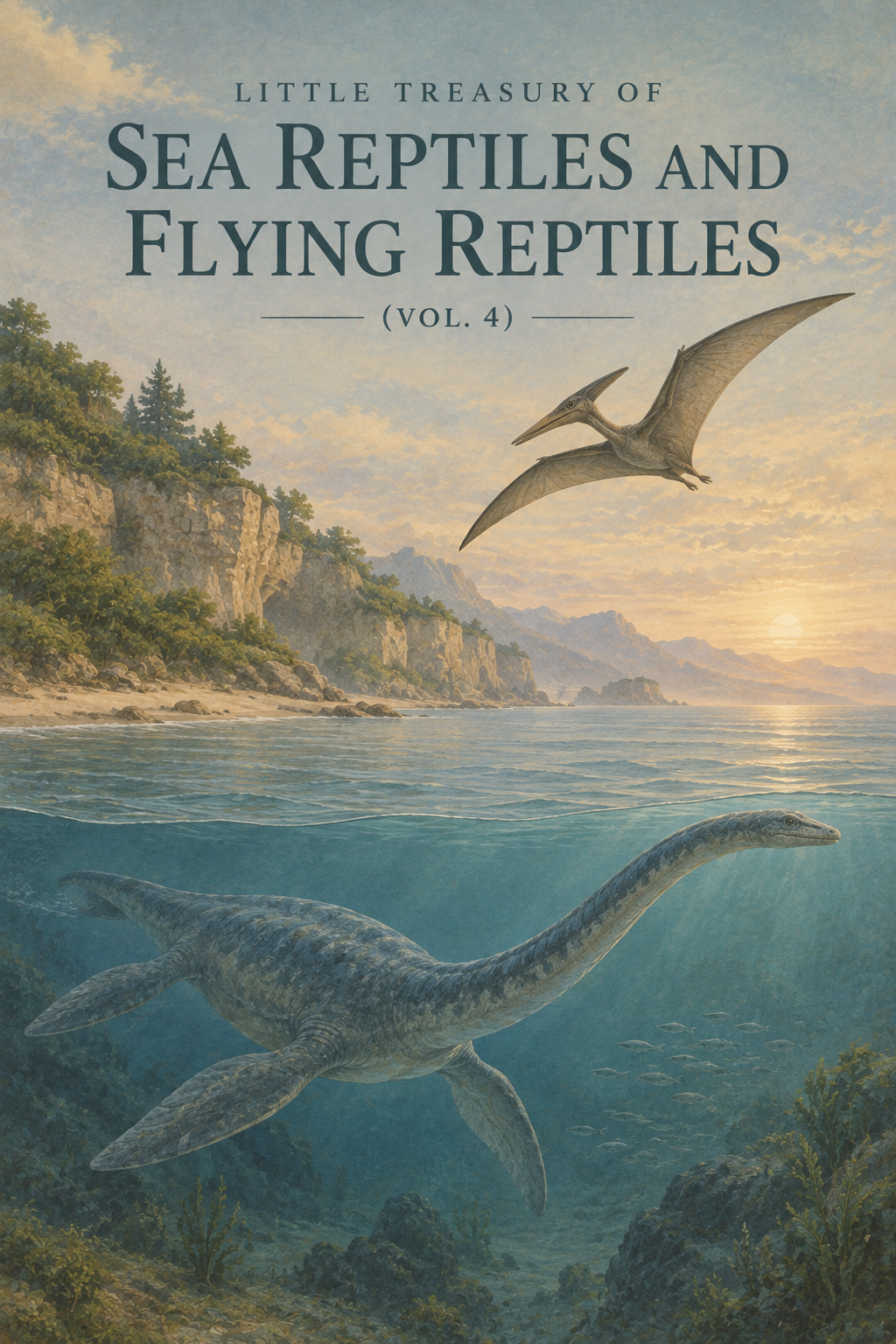
Little Treasury of Sea Reptiles and Flying Reptiles (vol. 4)
Distinct marine and flying reptiles evolved specialized body plans, from streamlined ichthyosaurs to winged pterosaurs, adapting uniquely to life in ancient seas and open skies.
The Unfolding Canvas of Mesozoic Life
Long before modern whales crossed the oceans and birds filled the skies, the ancient Earth was inhabited by reptiles whose bodies adapted to environments far beyond the land. Some of these creatures paddled through prehistoric waters using powerful tails and flipper like limbs, while others launched themselves into the air on expansive wings. To understand this era with scientific clarity, we must first recognize a fundamental distinction: the word dinosaur does not describe every giant reptile that lived during the Mesozoic Era. While dinosaurs dominated terrestrial ecosystems, the ancient oceans and open skies belonged to separate, distinctive reptilian groups. These marine and flying reptiles were related to the broader evolutionary history of reptiles, but they were not dinosaurs in the strict scientific sense. In Little Treasury of Sea Reptiles and Flying Reptiles (Vol. 4), the narrative focuses not merely on the size or strangeness of prehistoric beasts, but on the profound relationship between an animal's body structure and the environment in which it lived. The book serves as an essential complement to traditional works on land dinosaurs, expanding our imagination to reveal how life explored distinct avenues of movement, feeding, and survival.
The Story of Ichthyosaurs and Convergent Evolution
The ocean offered vast food resources such as fish and marine animals, but living in water required body plans suited for swimming rather than walking. Among the most remarkable early marine invaders were the ichthyosaurs, whose streamlined bodies closely resembled those of modern dolphins. Equipped with long snouts, large eyes, powerful tails, and limbs modified into flippers, ichthyosaurs became highly efficient underwater hunters. Their body shape illustrates a central principle of evolutionary science known as convergent evolution: unrelated animals facing similar physical demands can independently develop strikingly similar body forms. Although an ichthyosaur looked remarkably like a dolphin, they were not close relatives; rather, both groups independently evolved streamlined bodies optimized for fast movement through water. Furthermore, the study of ichthyosaur fossils demonstrates that ancient bones reveal far more than simple dimensions. The contours of a skeleton suggest how an animal moved, while its eyes and jaws offer logical clues about its hunting strategy.
The Story of Plesiosaurs and Alternative Swimming Designs
As the evolutionary narrative unfolds, the oceans produced alternative designs for marine survival. The plesiosaurs represented a completely different architectural approach, characterized by broad bodies, four powerful flippers, and varying neck lengths depending on the group. Long necked species, such as Elasmosaurus, featured extraordinarily extended necks paired with relatively small heads. Unlike ichthyosaurs, which relied on fishlike tails for forward propulsion, plesiosaurs used their four flippers to row through the water. This contrast reminds us that nature did not rely on a single perfect design for life in the sea. A streamlined tail suited one group, whereas four oars suited another.
The Story of Pliosaurs and Heavy Marine Predation
Within the same broad plesiosaur lineage, another distinct group evolved to fill the role of heavy predators: the pliosaurs. Formed by creatures such as Liopleurodon, pliosaurs featured massive heads, powerful jaws, robust bodies, and short necks. Their proportions allowed them to hunt substantial prey, demonstrating how closely related animals can diverge to occupy entirely different ecological roles in the same ancient seas.
The Story of Mosasaurs and Late Cretaceous Apex Predators
Later in the Cretaceous Period, another major reptilian group invaded the oceans: the mosasaurs. These large, active predators possessed elongated bodies, powerful tails, and limbs modified into flippers. Their jaws and teeth indicate they were formidable hunters. Belonging to a reptilian lineage distinct from both ichthyosaurs and plesiosaurs, mosasaurs added yet another branch to the reptilian conquest of the sea. Their lives were deeply tied to planetary conditions, including climate, sea levels, and prey availability. When the broad extinction crisis occurred at the end of the Cretaceous, mosasaurs vanished alongside many other groups. However, their extinction marked the end of specific evolutionary lines in a changing world, rather than a failure of reptiles as a whole.
The Story of Early Pterosaurs and the Physics of Flight
Turning from the ocean to the sky, prehistoric reptiles faced an entirely different physical challenge. Sustained flight demands more than light weight; an animal must generate lift, control direction, and manage high energy expenditures. The pterosaurs became the first vertebrates to achieve powered flight long before birds appeared. Their wings consisted of a skin membrane supported primarily by an extraordinarily elongated fourth finger extending along the side of the body, a structural design very different from bird wings. Early pterosaurs, such as Rhamphorhynchus, were characterized by long tails and distinctive teeth.
The Story of Pteranodon and Soaring Gliders
As pterosaur evolution progressed, later pterodactyloids developed modified body structures. Among the most famous was Pteranodon, which possessed short tails, long narrow skulls, and impressive wingspans suited for traveling above coastlines and open waters. Pteranodon had a toothless beak and a head crest that varied among individuals, which may have played a role in visual display or flight dynamics. It was neither a dinosaur nor a bird, but a member of a unique flying reptilian lineage.
The Story of Quetzalcoatlus and Biomechanical Limits
The story of flying reptiles reaches its extreme with Quetzalcoatlus, one of the largest flying animals known to science. With its immense wings and elongated limbs, Quetzalcoatlus was capable of traveling vast distances. Understanding how such a massive animal took off, walked, and fed requires paleontologists to apply principles of biomechanics and comparative anatomy. This highlights an essential scientific distinction emphasized throughout the book: the line between physical fossil evidence and reasonable behavioral interpretation. Pterosaurs as a whole demonstrate that flight did not require a single rigid body plan, as wing proportions, head crests, and feeding habits varied widely across species.
Review and Evaluation: The Logic of Prehistoric Science
As a work of popular science, Little Treasury of Sea Reptiles and Flying Reptiles (Vol. 4) succeeds by presenting paleontology not as a static list of extinct monsters, but as a dynamic, logical investigation. It teaches us that size and strangeness are not the true metrics of an animal's importance. What truly matters is the evidence fossils provide regarding the adaptability of living organisms. Evolution did not work toward a single ideal creature; instead, it produced a vast array of forms shaped by physics, environment, and inherited anatomy. Furthermore, the book highlights that paleontology is a continuing science. A single new fossil discovery or a revised comparison with living species can alter interpretations that once seemed settled. By presenting these sea and sky reptiles with clarity and logical rigor, the volume enriches our understanding of the Mesozoic world, making it far more diverse and complex than any story of land dinosaurs alone could ever convey.