How Did We Find Out About Sunshine
Asimov explores how humanity logically transformed sunshine from a divine mystery into understood physics, chemistry, and astronomy, proving the universe is understandable through cumulative curiosity.
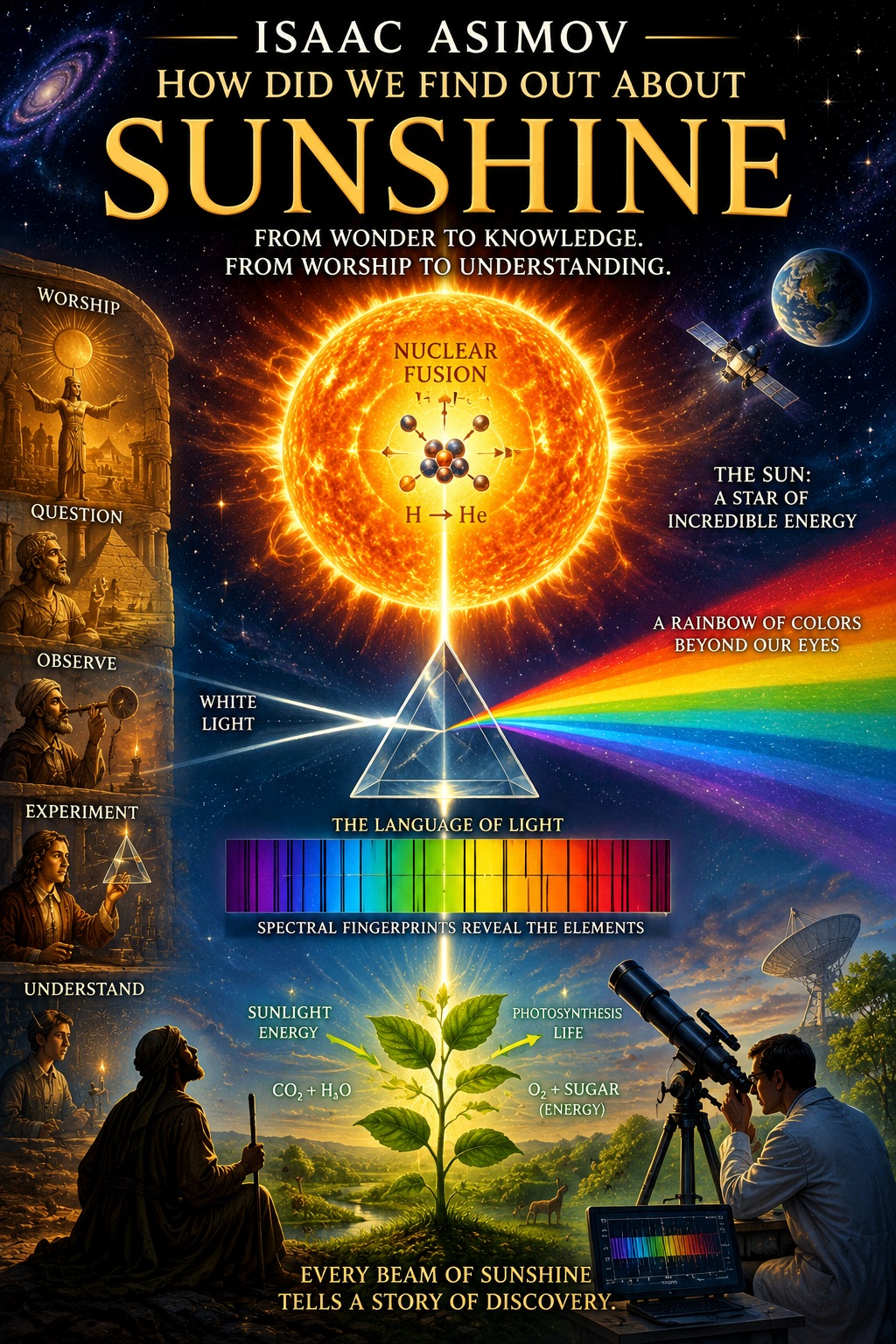
The story of our understanding of the heavens begins not with a set of cold equations, but with a simple, human gaze directed toward the morning horizon. For most of human history, the brilliant light that warms the Earth was viewed as an everyday miracle, a gift from divine beings who commanded the sky. To those early observers, the Sun was an eternal, perfect power, and the light it cast seemed to be an instantaneous presence that required no explanation. However, as Isaac Asimov demonstrates in his exploration of this subject, the true adventure began when people stopped merely worshipping the light and started asking what it actually was.
In this narrative of discovery, we see a familiar Asimovian theme: that science is a cumulative human journey where curiosity transforms mystery into understanding. The book functions as a bridge, connecting the ancient world’s awe with the modern world’s logic. It is a story of how humanity learned to see the invisible and touch the untouchable, all through the simple act of observing a beam of sunshine. Like much of Asimov's work, it builds from the most basic observations of our senses and leads toward a grander realization of our place in a vast, interconnected cosmos.
The first major episode in this journey of thought concerns the nature of light's movement. For thousands of years, it was assumed that light traveled instantly, filling a room the very moment a flame was struck. It was only through the careful observation of Jupiter’s moons that astronomers realized something startling: the timing of eclipses changed depending on how far Earth was from the giant planet. This led to the revolutionary realization that light has a finite speed of light and requires time to travel. Suddenly, sunshine was no longer a magical presence but a physical traveler racing through the vacuum of space, taking roughly eight minutes to reach our eyes.
Once we understood that sunshine traveled, we began to wonder if it was as simple as it appeared. A beam of white light seems uniform, yet when passed through a glass prism, it reveals a hidden complexity. The light spreads out into a vibrant band of colors known as the visible spectrum, proving that white light is actually a combination of red, orange, yellow, green, blue, indigo, and violet. This discovery turned the ordinary sunshine entering a window into a detective story, where scientists began to investigate the rainbow as a natural demonstration of light’s many components.
The investigation did not stop at what the human eye could perceive. Curious researchers began to experiment with the areas just outside the visible rainbow. They found warmth beyond the red light and chemical reactions occurring beyond the violet light. This revealed that sunshine contains invisible colors—infrared and ultraviolet—that affect our world even though we cannot see them. It is a powerful lesson in how science expands our limited senses, allowing us to detect the hidden portions of reality through the invention of clever instruments.
Perhaps the most elegant chapter in this story involves the language of light. When scientists looked closer at the spectrum of the Sun, they found thousands of tiny dark lines. These lines were eventually recognized as a chemical fingerprint through the science of spectroscopy; each element, like hydrogen or sodium, absorbs specific wavelengths of light. This allowed humanity to do the impossible: to determine exactly what the Sun is made of without ever having to leave the Earth. It proved that the laws of chemistry are universal, linking our terrestrial laboratories to the heart of a distant star.
With the composition of the Sun known, a new mystery arose regarding its endurance. If the Sun were made of coal or wood, it would have burned out in a few thousand years, yet it has shone for billions. This led scientists to look deep within the atom, where they discovered the process of nuclear fusion. In the crushing pressure of the solar core, matter is transformed into energy, providing a nearly eternal furnace that powers the entire solar system. This realization connects the gentle warmth of a summer day to the most powerful forces in the universe, explained through the relationship between mass and energy.
The story then brings our focus back to our own planet to show how this energy is used. Through photosynthesis, plants capture solar energy and store it, creating the foundation for all life on Earth. Every animal that moves and every human heart that beats is essentially running on bottled sunshine. Even the fuels we dig from the ground are merely ancient sunlight stored by prehistoric life. It becomes clear that life is not just illuminated by the Sun; it is a direct expression of solar energy.
As we move toward the modern era, our tools have become more sophisticated, allowing us to measure the Sun’s temperature, its size, and the turbulent gases that dance across its surface. Spacecraft have even climbed above our atmosphere to view the Sun without the interference of air or clouds. This technological progress has turned a familiar daily experience into a detailed scientific map, though Asimov is careful to note that the story is far from over. There are still mysteries in solar storms, magnetic fields, and the tiny particles known as neutrinos that continue to challenge our understanding.
In reviewing this narrative, it is clear that its greatest strength lies in celebrating the cumulative power of human reason. Asimov does not focus on isolated geniuses but on the way each generation builds upon the unanswered questions of the last. The book transforms a simple ray of light into a profound lesson in physics, biology, and chemistry. It leaves the reader with a sense of quiet optimism, suggesting that as long as we continue to ask questions, the universe will remain understandable.
The Mystery of Sunshine This initial story explores the ancient perspective where sunshine was an unquestioned, everyday miracle. Early civilizations worshipped the Sun as a god because they lacked a physical explanation for its eternal warmth and light. Asimov uses this to show that science begins when we move from worship to curiosity, treating the Sun as a puzzle to be solved rather than a mystery to be feared.
Light Travels This section details the discovery that light has a finite speed. By observing the moons of Jupiter, astronomers found that light takes time to travel across the vast distances of space. This changed sunshine from a magical, instant occurrence into a physical phenomenon that takes eight minutes to reach Earth, connecting us to the deep history of the space between the stars.
Breaking Sunshine Apart This summary focuses on the use of the prism to break white light into its component colors. It explains how a simple piece of glass revealed that sunshine is actually a mixture of many different types of light. This transformed the way we look at a simple beam of light, turning it into a complex subject of study for chemists and physicists alike.
Invisible Colors The rainbow seems complete, yet curious investigators continue asking questions. Experiments reveal warmth beyond the red end of the spectrum and invisible rays beyond violet capable of causing chemical changes. This part of the book teaches the reader that human senses reveal only a tiny portion of reality and that science expands our perception by inventing instruments to detect what eyes cannot see.
The Language of Spectra This story follows the discovery of dark lines in the solar spectrum, which act as a universal language. By reading these fingerprints, scientists were able to identify the chemical elements inside the Sun, such as hydrogen and helium, without ever leaving Earth. This proved that the same laws of nature apply both on our planet and in the furthest reaches of the cosmos.
The Fire of the Sun This part of the narrative explains how twentieth century physics solved the mystery of the Sun's longevity. It describes the process where hydrogen nuclei combine to form helium, releasing massive amounts of energy. This explains how the Sun can shine for billions of years, fueled by the conversion of matter into energy at its very core.
Sunshine and Life This story explains the biological necessity of sunshine. It details how plants turn light into chemical energy, which then feeds all other life on the planet. It illustrates the profound truth that all life, and even our modern fuels, are essentially stored sunshine from the past and present.
Measuring the Sun This section discusses the ongoing quest for precision. Scientists use ingenious instruments to measure solar radiation, temperature, and size. Telescopes and spacecraft allow us to see solar flares and sunspots, transforming a common experience into a detailed scientific subject through technological advancement.
Sunshine Beyond Earth The investigation naturally expands into the universe. By studying the light of our own Sun, astronomers learn to understand every star in the galaxy. Other stars differ in size and temperature, but the principles discovered through one daylight beam become the tools for exploring the entire cosmos.
The Continuing Story Asimov closes by emphasizing that the investigation of sunshine is an endless conversation. New questions arise regarding solar storms, magnetic fields, and particles like neutrinos. This final chapter reminds the reader that science is not a collection of static facts but a living process driven by human curiosity.