The Asteroids
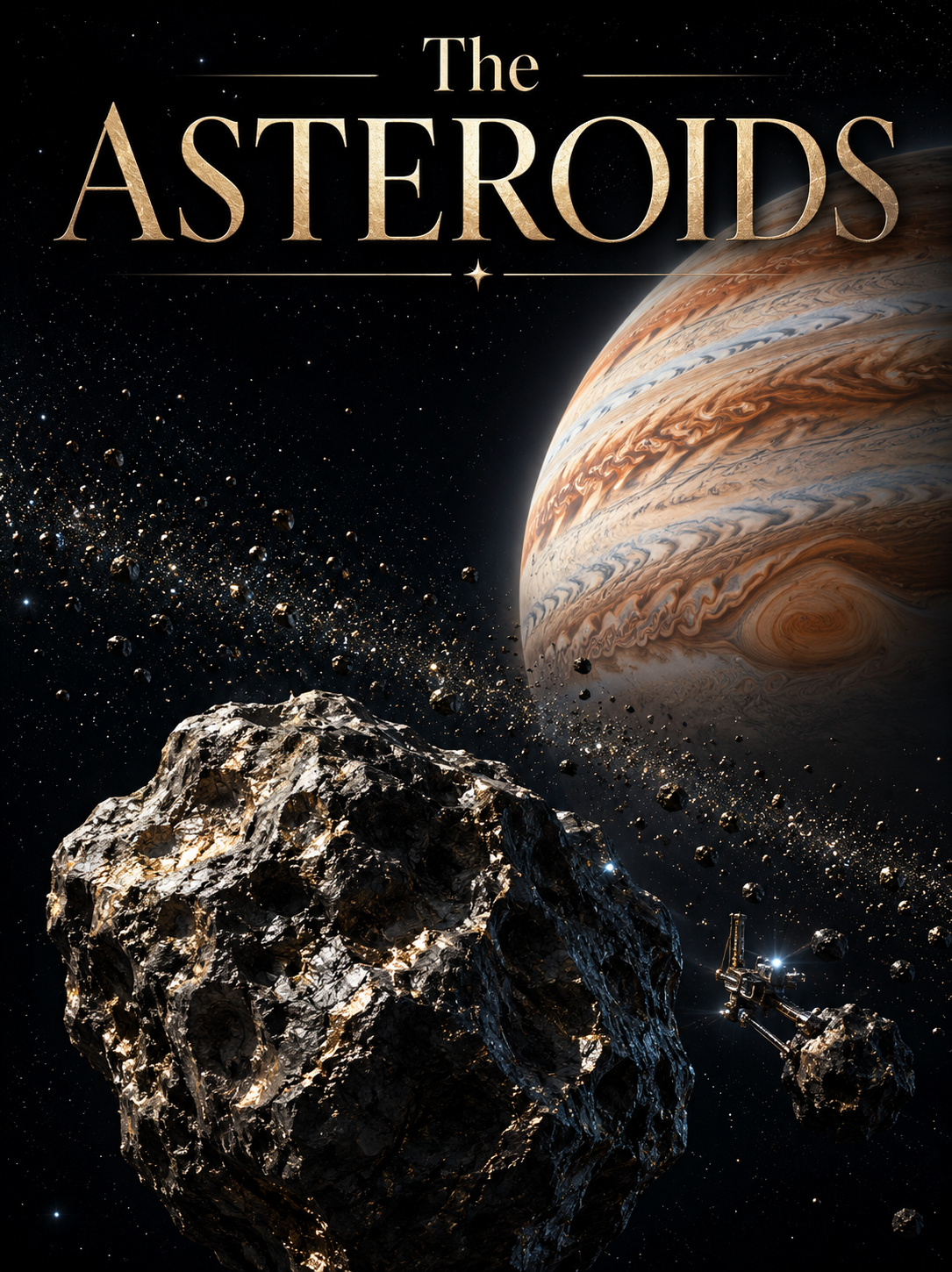
Asimov’s narrative describes asteroids as ancient fossils and planetary leftovers, chronicling their discovery, scientific importance, and future value as valuable space resources for expanding civilization.
For a long time, humanity looked at the night sky and thought they had counted every important member of the celestial family. There was the Sun, the Moon, and the five planets that moved against the backdrop of the fixed stars. These were the wanderers, and for centuries, they were enough to satisfy our curiosity. But the story of the asteroids is a story of how we realized that the family was much larger, much more crowded, and far more ancient than we ever dared to imagine.
In this narrative of discovery, Isaac Asimov takes us on a journey through time and logic. He treats the history of astronomy not as a dry list of dates, but as a unfolding detective story where each clue leads to a larger mystery. The story begins with a simple observation: a gap. Between the orbits of Mars and Jupiter, there was a vast, empty space that seemed to defy the mathematical harmony astronomers had begun to notice in the Solar System. It was as if a chair were missing from a dinner party, and the scientists of the late eighteenth century became obsessed with finding out who or what was supposed to be sitting there.
To understand the story of the asteroids, one must look at the mini stories that comprise the whole, for each one represents a different era of human understanding.
The Story of the Missing World The first mini story begins with a group of astronomers who called themselves the Celestial Police. They were determined to find the planet they believed must exist in the gap between Mars and Jupiter. However, the discovery did not come to the organized searchers. Instead, it came to a quiet Italian astronomer named Giuseppe Piazzi. On the first night of the nineteenth century, he saw a tiny point of light that moved. He first thought it was a comet, but its circular path revealed something more profound: it was a world. It was named Ceres, and for a short time, humanity believed the gap was finally filled.
The Story of the Star like Swarm The narrative takes a turn when Ceres is revealed to be far too small to be a proper planet. Soon, another point of light was found, then another, and then a fourth. Pallas, Juno, and Vesta joined the ranks. Instead of one large world, astronomers had stumbled upon a swarm. These objects were so small that they did not appear as disks through a telescope, but remained as points, like stars. This gave them their name: asteroids, or star like. This part of the story illustrates a common theme in Asimov’s view of science that the universe is rarely as simple as our first theories suggest.
The Story of the Great Void As the number of discovered asteroids grew from four to thousands, a popular myth began to take hold. Many people imagined the asteroid belt as a cluttered, dangerous graveyard of rocks where collisions were constant. However, Asimov uses logic to dismantle this image. He explains that the region of space between Mars and Jupiter is so immense that even with billions of rocks, the average distance between them is vast. It is not a crowded highway but a lonely wilderness. This realization changed how we viewed the danger of space travel, showing that a spacecraft can sail through the belt with almost no chance of hitting anything.
The Story of the Unfinished Building Perhaps the most compelling mini story is that of the origin of these rocks. For a long time, the leading theory was a tragic one: that a full sized planet had once existed there and exploded. Asimov carefully walks the reader through why this idea, though romantic, does not hold up to the weight of evidence. The total mass of the asteroids is too small to make a planet, and the physics of a world exploding does not quite work. Instead, he presents a more fascinating reality. The asteroids are not the ruins of a finished world; they are the leftover bricks and mortar from the birth of the Solar System. Because of the massive gravitational bullying of nearby Jupiter, these pieces could never settle down to form a planet. They are fossils of the very beginning of time.
The Story of the Messengers from the Sky The narrative then brings these distant rocks down to Earth. Scientists realized that the meteorites that occasionally streak through our atmosphere and land in our fields are often fragments of these very asteroids. This part of the story is about the thrill of physical contact. We do not have to just look through telescopes to understand the asteroid belt; we can hold pieces of it in our hands. By studying these fallen stars, we can determine what the early Solar System was made of some are rich in stone, others are solid iron and nickel, and some are filled with carbon rich materials that hint at the chemistry of life.
The Story of the Future Frontier The final mini story turns from the past to the future. Asimov looks at the asteroids not just as historical artifacts, but as a bounty. He describes them as a treasure chest of resources waiting for a spacefaring civilization. Within these rocks are the metals and water needed to build cities among the stars. But he also includes a note of caution. While the belt is far away, some individual asteroids have orbits that cross the path of the Earth. This adds a layer of suspense to the story: we must track these wanderers not just for science, but for our own survival.
In reviewing this work, it is clear that Asimov is doing something far more important than cataloging rocks. He is showing us the evolution of the human mind. He begins with the ancient, limited view of the world and ends with a vision of a humanity that mines the stars and protects its home planet from cosmic debris. His style is, as always, a model of clarity. He avoids the purple prose of sensationalism, preferring to let the logic of the universe provide the drama. He treats the reader as an intelligent companion, leading them through the why and the how rather than just the what.
The book serves as a bridge between the cold facts of astronomy and the warmth of human curiosity. It reminds us that every discovery is a correction of a previous mistake. We thought there was one planet; we found a thousand small ones. We thought they were an explosion; we found they were a beginning. This constant refinement of knowledge is the heartbeat of the story.
Ultimately, the narrative leaves us with a sense of perspective. We live in a Solar System that is messy, evolving, and filled with surviving witnesses to our own creation. The asteroids, once dismissed as mere vermin of the skies by frustrated astronomers, are revealed to be the keys to understanding our past and securing our future. They are the silent storytellers of the void, and through Asimov’s clear and logical presentation, we finally learn how to listen to what they have to say.