Isaac Asimov Presents Superquiz III
This massive trivia challenge features five thousand questions, presenting human knowledge as an interconnected web and an endless adventure through the vast landscape of discovery.
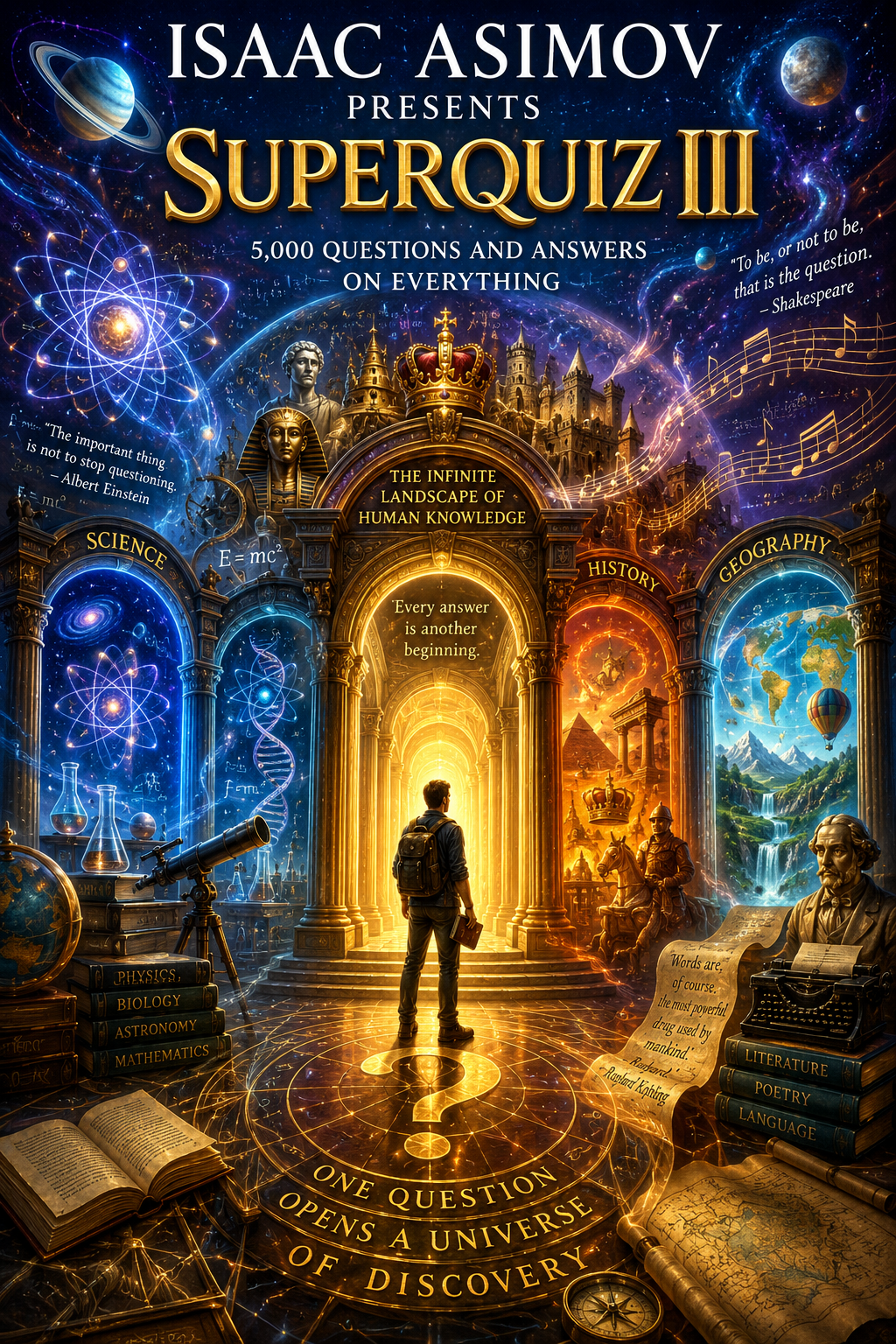
Imagine a traveler standing before the entrance of a vast and brightly lit museum, representing the experience of Isaac Asimov Presents Superquiz III. This is not a collection of fictional tales, but an intellectual journey through human knowledge presented as a massive trivia challenge. The book serves as a map for this expedition, and while it does not follow a traditional plot, it treats the pursuit of facts as a grand adventure where every question becomes a doorway and every answer opens another corridor leading to unexpected connections.
Everyday Knowledge The journey begins with the story of everyday knowledge. The reader is welcomed with seemingly simple questions about famous capitals or historical figures, designed to build confidence before the path gradually shifts toward more specialized subjects. This opening phase emphasizes that the pleasure of the book lies not merely in knowing the answer, but in discovering the sheer breadth of human understanding.
Science The science wing feels particularly alive with the spirit of the author. The narrative here transitions from the vastness of planets and stars found in Astronomy down to the invisible structure of atoms explored in Physics. This section also delves into the complexities of Biology and the structural logic of Mathematics, illustrating that science is a living adventure rather than a collection of dry facts. Each correct answer is a tiny victory, while every mistake serves as an invitation to explore a new room in the museum of the mind.
History History forms another major landscape within the quiz where ancient civilizations stand alongside modern political events. In this story, kings share pages with revolutionaries, and forgotten battles appear next to world changing discoveries. Rather than a chronological lecture, history is presented as a game of unexpected associations where a question about Ancient Egypt might be followed by one concerning the American Revolution or the Renaissance. This forcing of the mind to leap across centuries keeps the traveler engaged and alert.
Literature and Language The intellectual expedition continues into the realms of literature and language. Classic novels, famous poets, and Shakespearean characters compete for attention alongside idioms and vocabulary challenges. The traveler learns that a wide appreciation of culture is more valuable than knowing a single masterpiece in isolation. This chapter rewards curiosity accumulated over a lifetime of reading rather than simple memorization.
Geography Geography turns the world into a puzzle of rivers, mountains, and national boundaries. This section encourages the reader to mentally travel across continents, demonstrating how physical landscapes shape the history and culture of civilizations. Every answer provided paints another small piece of the world map, reinforcing the interconnectedness of all geographic facts.
Entertainment and Popular Culture Entertainment and popular culture provide lighter moments in the narrative. Questions about movies, television, music, and awards remind the traveler that knowledge extends far beyond the walls of classrooms and libraries. This balance between academic and popular subjects ensures that every participant has an opportunity to excel while remaining humbled by the sheer variety of human achievement.
Sports The story of sports contributes energy and unpredictability to the journey. Championships, records, and legendary athletes occupy an important place in collective human memory. Even those unfamiliar with athletics may discover surprising historical connections and remarkable accomplishments, illustrating that physical achievement is a vital part of the human record.
Curiosity and Discovery A hidden story running throughout the entire volume is the internal journey of the reader. At first, confidence dominates as familiar answers come easily, but uncertainty arrives as obscure questions appear. Soon, determination replaces hesitation as the reader searches for patterns and discovers forgotten facts. The structure of the book deliberately mixes subjects, such as a sudden leap from Chemistry to classical mythology, to prevent mechanical thinking and reward flexible intelligence. Every unanswered question creates a small mystery that mirrors scientific inquiry, where each solution opens a new frontier instead of providing final certainty.
Conclusion The greatest strength of Isaac Asimov Presents Superquiz III is its celebration of general knowledge as an interconnected web where science influences history and literature reflects politics. It succeeds as an educational game and a playful encyclopedia that challenges even the most knowledgeable readers. The lasting message is quietly optimistic, suggesting that knowledge is not a final destination but an endless adventure and an invitation to keep exploring the vast landscape of human understanding.