Isaac Asimov Presents the Great SF Stories, 16
This 1954 anthology of seventeen stories explores human identity, ethics, and psychology through logical, timeless, and profound examinations of our enduring and complex human condition.
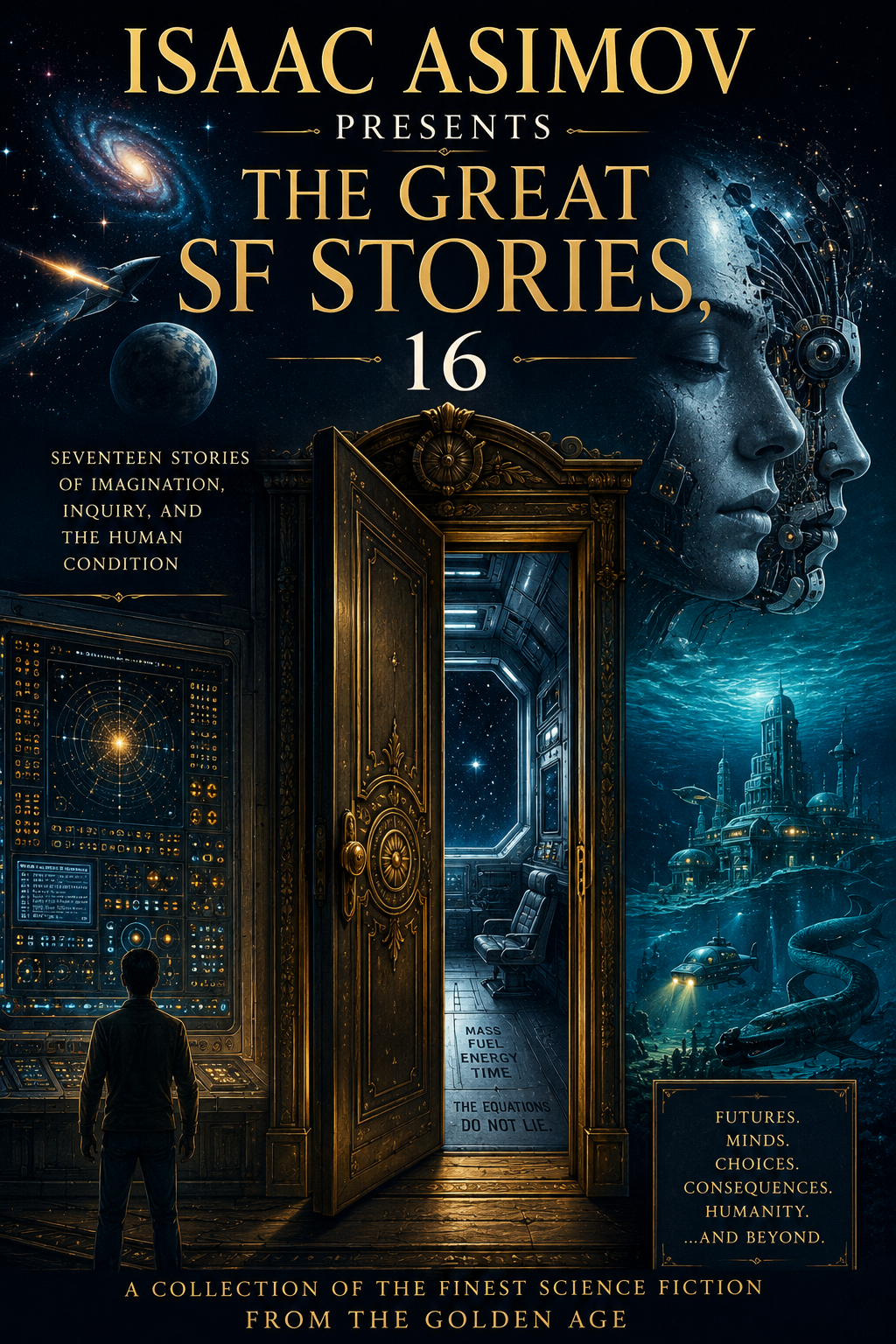
Imagine a heavy, ornate door labeled 1954. This year marks a pivotal moment in the evolution of the human imagination. If a person were to turn the handle, as Isaac Asimov and Martin H. Greenberg invited readers to do, a time capsule would appear, meticulously assembled to showcase the maturation of science fiction. During this era, the genre began to shed an outer layer of simple rockets and ray guns, revealing a core concerned with psychology, ethics, society, and the definition of humanity itself. This anthology serves as a bridge between the wonder of the Golden Age and the deep philosophical inquiries of the future.
The journey begins with The Test by Richard Matheson. An ordinary elderly man prepares for what appears to be a routine government examination. Tension replaces familiarity as every question becomes a matter of survival. The examination is a judgment of a person's right to continue existing in an overcrowded society. Matheson transforms a simple interview into psychological suspense, forcing a consideration of whether knowledge or age should determine human worth. The terror comes from bureaucracy, making the story disturbingly believable.
The next doorway opens into Anachron by Damon Knight. Time travel refuses to obey logic as experiments with chronology create paradoxes that challenge both scientists and readers. Knight treats it as a dangerous manipulation of reality where every alteration ripples through existence. In Black Charlie, Gordon R. Dickson explores prejudice through an unexpected scientific lens. The arrival of an unusual being exposes irrational fears and assumptions hidden beneath civilized behavior. Dickson uses science fiction to hold a mirror before humanity, revealing that ignorance often proves more alien than any visitor from another world.
William Tenn's Down Among the Dead Men shifts from social commentary to dark satire. Humanity discovers the possibility of immortality, but eternal life arrives with ironic consequences. Tenn delights in exposing the absurdity of human ambition, suggesting that people rarely consider the practical implications of achieving greatest dreams. Randall Garrett's The Hunting Lodge combines mystery and speculative science. A seemingly ordinary retreat becomes the setting for intellectual combat where every clue points toward impossible conclusions. Garrett layers deduction upon deduction until the solution reveals that the future can hide inside the familiar.
The Lysenko Maze by Donald A. Wollheim enters territory where politics attempts to rewrite science. The story imagines biological research distorted by ideology, creating a labyrinth in which truth becomes secondary to power. Scientists struggle against governments that demand comforting lies instead of uncomfortable facts. One of the anthology's masterpieces is Alfred Bester's Fondly Fahrenheit. The relationship between a wealthy owner and his android servant gradually dissolves into shared madness until identity itself becomes uncertain. Artificial intelligence, murder, guilt, and responsibility merge into an unforgettable meditation on consciousness.
Tom Godwin's The Cold Equations remains among the most influential stories in science fiction. A young stowaway is discovered aboard a spacecraft carrying precisely calculated fuel reserves. Every possible solution fails because the laws of physics refuse to compromise with emotion. The tragedy unfolds not because of cruelty but because physical laws remain indifferent to hope. Godwin demonstrates that nature possesses only absolute consistency, making the inevitable conclusion devastating.
Mildred Clingerman offers warmth in Letters from Laura. Through ordinary correspondence, small miracles quietly transform everyday life. Fantasy gently intersects with domestic reality, suggesting that wonder exists within kitchens and family relationships. Chad Oliver's Transformer presents exploration from an anthropology perspective rather than that of a conqueror. Alien encounters become opportunities for understanding instead of conflict. Oliver reminds readers that discovery changes both the observer and the observed.
Edgar Pangborn's The Music Master of Babylon imagines art surviving catastrophe. In a fractured future civilization, music preserves fragments of lost humanity and forgotten greatness. The search for beauty becomes an act of resistance against barbarism, illustrating that culture may endure long after technology collapses. Algis Budrys contributes The End of Summer, a melancholic meditation on endings. Change arrives through the quiet realization that every civilization, relationship, and season eventually reaches its conclusion. Budrys finds profound emotion in impermanence.
Philip K. Dick's The Father Thing transforms childhood fear into cosmic horror. A young boy becomes convinced that the being who looks exactly like his father is an alien imitation. Adults dismiss the fears, leaving the boy isolated against an invisible threat. Dick masterfully captures the uncertainty of perception, asking whether paranoia sometimes reveals truths that rationality refuses to see. Arthur C. Clarke's The Deep Range moves beneath the oceans of Earth rather than beyond the atmosphere. Humanity expands into the sea, creating new frontiers where giant creatures and advanced technology coexist. Clarke fills the narrative with optimism, presenting exploration as a natural destiny.
Anthony Boucher's Balaam blends prophecy with speculation. Ancient symbols gain unexpected scientific significance, demonstrating how mythology and future possibility often intersect. The narrative questions whether prediction shapes destiny or merely reflects eternal hopes and fears. H. L. Gold's Man of Parts examines identity through physical fragmentation. As technology permits extraordinary alterations of the human body, the protagonist struggles to determine whether personality survives endless modification. The story becomes a philosophical investigation into what truly defines an individual.
The anthology concludes with Fredric Brown's brilliantly concise Answer. Humanity builds the ultimate supercomputer and asks the oldest question imaginable. The machine's response compresses theology, cosmology, and irony into a few unforgettable lines, leaving a sense of infinite possibility. Rockets and robots in these stories serve merely as instruments for exploring conscience, morality, and imagination.
Reviewing this work as a whole, it is clear that 1954 was a year when science fiction matured into literature capable of addressing profound philosophical and social questions. The anthology balances scientific rigor with emotional depth, presenting futures that feel simultaneously distant and familiar. Even decades later, the stories continue to challenge because central concerns regarding identity, responsibility, and discovery remain timeless. It stands as a living conversation between the optimism of the Golden Age and the enduring complexities of being human.