How Did We Find Out About Superconductivity
Asimov traces the historical journey from early electricity to cryogenic physics, detailing the discovery of zero resistance and its quantum explanation through electron Cooper pairs.
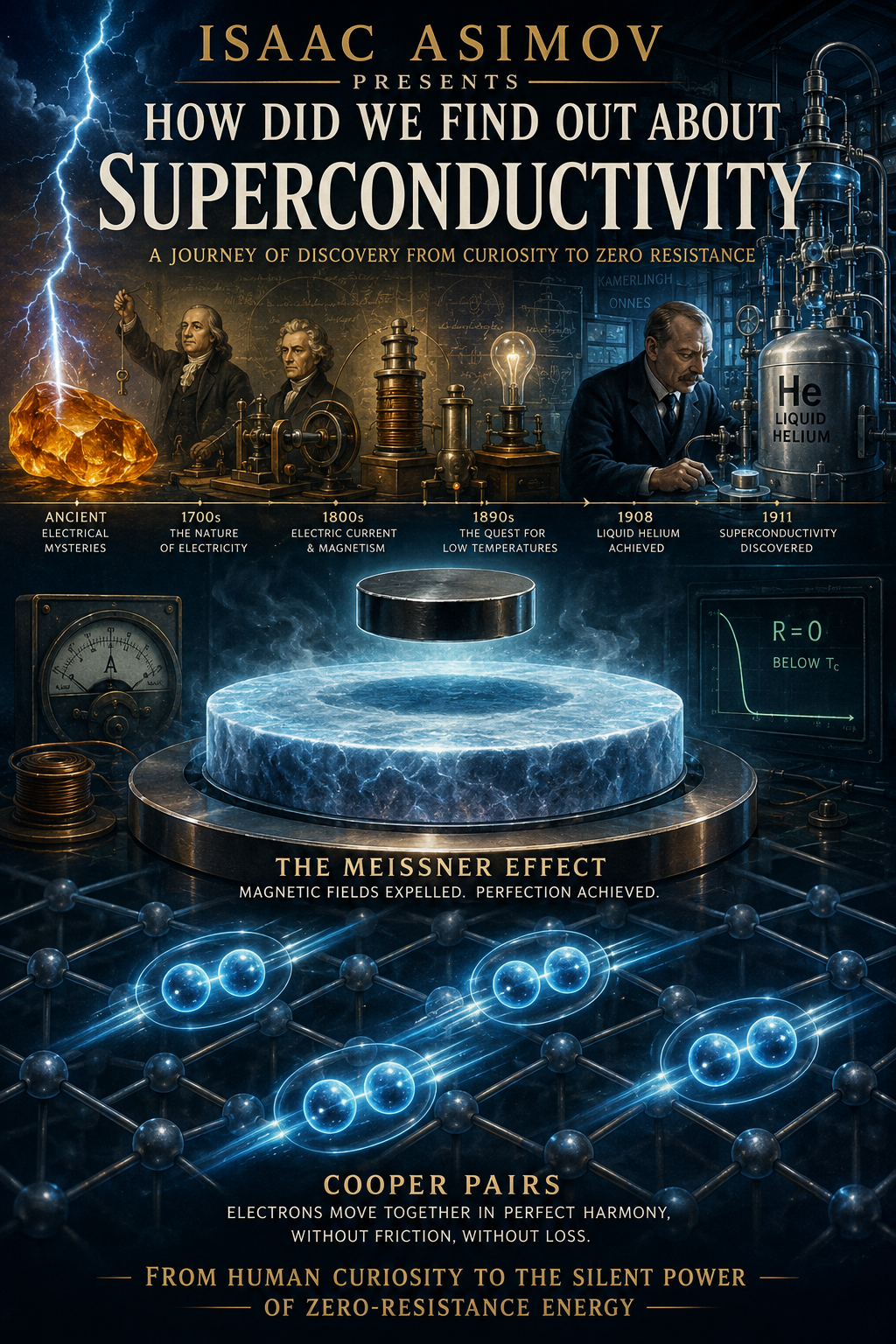
Isaac Asimov often looked at the history of as a great adventure where each person adds a piece to a giant puzzle. In his book about how we found out about superconductivity, he shows us that even the most complex modern technology has its roots in simple observations made a long time ago. He writes in a way that makes every step feel like the only logical thing to happen next. This is not just a list of facts but a story of how human beings think and solve problems.
The Mystery of Electricity Long ago, the ancient Greeks noticed that rubbing a piece of amber could make it attract light objects. For a very long time, this was just a curious trick. Later, people like William Gilbert and Benjamin Franklin started to treat these events as science. Franklin showed that lightning was the same thing as the sparks seen in a lab. This was a big moment because it proved that electricity followed rules we could understand rather than being a magical force.
Electric Current Becomes Useful The story changed when Alessandro Volta built the first battery. This gave scientists a steady flow of electricity to study instead of just quick sparks. With a steady current, people like Ampere and Faraday could see how electricity and magnetism worked together. This period turned science into something that could power the world.
Understanding Electrical Resistance As scientists worked with these currents, they noticed that some materials were better at carrying them than others. They realized that every material has some amount of electrical resistance. Asimov explains this by imagining atoms as obstacles that electrons bump into as they move. These collisions create heat and waste energy. For many years, everyone thought that resistance was just a part of nature that we could never get rid of.
The Search for Extreme Cold While some people studied electricity, others were interested in how cold things could get. They wanted to reach absolute zero, which is the point where all movement of atoms almost stops. To get there, they had to learn how to turn gases like oxygen and nitrogen into liquids. This was a very hard job that took many years of work by many different researchers.
Heike Kamerlingh Onnes and Liquid Helium A scientist named Heike Kamerlingh Onnes finally managed to turn helium into a liquid in 1908. This was a huge achievement because helium was the hardest gas to liquefy. Once he had liquid helium, he could cool materials down to temperatures that were colder than anything ever seen before. He was then able to see how materials behaved when they were very close to absolute zero.
The Discovery of Superconductivity In 1911, Onnes tested a sample of mercury at these very low temperatures. He expected the resistance to go down slowly, but instead, it completely vanished all at once. The mercury had no resistance at all, which meant electricity could flow through it forever without losing any energy. This was a complete surprise because it went against what everyone thought they knew about physics.
Exploring Superconductors After this discovery, other scientists started testing different metals. They found that many materials like lead and tin also lost their resistance if they were cold enough. Each material had its own special temperature where this change happened. Scientists realized they were looking at a new way for matter to behave, but they did not know why it was happening yet.
Magnetism and the Meissner Effect Later on, researchers found that these materials did something else strange. They would push away magnetic fields, which would make a magnet float right above them. This showed that being a superconductor was not just about having no resistance. It was a new state of matter that changed how the material interacted with the world around it.
Searching for an Explanation For nearly fifty years, the greatest minds in science tried to explain why this happened. Even the new ideas of quantum mechanics could not quite get it right at first. Asimov uses this part of the story to show that sometimes we can see a phenomenon long before we can truly understand it. Science requires patience as much as it requires smart ideas.
The BCS Theory The answer finally came in 1957 from three scientists named Bardeen, Cooper, and Schrieffer. Their BCS Theory showed that at very low temperatures, electrons stop acting like individuals and start moving in pairs. These pairs can move through the atoms of a metal without bumping into anything. This coordination is what allows the electricity to flow without any resistance at all.
Practical Uses of Superconductivity Today, we use this science in many important ways. It helps us build very strong magnets for medical machines like MRIs and for giant machines that study the building blocks of the universe. Engineers hope that one day we can use it to send power across long distances without losing any electricity along the way. The main problem is still the need for extreme cold, which is very expensive to maintain.
The Continuing Search The story is not over yet. Scientists are still looking for materials that can work as superconductors at higher temperatures. If they can find something that works at room temperature, it would change everything about how we live. It would lead to better transportation and much more efficient energy for everyone. Asimov ends by reminding us that there are always more mysteries waiting to be solved.
Overall Review This book is a perfect example of why Isaac Asimov is such a great teacher. He takes a topic that sounds very difficult and turns it into a clear and logical path. He shows us that science is a human activity filled with hard work and lucky breaks. By the time you finish the book, you feel like you have been part of the journey yourself. It is a wonderful look at how we learn about the universe one step at a time.