Isaac Asimov Presents From Harding to Hiroshima
Asimov explores the path from 1920s prosperity through the Great Depression and World War II, showing how scientific brilliance outpaced wisdom with the atomic bomb.
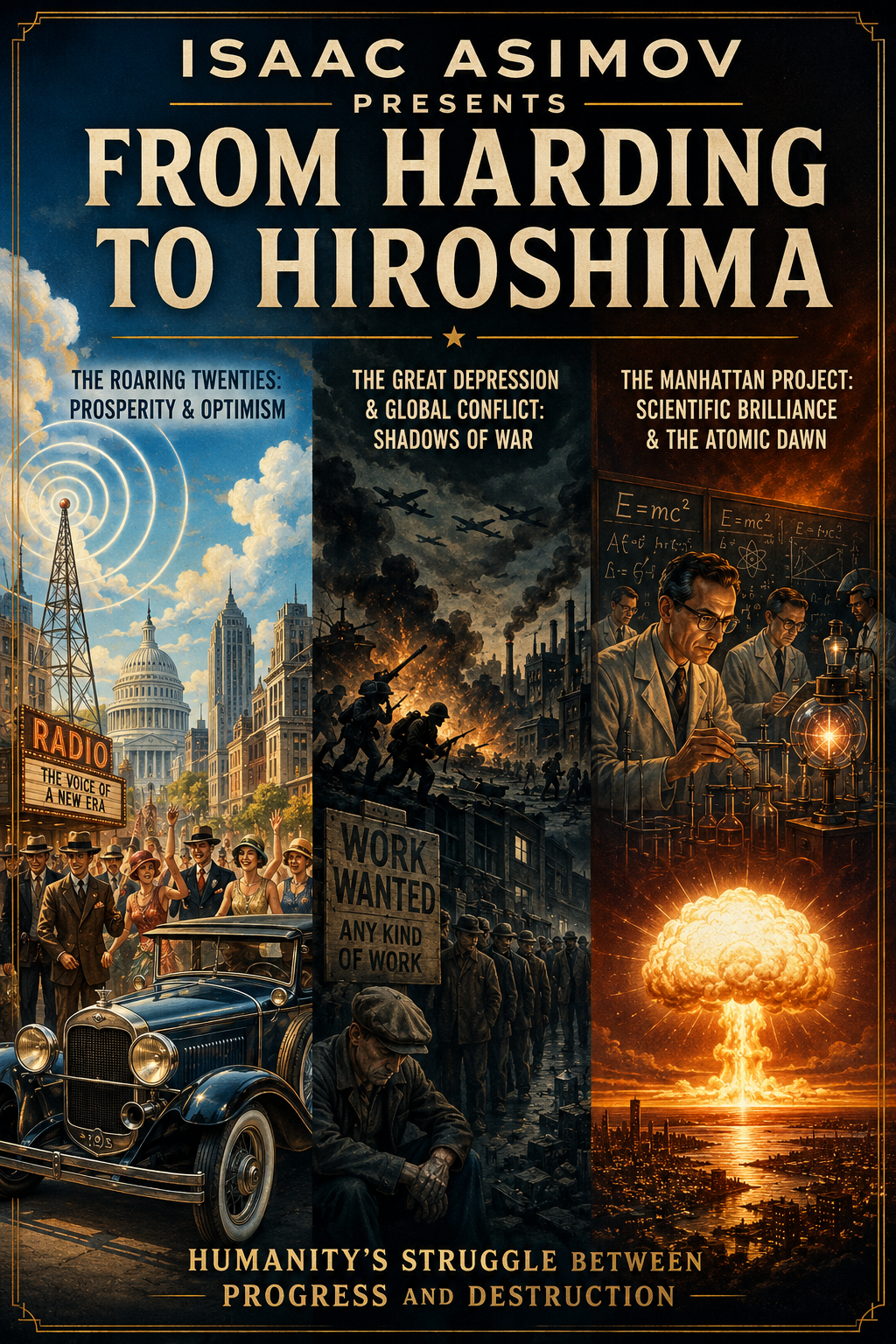
From Harding to Hiroshima is Isaac Asimov's journey through one of the most dramatic periods in modern history. Rather than presenting a dry chronology, Asimov tells the story of a world moving rapidly from the uneasy peace that followed the First World War to the terrifying dawn of the atomic age. As always, he writes with the calm confidence of a teacher and the curiosity of a scientist. His focus is not merely on presidents, generals, and diplomats, but on the forces that shaped ordinary lives technology, economics, ideology, and scientific discovery. Each chapter functions as a self-contained story while contributing to the larger narrative of humanity's struggle between progress and destruction.
Warren G. Harding: A Promise of Normalcy
The story begins with the election of Warren G. Harding in 1920. America had emerged victorious from the First World War, but its people were weary of international entanglements and social upheaval. Harding promised a return to normalcy, and his election reflected the nation's desire for peace and prosperity rather than reform. Asimov explains that Harding himself was neither a visionary nor an especially capable administrator. Instead, his presidency became famous for the contrast between America's growing economic strength and the corruption that surrounded several members of his administration. The Teapot Dome scandal emerged as one of the greatest political scandals of its era, demonstrating that even during times of prosperity, greed could flourish within government. Harding's sudden death in 1923 changed the course of American politics. Though his presidency ended abruptly, it symbolized the closing chapter of postwar adjustment and the beginning of the exuberant decade known as the Roaring Twenties.
Calvin Coolidge: Prosperity Without Intervention
Calvin Coolidge succeeded Harding with an entirely different personality. Quiet, disciplined, and deeply committed to limited government, Coolidge believed that business should be allowed to thrive with minimal interference. Asimov portrays Coolidge as a president whose restraint matched the optimism of the decade. Factories expanded, automobiles transformed daily life, electricity spread into homes, and radio connected millions of Americans. Scientific innovation and industrial efficiency produced unprecedented wealth. Yet beneath the prosperity, Asimov carefully identifies hidden weaknesses. Farmers struggled while cities flourished. Wealth became concentrated among relatively few people. Easy credit encouraged reckless speculation. These cracks remained invisible to many contemporaries but would eventually widen into catastrophe.
Herbert Hoover and the Great Depression
Herbert Hoover entered office in 1929 with an impressive reputation as an engineer, humanitarian, and organizer. Few presidents seemed better prepared for leadership. Unfortunately, only months after his inauguration, the stock market collapsed. Asimov describes the Great Depression not as a single event but as a chain reaction. Banks failed, businesses closed, unemployment soared, and confidence evaporated. Hoover believed voluntary cooperation and limited federal intervention would eventually restore prosperity, but the scale of the disaster overwhelmed these measures. The author emphasizes that Hoover's reputation suffered not because of personal dishonesty or laziness, but because the crisis demanded solutions beyond the political philosophy of the time. The Depression became both an economic catastrophe and a psychological one, changing Americans' expectations of government forever.
Franklin D. Roosevelt and the New Deal
Franklin Delano Roosevelt enters the narrative as one of history's transformative leaders. Despite living with paralysis caused by polio, Roosevelt projected optimism that inspired millions during the darkest years of the Depression. Asimov examines the New Deal as a vast experiment rather than a perfectly designed program. Through banking reforms, public works projects, Social Security, labor protections, agricultural assistance, and financial regulation, Roosevelt attempted to restore confidence while reshaping the relationship between citizens and government. The author does not present Roosevelt as flawless. Critics argued that some programs were inefficient or unconstitutional, while others believed he had not gone far enough. Yet Asimov concludes that Roosevelt succeeded in restoring hope and preserving democratic institutions during a period when many nations turned toward dictatorship.
The Rise of Dictators
While America struggled with economic collapse, Europe witnessed the emergence of aggressive authoritarian governments. Asimov introduces Benito Mussolini in Italy, who demonstrated how fascism could replace democratic institutions through promises of national revival. Even more dangerous was Adolf Hitler, whose rise in Germany combined economic desperation, nationalism, racism, and relentless propaganda. The narrative also examines Joseph Stalin's Soviet Union. Although Stalin opposed Hitler ideologically, his regime relied on terror, forced collectivization, political purges, and centralized control. Asimov avoids simplistic comparisons, instead explaining how different political systems could each produce immense human suffering when power became concentrated. Japan followed its own path toward militarism. Military leaders gained increasing influence, believing territorial expansion was essential for national survival and prestige. Together, these developments prepared the world for another global conflict.
The Road to World War II
The next story follows the gradual collapse of international peace. The League of Nations proved unable to restrain aggression. Japan occupied Manchuria. Italy invaded Ethiopia. Germany remilitarized the Rhineland, annexed Austria, and demanded portions of Czechoslovakia. Asimov explains how the policy of appeasement emerged not from cowardice alone but from the painful memory of the First World War. Britain and France desperately hoped that limited concessions might preserve peace. Instead, each concession strengthened Hitler's confidence. The invasion of Poland in September 1939 finally forced Britain and France to declare war, beginning the Second World War in Europe.
The Global Conflict
World War II rapidly expanded beyond Europe into a truly global struggle. Germany conquered much of Western Europe with astonishing speed using Blitzkrieg tactics. Britain survived through determination during the Battle of Britain, preventing German invasion despite relentless aerial bombardment. Asimov highlights technological advances such as radar, demonstrating once again his fascination with the relationship between science and history. The Soviet Union initially signed a nonaggression pact with Germany but became one of Hitler's principal enemies after Operation Barbarossa in 1941. The Eastern Front evolved into the largest and bloodiest theater of the war, consuming millions of lives.
Pearl Harbor and America's Entry
Japan's surprise attack on Pearl Harbor transformed America's role overnight. Public opinion shifted instantly from isolation to total commitment. Asimov carefully explains Japan's strategic reasoning. Faced with economic sanctions and limited access to vital resources, Japanese leaders hoped that crippling the American Pacific Fleet would secure freedom of action across Asia. Instead, the attack united the United States and guaranteed a prolonged industrial and military response far beyond Japan's expectations. America's enormous manufacturing capacity became one of the decisive factors of the war. Factories that once produced automobiles now built tanks, aircraft, ships, and weapons at unprecedented speed.
Science at War
Throughout the book, Asimov repeatedly returns to scientific progress. Radar, sonar, improved medicine, code-breaking, aviation, rockets, and industrial engineering all became essential weapons. Particular attention is devoted to the Manhattan Project. Scientists from multiple nations collaborated in extraordinary secrecy to unlock the energy hidden within the atom. Asimov describes nuclear physics with remarkable clarity, showing how discoveries intended to expand human knowledge became instruments of war. The ethical dilemma grows steadily throughout this section. Scientific achievement had reached astonishing heights, yet its greatest accomplishment threatened civilization itself.
Victory in Europe
The Allied invasion of Normandy opened the Western Front in 1944. Germany found itself trapped between advancing Soviet armies from the east and Allied forces from the west. Asimov recounts the liberation of occupied nations and the shocking discovery of Nazi concentration camps, whose horrors revealed the full consequences of Hitler's ideology. Germany surrendered in May 1945, bringing the European war to an end but leaving much of the continent devastated.
Hiroshima and the Atomic Age
The final story brings readers to August 1945. Although Germany had fallen, Japan continued fighting despite overwhelming losses. President Harry Truman authorized the use of atomic bombs against Hiroshima and later Nagasaki. Asimov presents the decision with characteristic balance, explaining both the military arguments supporting the bombings and the profound moral questions they created. The destruction of Hiroshima demonstrated that humanity had entered an entirely new age. A single weapon could annihilate an entire city within moments. Scientific progress had outrun humanity's political wisdom. Japan surrendered shortly afterward, ending the Second World War. Yet peace arrived under the shadow of nuclear weapons, ensuring that future conflicts would carry unimaginable risks.
Overall Review
Like the other volumes in Asimov's historical series, From Harding to Hiroshima succeeds because it transforms history into an interconnected story rather than a collection of isolated events. Economic policy leads naturally to political change. Political instability gives rise to dictatorship. Scientific discovery reshapes warfare. Individual decisions alter the fate of millions. Asimov's greatest strength lies in explaining complexity without oversimplification. He neither glorifies nor condemns historical figures without evidence, preferring to show how circumstances, personalities, and unintended consequences combined to shape events. His scientist's perspective is evident throughout the narrative, emphasizing cause and effect over mythology. The book ultimately serves as both a history of a turbulent quarter century and a meditation on the responsibilities that accompany knowledge. Humanity demonstrated extraordinary ingenuity in overcoming depression, building industrial power, and unlocking the secrets of the atom. Yet those same achievements culminated in Hiroshima, where scientific brilliance produced unprecedented destruction. Asimov leaves readers with an enduring lesson: progress is never purely technological. Unless wisdom advances alongside knowledge, civilization risks turning its greatest triumphs into its greatest tragedies.