Purr-fect Crime
Edited by Isaac Asimov, Purr-Fect Crime compiles fourteen diverse mystery and horror stories where domestic cats act as silent witnesses, clues, and symbols of guilt.
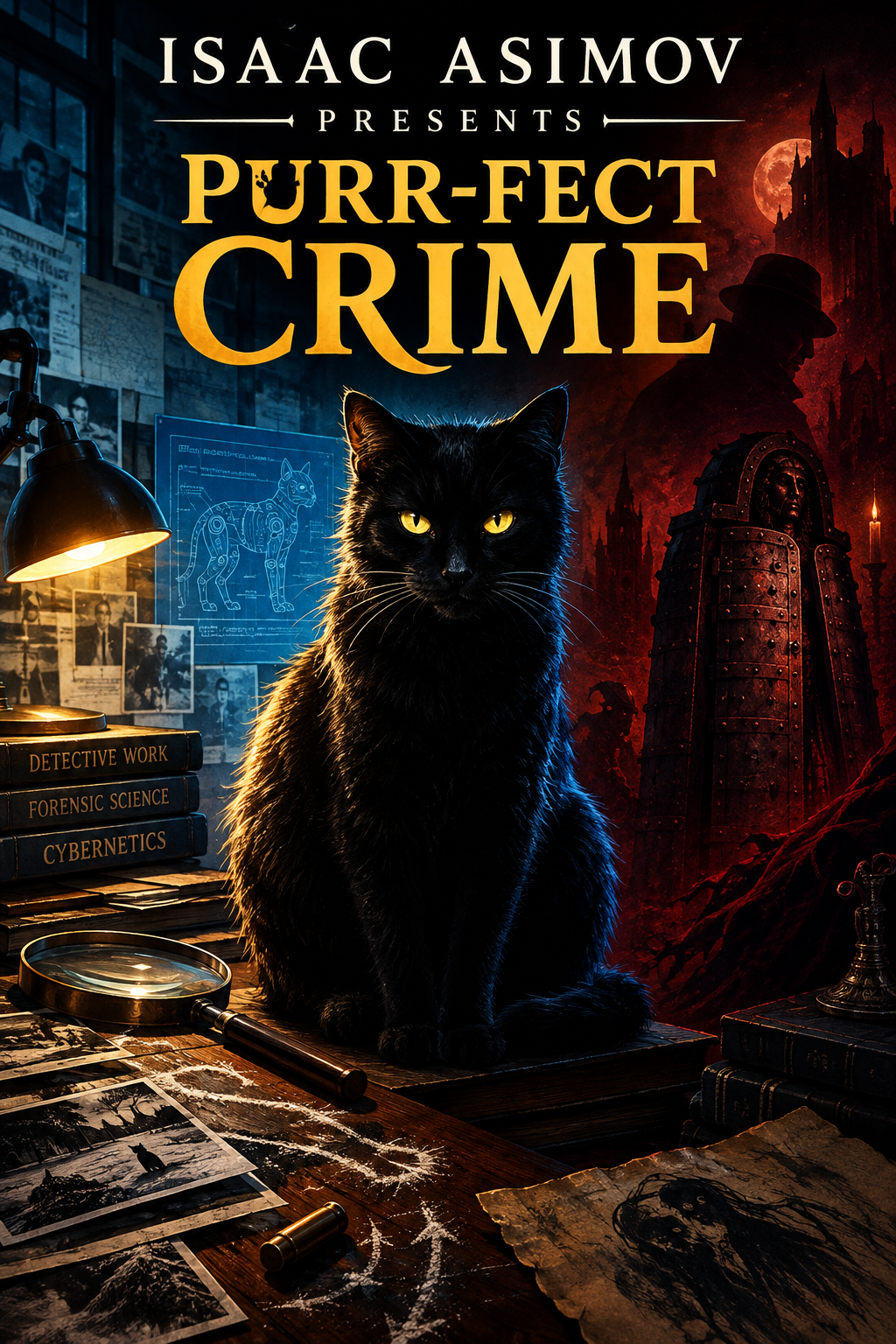
The 1989 anthology Purr Fect Crime, co edited by Isaac Asimov, Martin H. Greenberg, and Carol Lynn Rössel Waugh, gathers fourteen mystery and horror tales that place domestic cats at the center of human deception and violence. In his introduction, Asimov notes that while a dog normally belongs to a person, a cat often behaves as though the human being belongs to it, moving silently and observing without revealing what it knows. This independent nature makes the animal ideal for detective fiction, merging Asimov's characteristic rational curiosity with the darker imagination of various authors. Across the collection, the feline appears as a clue, weapon, suspect, victim, accomplice, or silent observer. The overarching story of the anthology is not merely about animal involvement, but about how much meaning human beings attach to a creature that refuses to explain itself.
The anthology opens with John D. MacDonald’s “Black Cat in the Snow,” establishing a traditional detective puzzle in an isolated Adirondack community. After a local man named Martin Wadaslaw is shot dead, his son Stanley claims he merely fired a rifle at the snow near a black cat to frighten it, causing the bullet to ricochet. Although police confirm the ricochet is physically possible, a local doctor senses hidden motives and begins examining the family's strange behavior. The narrative builds a classic "howdunit" around whether an apparent accident was actually an intentional crime. The collection then shifts into futuristic science fiction with Allen Kim Lang’s “Murder Is a Gas,” featuring a cybernetic cat named Kitten. The story explores how mechanical precision and animal unpredictability combine when artificial technology becomes tied to human violence and deception.
Ellery Queen’s “The Adventure of the Seven Black Cats” introduces a pure deductive puzzle centered on Euphemia Tarkle. Despite her known hostility toward cats, the elderly woman continuously purchases black cats from a pet shop. Ellery Queen collaborates with pet shop employee Marie Curleigh to understand why someone who dislikes animals would hoard them, following clues into a dark domestic mystery. The tone changes again in Randall Garrett’s “A Little Intelligence,” where alien visitors arrive convinced that cats are the dominant intelligent species on Earth. This misunderstanding originates from a human diplomat's lie, creating a high stakes scenario where an alien investigation into a murder turns a minor diplomatic falsehood into a matter of human survival.
Psychological suspense takes over in Betty Ren Wright’s “The Invisible Cat,” set in a small community unsettled by an unseen feline and an escaped mental patient. The narrative deliberately withholds key information, prompting readers to question whether the entity is supernatural or a product of human fear. L. T. Meade and Robert Eustace’s “The Outside Ledge” shifts to Victorian detective fiction featuring investigator Miss Florence Cusack. Rather than focusing on who committed the crime, the story concentrates on the physical mechanism and animal movements that allow Miss Cusack to reconstruct what happened.
Edward D. Hoch’s “The Theft of the Mafia Cat” features professional thief Nick Velvet, who specializes in stealing objects of little monetary value. Nick is hired for a substantial fee to steal a Mafia leader's cat, Sparkle, and return it one day later. The central riddle forces Nick to determine how to execute the theft while discovering why anyone would pay for such a short borrowing. William Brittain’s “Mr. Strang and the Cat Lady” presents a quieter, melancholy mystery investigated by an amateur detective. Examining the death of an old woman who regularly bought cat food despite having no cat, Mr. Strang uncovers a subtle detail that reveals tragic human circumstances.
Dorothy L. Sayers’s “The Cyprian Cat” moves into Gothic terror as a visitor becomes increasingly disturbed by his friend’s wife Felice and a large tabby cat that frequents his window. Fearing both the cats and Felice's strange aversion to water, the visitor buys a revolver as tension escalates toward a terrifying confrontation. The narrative leaves the reader balanced between a logical explanation and supernatural possibilities. Clark Howard’s award winning story “Animals” presents a brutal, contemporary crime narrative focused on desperation and extreme human choices. It examines the darker side of human behavior without romanticizing the animal relationship.
Wilbur Daniel Steele’s “The Yellow Cat” creates a maritime mystery aboard a troubled ship accompanied by a strange yellow feline. The animal acts as an eerie omen, but the underlying danger stems from hidden human motives among the crew. Edgar Allan Poe’s classic “The Black Cat” explores psychological collapse, alcohol fueled violence, and guilt. As the narrator's cruelty toward his cat Pluto escalates, his mental deterioration transforms the animal into a terrifying symbol of his own crimes.
Bram Stoker’s “The Squaw” delivers a tale of supernatural vengeance set in Nuremberg. After an arrogant tourist named Elias P. Hutcheson accidentally kills a kitten, the mother cat stalks him into a torture chamber containing an Iron Maiden. His reckless arrogance inside the chamber leads to a fatal encounter, making the story a fable about cruelty and retribution. Finally, Janwillem van de Wetering’s “A Great Sight” concludes the collection with philosophical detective fiction. It demonstrates that simple observation of human behavior from an outside perspective is enough to unearth secrets.
As a complete review, Purr Fect Crime succeeds because it leverages the contradictory nature of domestic cats. Cats are familiar yet mysterious, affectionate yet capable of sudden independence. Asimov's editorial presence grounds the anthology in rational curiosity while allowing room for Gothic horror and science fiction. The title reflects a central paradox: a perfect crime requires silence and an absence of testimony, both of which a cat naturally provides. Ultimately, the anthology uses animals to expose what people conceal, demonstrating that while humans try to solve the mystery, the silent cat already understands the truth.