Puzzles of the Black Widowers
Twelve mystery stories follow the Black Widowers dining club as guests present baffling intellectual riddles, which observant waiter Henry masterfully solves using clear, logical deduction.
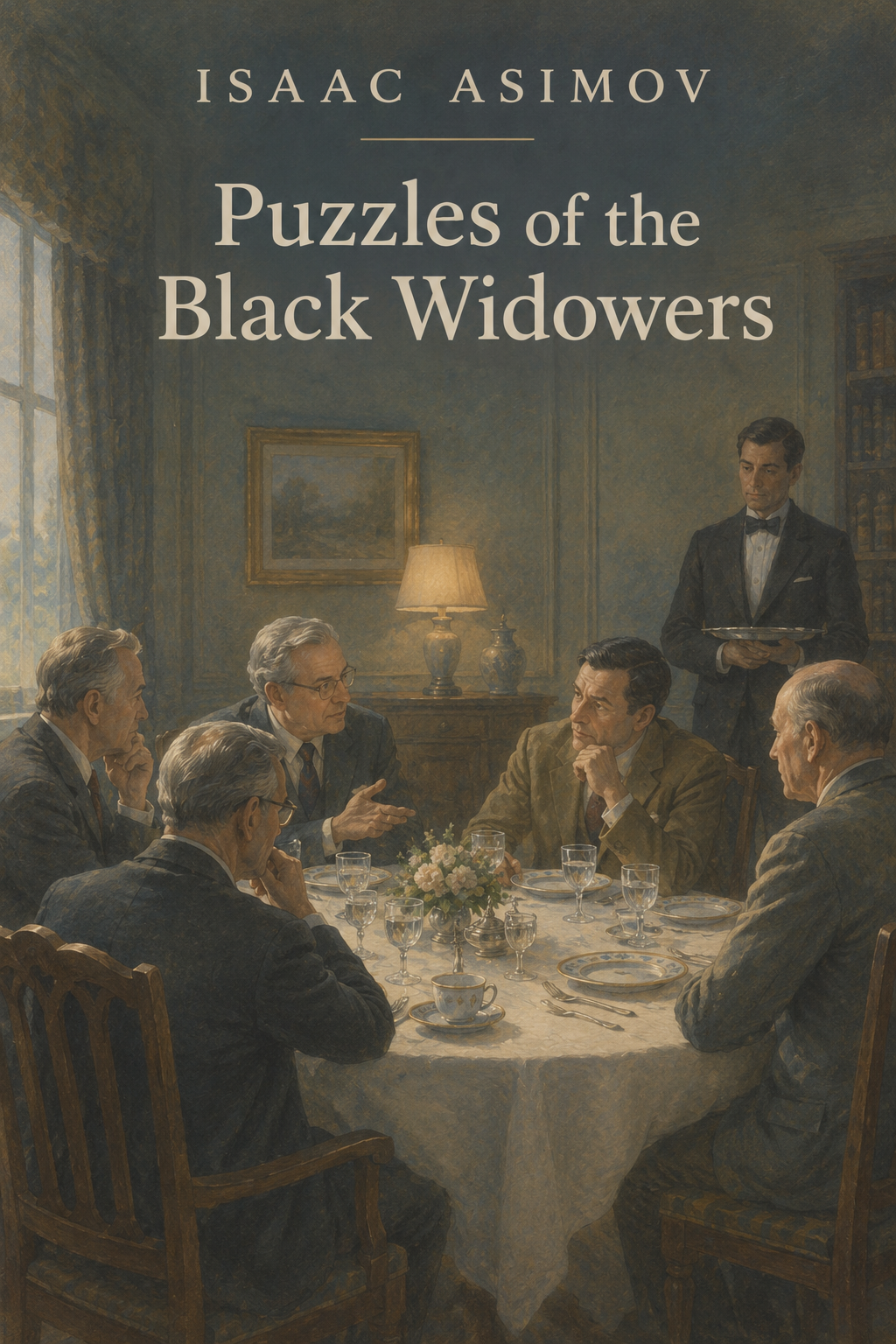
Isaac Asimov’s Puzzles of the Black Widowers, first published in 1990, serves as the fifth collection in his celebrated Black Widowers mystery series. It compiles twelve short mysteries built around a distinctive combination of dinner-table conversation, unusual facts, human behavior, and logical deduction. The collection follows a recurring pattern in which a guest presents a puzzling situation to the club, the members debate possible explanations, and Henry, the quiet waiter, notices the crucial detail everyone else has overlooked.
The narrative setting centers on the Black Widowers, a private dining club whose members enjoy intellectual discussion as much as good food. These men come from diverse professional backgrounds, and their differing personalities, backgrounds, and friendly rivalries give the gatherings much of their charm. Each meeting begins with a customary question asking how the visitor justifies his existence, inviting an explanation of the guest's work or accomplishments while introducing a distinct personal history. Sooner or later, a difficulty emerges as the visitor reveals an unexplained event, an impossible occurrence, or a situation whose details fail to fit together.
The club members approach each problem through their respective specialties, focusing on language, scientific facts, or practical experience. However, cleverness does not always lead to the truth, and Henry, who serves dinner while listening quietly, often finds the decisive clue. This framework demonstrates how human assumptions influence thought, how information can be misinterpreted, and how a single small fact can overturn an elaborate theory. Rather than relying on violence, elaborate detective work, or dramatic chases, Asimov invites readers to participate directly in the investigation, showing that the solution was hidden in the available information all along.
The opening mystery, “The Fourth Homonym,” establishes the collection’s focus on the peculiar relationship between words and reality. In this tale, linguistic coincidences and homonyms create misunderstandings that conceal essential distinctions. The story demonstrates how a witness can use a word in one sense while listeners assume another, creating an intellectual trap where a statement remains perfectly accurate yet entirely misunderstood.
The second story, “Unique Is Where You Find It,” explores the concept of uniqueness and how people mistake unusual circumstances for extraordinary phenomena. The members examine an object or event by asking what specific features set it apart from everything around it. Asimov illustrates that uniqueness is relative to available evidence, leading the investigation toward precise classification and the unexpected consequences of simple facts.
In “The Lucky Piece,” the narrative turns to superstition and the human tendency to attribute unexpected outcomes to good luck or keepsake objects. The guest presents a situation centered on a coin or token tied to a remarkable coincidence. The Black Widowers subject this belief to rational examination, separating genuine causal connections from mistaken assumptions without depending on superstition.
The mystery “Triple Devil” presents a problem involving an unusual combination of three distinct elements. The apparent complexity tempts the club members to craft an elaborate explanation before fully grasping the foundational facts. The story serves as a study in intellectual misdirection, proving that misinterpreting how three components interact can obscure a simple truth until precise analysis brings clarity.
In “Sunset on the Water,” Asimov uses an everyday landscape to explore the limitations of human perception. The puzzle examines how light, reflections, distance, and an observer’s position can distort what a witness believes they saw. Rather than questioning only what was reported, the investigation focuses on how the witness perceived the event, showing how ordinary settings harbor uncertainty.
The narrative “Where Is He?” frames the search for a missing person as a purely logical exercise. The central difficulty lies in separating established facts from unexamined assumptions regarding a person's presence or absence. By testing competing theories against timing and descriptive accuracy, the story highlights the necessity of framing questions correctly.
In “The Old Purse,” an everyday personal object becomes the focal point of a mystery. The age, condition, contents, and ownership of a purse challenge an account that initially appears convincing. Asimov shows how physical items carry traces of past events that reveal more than long verbal explanations when examined with care.
The tale “The Quiet Place” transforms a serene, silent setting into an intellectual challenge. The mystery centers on interpreting the absence of activity or witnesses, showing that silence does not prove nothing occurred. The members debate what can legitimately be inferred from missing details, proving that the crucial clue is often what seems to be absent.
In “The Four-Leaf Clover,” the symbol of a rare plant variation opens an inquiry into probability and belief. The story examines how people assign deep meaning to rare events or coincidences. The Black Widowers evaluate whether an unusual occurrence stems from a hidden cause or simple chance, testing whether a detail's apparent importance survives scrutiny.
The mystery “The Envelope” focuses on written communication and the physical details of a simple paper container. Information can be delayed, concealed, or misunderstood, while the condition and handling sequence of the envelope provide crucial evidence. Asimov demonstrates how close attention to an everyday object can overturn flawed theories.
In “The Alibi,” the club investigates a guest’s account of someone’s whereabouts during a critical timeframe. The debate scrutinizes clocks, travel time, and witnesses, separating verified truths from mistaken assumptions. The narrative reveals that a truthful statement can still be incomplete, and an apparently impossible sequence becomes logical once false assumptions are removed.
The final mystery, “The Recipe,” turns to domestic cooking instructions that depend on precise steps, ingredients, and quantities. Ambiguities in written instructions and practical culinary knowledge form the core of the puzzle. As with the rest of the book, the solution emerges from a closer look at information that was available from the beginning.
In reviewing Puzzles of the Black Widowers as a unified work, its primary strength lies in its intellectual structure and conversational format. The recurring presence of Henry, the quiet waiter who sees through confusion while serving dinner, provides a compelling contrast to the elaborate theories of the educated club members. His role underscores Asimov’s belief that formal authority and eloquence do not guarantee sound reasoning. The collection continuously emphasizes the vital distinction between holding information and truly understanding its significance.
However, the book is not without limitations. The repeated dinner-table formula can feel predictable over twelve stories, and certain solutions rely on obscure or specialized facts that a reader might not anticipate. A contemporary review in Publishers Weekly similarly noted this repetitive structure and reliance on specialized facts, even while acknowledging them as essential parts of the series' identity. Despite these minor flaws, the collection remains an enduring celebration of careful listening, showing that the world becomes clear when approached with patient observation.