How Did We Find Out About Photosynthesis
Isaac Asimov details how centuries of scientific discoveries revealed that plants use sunlight, water, and carbon dioxide to produce oxygen and sustain Earth's living organisms.
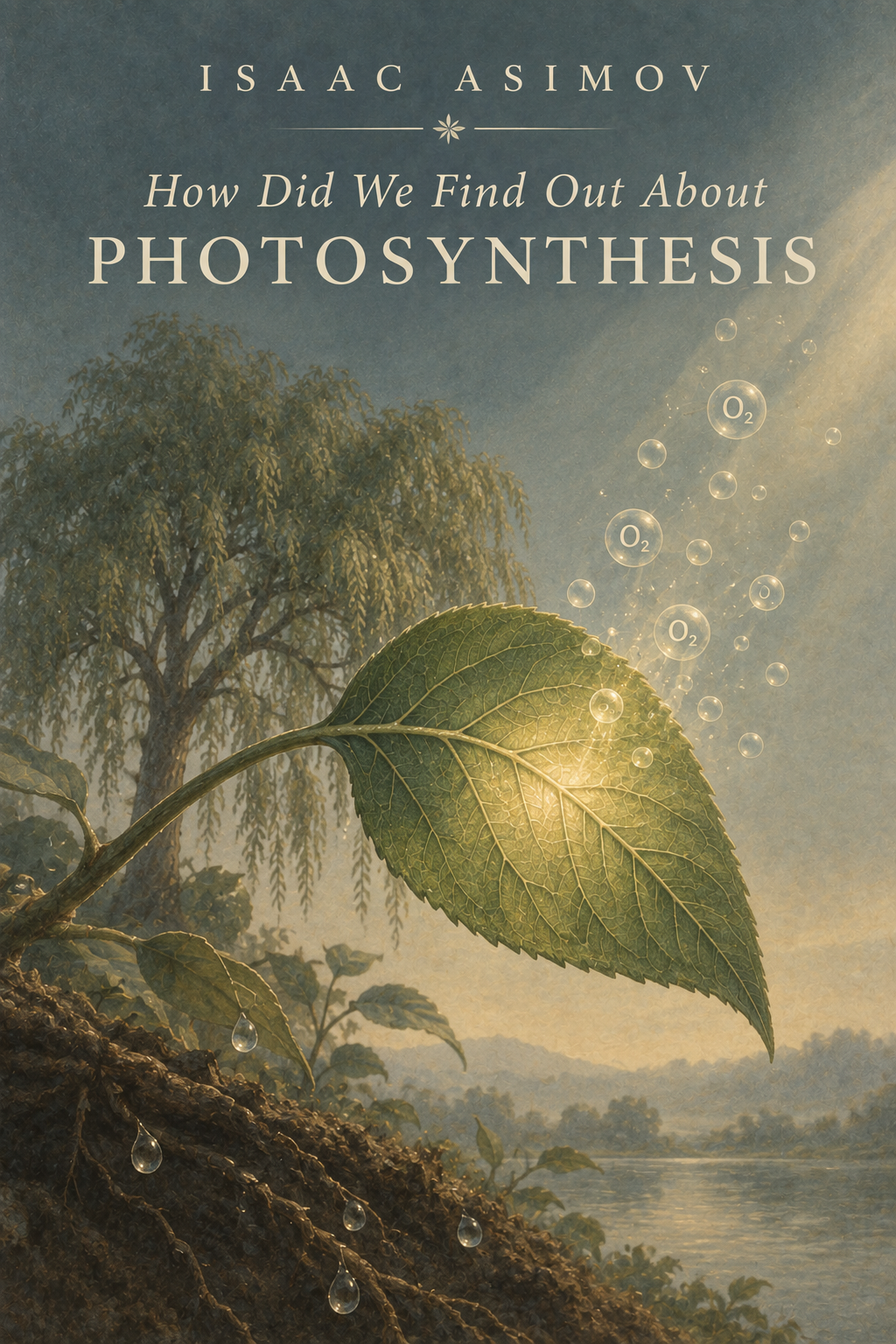
Isaac Asimov possessed a singular talent for converting complex scientific principles into lucid, engaging human narratives. Throughout his extensive body of work, whether weaving galactic history or tracing the history of human thought, Asimov approached science not as a static ledger of textbook facts, but as an unfolding detective story driven by curiosity, patience, and logic. In his book How Did We Find Out About Photosynthesis?, he applies this signature approach to one of the most fundamental biological processes on Earth. Rather than presenting photosynthesis as a finished chemical equation, Asimov constructs a historical mystery that begins with two seemingly mundane questions: why does the Earth never run out of breathable oxygen despite endless burning and respiration, and where do plants obtain their massive physical substance? The narrative builds from these basic observations of everyday life, step by step, leading the reader across centuries of scientific inquiry toward a profound realization about planetary history and our ecological place within it.
The story of discovery begins in the seventeenth century with the Belgian scientist Jan Baptista van Helmont, who attempted to measure where plant mass comes from rather than merely speculating. By planting a willow tree in a weighed container of soil and watering it for five years, van Helmont observed that the tree gained massive weight while the soil lost almost none, leading him to conclude that the plant material was created entirely from water. Though his conclusion was incomplete because the chemical nature of gases was not yet understood, his quantitative method opened the door to modern experimental biology. Subsequent investigations shifted focus from the soil to the atmosphere. Stephen Hales suggested that gases contributed to plant growth, while Joseph Black isolated carbon dioxide. In 1771, Joseph Priestley made a breakthrough by demonstrating that a mouse enclosed in a sealed jar would perish and a candle would extinguish, but placing a living green plant inside the jar restored the air so that candles could burn and mice could survive. Antoine Lavoisier later clarified that air was a mixture of gases containing oxygen, revealing the fundamental mystery that while animals continually consume oxygen, green plants somehow restore it.
Having established that plants interact with atmospheric gases, the scientific investigation moved toward understanding the energy and raw materials that fuel this transformation. In 1779, Jan Ingenhousz demonstrated that plants do not restore oxygen continuously; they perform this miracle only when exposed to sunlight. This observation proved that solar energy provided the driving force to assemble complex organic substances from simple raw materials, giving rise to the term photosynthesis, which means putting substances together using light. In 1782, Jean Senebier proposed that carbon dioxide supplied the carbon for plant structures, and Nicolas-Théodore de Saussure refined van Helmont's early work by carefully measuring the water and carbon dioxide absorbed by growing plants. These findings unveiled a magnificent conceptual symmetry: while animals consume food and breathe in oxygen to release energy through respiration, plants capture solar energy to convert carbon dioxide and water into food while releasing oxygen. William Prout later categorized organic nutrients into carbohydrates, fats, and proteins, highlighting how plants manufacture massive quantities of carbohydrates like starch and glucose to sustain living organisms.
The inquiry next turned to a visual clue that separates plants from animals: their green color. Scientists realized that not all green objects could produce food, suspecting that a specific internal substance was required. In 1817, Pierre-Joseph Pelletier and Joseph-Bienaimé Caventou isolated this primary green pigment and named it chlorophyll, meaning green leaf. However, discovering the pigment was only the beginning of a complex chemical puzzle. Richard Willstätter later separated chlorophyll into two distinct forms, chlorophyll-a and chlorophyll-b, discovering that its intricate molecular architecture contained a central atom of magnesium alongside carbon, hydrogen, oxygen, and nitrogen. Hans Fischer subsequently demonstrated striking structural similarities between chlorophyll and heme, the red iron-bearing pigment in human blood, while Robert Burns Woodward eventually confirmed the exact molecular arrangement through laboratory synthesis.
Asimov then guides the reader inside the microscopic realm of the plant cell to show that isolated chlorophyll alone cannot perform photosynthesis. The process requires an organized biological framework. Within plant cells lie specialized structures called organelles, including mitochondria associated with energy-releasing respiration and chloroplasts dedicated to energy-capturing photosynthesis. In 1883, Julian von Sachs showed that starch formation occurs exclusively within the green sections of leaves exposed to light, and later researchers identified the chloroplast as the specific cellular factory where photosynthesis takes place. Daniel Arnon eventually succeeded in isolating intact chloroplasts that could carry out photosynthetic activity outside the cell under suitable laboratory conditions, shifting the core scientific question from identifying what photosynthesis is to uncovering how its chemical steps occur.
To explain these chemical steps, Asimov introduces a logical principle of biochemistry: living cells cannot withstand a massive, sudden release or absorption of energy. Instead of rearranging atoms in one giant chemical leap, biological systems operate through a chain of controlled intermediate reactions. Arthur Harden's studies on fermentation revealed how intermediate compounds and phosphate groups allow cells to transfer energy gradually. This led to the discovery of adenosine triphosphate, or ATP, which acts as a manageable energy currency inside living cells. Asimov uses a clear everyday analogy to explain this concept, noting that just as a large sum of money is impractical for daily purchases unless broken down into smaller coin and bill denominations, the energy bound in food is divided into smaller ATP units that cells can easily handle. Consequently, the carbon atoms entering a plant pass through an orderly sequence of intermediate substances rather than appearing instantaneously as finished sugar.
One of the most dramatic turns in the story occurred when scientists realized that a long-held logical assumption was completely incorrect. For decades, it seemed obvious that plants split carbon dioxide molecules, retaining the carbon to build carbohydrates and releasing the oxygen into the atmosphere. However, in 1937, Robert Hill discovered that damaged chloroplasts could still release oxygen under specific experimental conditions even when they were incapable of producing carbohydrates, proving that oxygen generation could be separated from carbon fixation. The definitive proof arrived in 1941 through the work of Martin David Kamen, who utilized heavy oxygen-18 isotopes as atomic tracers. When plants were supplied with water containing oxygen-18, the released oxygen gas carried the isotopic label, proving conclusively that atmospheric oxygen originates from the splitting of water molecules rather than carbon dioxide.
Mapping the remaining pathway of carbon required equally sophisticated scientific detective work. Because carbon intermediates convert rapidly inside living cells, isolating them was extraordinarily difficult. Kamen's pioneering work with radioactive isotopes, combined with paper chromatography, provided scientists with molecular labels to track atoms through complex chemical pathways. In 1948, Melvin Calvin utilized microscopic algae, which photosynthesize rapidly, exposing them to radioactive carbon-14 for only a few seconds before halting the cellular reactions. By identifying phosphoglyceric acid as one of the earliest labeled compounds, Calvin and his team systematically mapped the cyclic network of chemical steps by which carbon dioxide is transformed into sugars, a monumental achievement that earned Calvin the 1961 Nobel Prize in Chemistry.
After tracing the discovery from macroscopic trees to microscopic atoms, Asimov expands the narrative backward into deep time, asking how photosynthesis originally began. Reasoning from planetary science and chemistry, Asimov compares Earth to Mars and Mercury, whose atmospheres contain carbon dioxide and nitrogen but virtually no free oxygen. Four billion years ago, the young Earth similarly lacked an oxygen-rich atmosphere until primitive aquatic organisms evolved the ability to capture solar energy and split water molecules. Over billions of years, the steady release of oxygen from early photosynthetic organisms transformed the global atmosphere, making aerobic respiration possible and enabling the evolution of complex animal life. Thus, the oxygen surrounding us today is not an inanimate geological feature, but the cumulative product of ancient biological activity.
In reviewing How Did We Find Out About Photosynthesis?, the true brilliance of Asimov's writing lies in his choice of narrative perspective. Standard science textbooks typically present facts in reverse, starting with completed chemical formulas and demanding memorization. Asimov instead reconstructs the intellectual journey, placing the reader in the shoes of historical investigators who faced confusion, incomplete clues, and misleading logic. He demonstrates that scientific progress is a collaborative, multi-generational effort where wrong assumptions and partial answers gradually refine our understanding of the universe. The narrative weaves a compelling sense of ecological interconnectedness, showing how respiration and photosynthesis form a grand, balanced cycle that unites all living things. Asimov concludes not merely with intellectual satisfaction, but with a sober call to environmental stewardship, reminding us that modern civilization relies entirely on green plants for atmospheric stability and food security. Through simple words, rigorous logic, and masterly storytelling, Asimov turns an ordinary green leaf into what it truly is: one of the most extraordinary chemical factories in the cosmos, connecting every breath we take to the energy of ancient sunlight.