Space Garbage
Isaac Asimov's Space Garbage reveals how space exploration transformed Earth's orbit into a hazardous debris field, requiring scientific tracking, orbital mechanics, and international environmental responsibility.
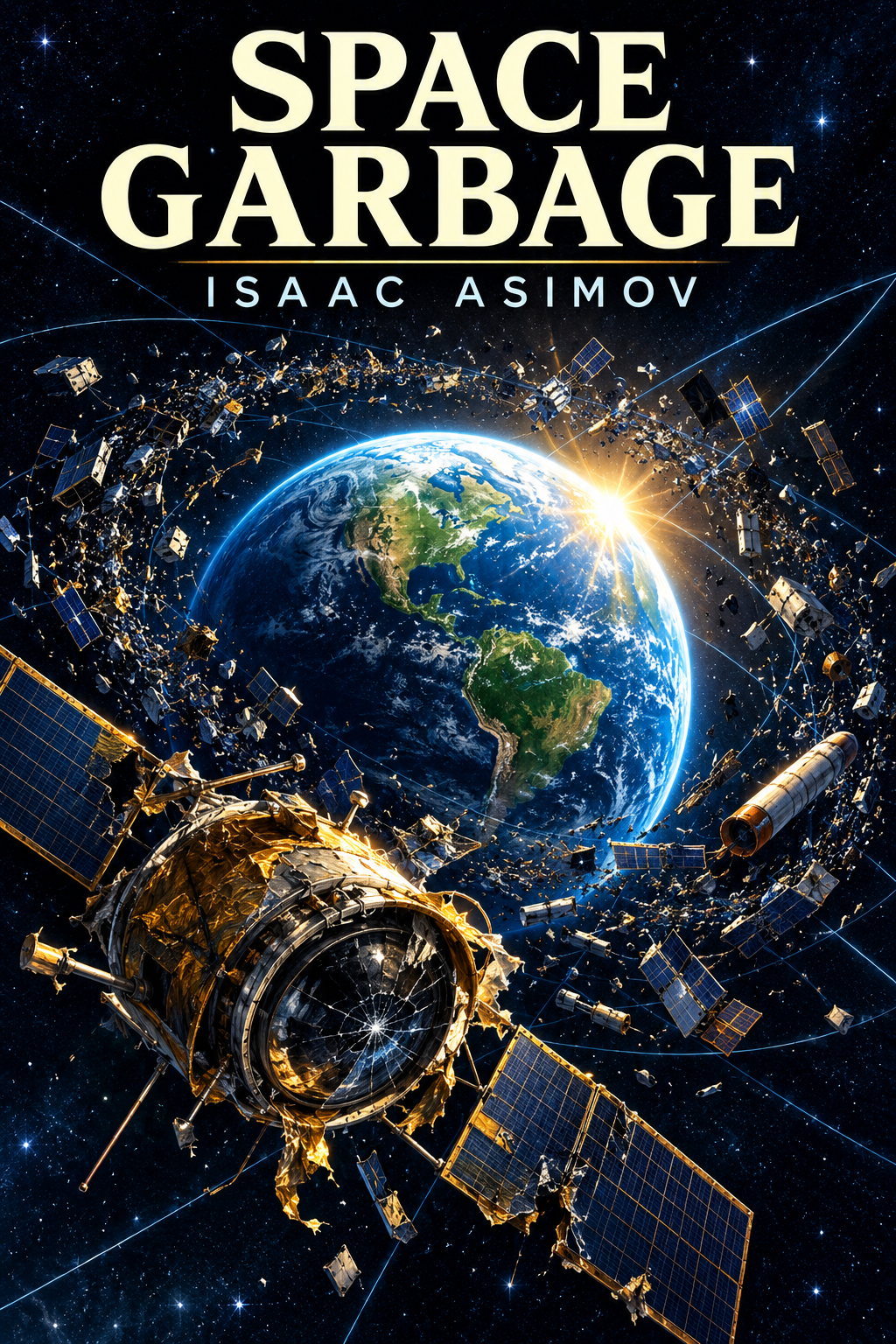
Human beings have always produced waste on Earth, but as soon as space exploration began, humanity carried that same habit beyond the atmosphere. In doing so, rockets, satellites, spacecraft, equipment, fragments, and tiny particles were left behind in orbit. The central irony of entering space believing it was an empty, pristine wilderness only to turn it into a cosmic junkyard forms the starting point of Isaac Asimov’s Space Garbage. Written for younger readers as part of his Library of the Universe series, the book confronts a serious scientific question regarding artificial objects in space that no longer serve a useful purpose. Asimov builds his narrative from the birth of the Space Age, illustrating how the initial triumphs of human ingenuity contained the seeds of an unexpected problem. Early satellites were celebrated as symbols of scientific achievement that transmitted information, observed weather, studied the atmosphere, supported communication, and proved that machines could operate beyond Earth. Yet every successful launch required discarded rocket stages and equipment, transforming former symbols of progress into orbiting debris.
Asimov structures the book around a core paradox: space garbage is not created out of a deliberate desire to pollute, but as an unavoidable byproduct of exploration. Abandoned spacecraft, failed satellites, and discarded rocket components continue circling Earth while smaller pieces break away and multiply. In everyday life on Earth, a small metal fragment sitting on the ground is completely harmless, but in orbit, the rules of physics change dramatically. Because orbital motion grants objects immense velocity, impact energy increases enormously, turning a fragment only a few centimeters across into a dangerous projectile. A tiny piece of debris can consequently puncture equipment, damage functional spacecraft, or endanger the lives of astronauts. This reality shifts space debris from a simple untidy curiosity into a complex three dimensional traffic and engineering problem. Rather than being a motionless storage room, space near Earth is a crowded domain where operational spacecraft must share paths with discarded objects traveling at high speeds.
Although Space Garbage contains no fictional mini stories, Asimov structures the book into two main sections that function like distinct stages in a scientific detective story. The first stage, titled "Tracking the Trash", focuses on the immediate challenge of locating debris that is too small or faint to be seen directly. To solve this problem, scientists rely on ground based radar and telescopes to observe larger pieces of orbital debris and calculate their trajectories. Asimov uses orbital mechanics to explain how gravity and velocity govern an object's path, allowing scientists to calculate where debris will be in the future and determine if avoidance maneuvers are necessary. This section highlights one of Asimov’s favorite scientific themes: prediction is one of the great powers of science because it allows humanity to observe, measure, calculate, and act. However, the problem remains massive as collisions and breakups produce thousands of smaller fragments, creating the frightening possibility of a chain reaction where accumulating debris causes endless further collisions.
The second stage of the narrative, titled "Cosmic Litter Will It Last Forever?", examines the long term fate of space waste. Asimov explains that Earth possesses a natural cleanup mechanism, as thin drag from the upper atmosphere gradually slows down low orbit debris until it descends and burns up during reentry. Nevertheless, this atmospheric cleanup is not equally effective everywhere, because objects in higher orbits can remain in space for extremely long periods. Asimov introduces the striking concept that high altitude space garbage can outlast the human civilization that created it, leaving behind an archaeological record of technology for future beings to discover. He also distinguishes human made artificial debris from natural cosmic material like meteoroids, emphasizing that while nature has always supplied space with rocks and dust, human activity has added a brand new environmental concern. Because satellites from different countries share overlapping orbital regions, collisions threaten spacecraft belonging to all nations, making space debris an issue that demands international awareness and responsibility.
Through simple language and clear, logical presentation, Asimov transforms a potential catalogue of rockets and fragments into a thought provoking review of human civilization. The lasting strength of the story rests on its clarity, showing that in space there is no ordinary place called "away" where waste simply disappears without consequence. The narrative builds logically from humanity's first steps into orbit, moves through the realization of orbital hazards, and leads toward a broader lesson in environmental maturity. Asimov delivers a quietly environmental message by demonstrating that useful orbits are finite and that space pollution accumulates much like pollution on Earth. Ultimately, the title's "garbage" refers to more than metal fragments, serving as a reminder that every technological advancement brings responsibilities alongside opportunities. The story closes by asking whether humanity's expansion into the universe will carry old habits forward, or whether exploration will teach us to protect the orbital environment before moving farther into space.