Norby and the Oldest Dragon
Cadet Jeff Wells and his robot Norby visit planet Jamyn, teaming with an ancient dragon to peacefully resolve a mysterious sentient vapour threatening the world.
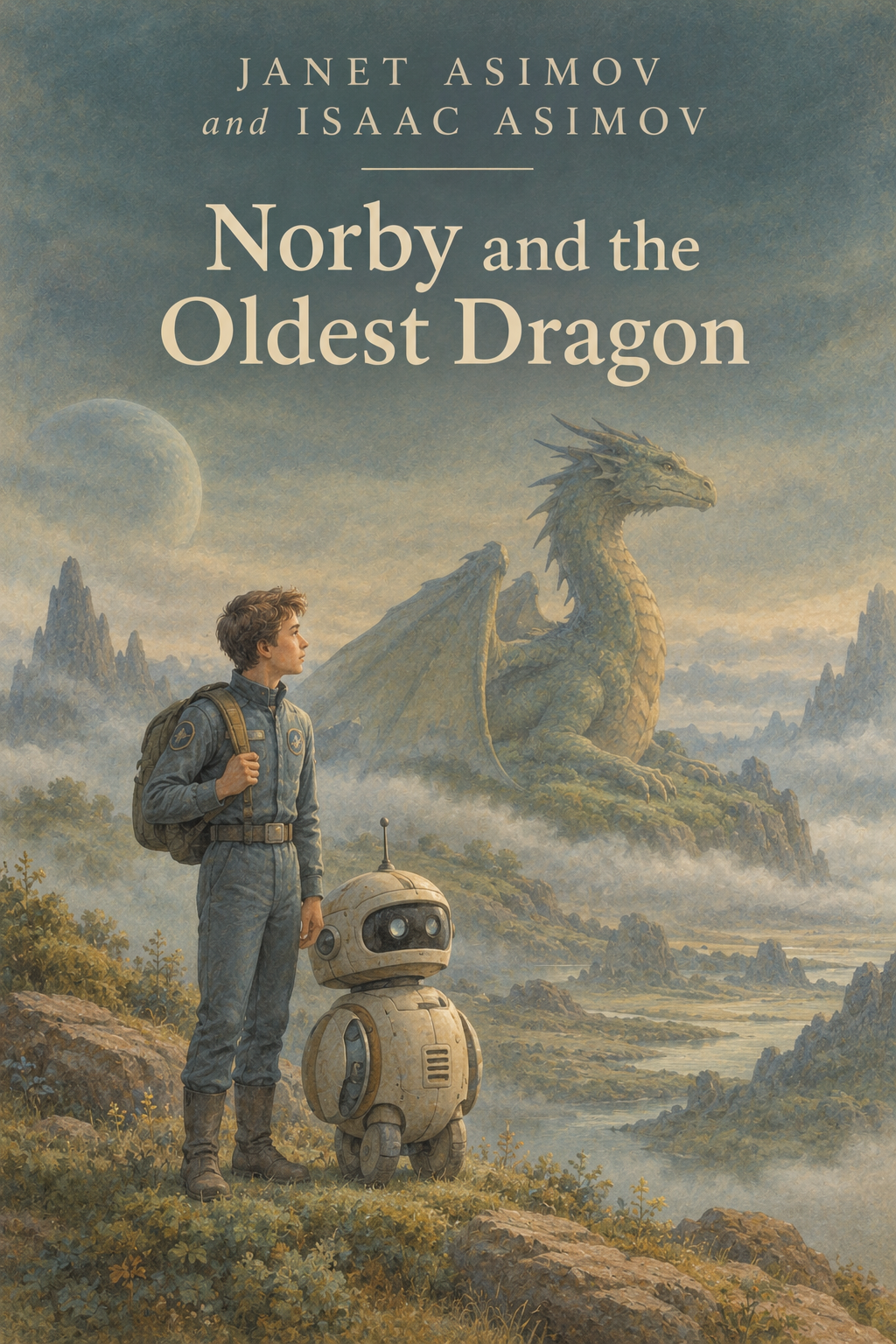
Norby and the Oldest Dragon, published in 1990, stands as the ninth entry in the Norby Chronicles created by Janet and Isaac Asimov. The story begins not with a grand galactic crusade, but with a relatable human dilemma centered on young Space Academy cadet Jeff Wells. Jeff is a dedicated cadet who values his routine, his training, and his growing independence at the Academy. When he receives an invitation to travel to the distant planet Jamyn for the Grand Dragon's birthday celebrations, his initial reaction is reluctance rather than excitement. He views the upcoming journey as an unwanted social obligation that threatens to disrupt his carefully managed plans. Accompanying Jeff is his extraordinary personal robot, Norby, whose relationship with Jeff is a lively mix of loyalty, friendship, and constant exasperation. Norby is no ordinary mechanical servant; he possesses peculiar abilities and an unpredictable personality that make him both an invaluable asset and a source of perpetual surprise. This opening dynamic grounds the narrative in classic Asimovian science fiction, where futuristic technology and space travel intersect with human relationships, everyday responsibilities, and robotic companionship.
As the narrative unfolds, what begins as a routine trip quickly develops into a story about expanding horizons and encountering non-human societies. The planet Jamyn is home to an intelligent, socially organized dragon civilization governed by elaborate customs, formal traditions, and complex relationships. The Grand Dragon's birthday is a major event that gathers dragon society alongside human guests, creating a colorful backdrop of ceremony. However, Jeff soon discovers that his visit involves more than sitting through formal proceedings. He is given an unexpected assignment: to locate the Grand Dragon's mother, known as the Dowager Dragon. This simple errand serves as the catalyst that draws Jeff out of his self-absorbed frustration and immerses him in the life of Jamyn. The Dowager Dragon introduces a crucial element to the story, representing age, deep experience, and an ancient perspective that neither the young human cadet nor the erratic robot possess.
From this quiet beginning, the story builds toward a crisis that fundamentally alters the nature of Jeff's journey. The colorful birthday celebrations are suddenly interrupted by an alarming physical threat: a mysterious, enveloping vapour surrounds Jamyn, jeopardizing the lives of everyone on the planet. What seemed like a minor social inconvenience transforms into an urgent planetary emergency. The narrative moves from social ceremony to a scientific mystery, asking the characters to determine the true nature of the hazard. Is the cloud a natural environmental disaster, an unfamiliar technological weapon, or a sentient entity capable of independent thought, communication, and decision-making? This premise sits at the intellectual heart of the book, inviting readers to reconsider the boundaries between physical phenomena and living intelligence—a recurring theme across Isaac Asimov's broader body of work.
As the vapour threatens the entire world, the story leads into an intense battle of wits rather than a battle of brute force. Jeff realizes that physical strength and standard technology are insufficient to overcome a hazard that may possess intelligence. To protect Jamyn, Jeff must observe the vapour's behavior carefully, ask logical questions, and test whether its actions can be influenced through reasoning. This challenge marks an essential step in Jeff's personal growth. As a young cadet, he learns that courage does not mean having all the answers immediately; rather, it requires the willingness to keep working when outcomes are uncertain and to discard faulty assumptions when new evidence appears. The situation becomes intensely personal when Jeff's brother, Fargo, becomes drawn into the crisis. Faced with saving both his brother and an entire alien population, Jeff must embrace a broader sense of responsibility that extends far beyond his own personal routine.
The narrative reaches its peak as Jeff, Norby, and the Dowager Dragon combine their unique strengths to confront the sentient cloud. Norby contributes his unusual, unpredictable capabilities, while the Dowager Dragon provides age-old wisdom and guidance, complementing Jeff's practical human judgment and determination. Through cooperation, logical deduction, and clear communication, the trio works to rescue Fargo and resolve the threat to Jamyn without relying on destructive force. The story leads from Jeff's initial wish to avoid an inconvenient social trip to his active participation in saving a world, illustrating that true maturity involves looking beyond personal preferences, recognizing one's limitations, accepting help, and using reason in service of others.
In reviewing Norby and the Oldest Dragon, the novel stands out as a thoughtful and engaging piece of children's science fiction that reflects the signature storytelling principles of Janet and Isaac Asimov. Written in simple, clear, and logical prose, the book introduces young readers to foundational science-fiction concepts—such as robotics, alien ecology, space travel, and artificial or non-human sentience—without overwhelming them with overly dense exposition. Its narrative escalation from a quiet personal obligation to a high-stakes planetary rescue gives the story a satisfying and well-paced structure. By making the central threat a sentient vapour rather than a standard villain, the authors transform a potentially conventional disaster narrative into an intellectual puzzle centered on communication, observation, and understanding.
A major strength of the novel lies in its emphasis on partnership and mutual respect across differing perspectives. Jeff cannot resolve the crisis through individual willpower alone, Norby's advanced robotic abilities cannot replace human judgment, and the Dowager Dragon's ancient experience provides the necessary depth to handle an unprecedented challenge. The humorous dynamic between Jeff and Norby—marked by Jeff's frequent impatience and Norby's quirky independence—keeps the narrative lively and entertaining. Furthermore, the book reinforces a core principle found throughout Asimov's fiction: technology, no matter how sophisticated, is most valuable when guided by human intelligence, ethical responsibility, and empathy.
Ultimately, Norby and the Oldest Dragon succeeds both as an adventurous tale and as a clear, accessible exploration of personal growth. Rather than being a collection of mini-stories, it is a single, unified novel serving as the ninth installment in the Norby series, delivering a cohesive narrative arc from start to finish. It teaches younger readers that maturity is achieved when individuals stop asking what would be most convenient for themselves and start asking what a situation requires of them. Through its blend of whimsical dragon culture, futuristic robotics, and logical problem-solving, the novel delivers a compelling story that honors the enduring legacy of Asimovian science fiction.