The Relativity of Wrong
Asimov’s essays argue that science progresses by refining useful approximations through intellectual honesty, allowing humanity to become steadily less wrong as our scientific knowledge accumulates.
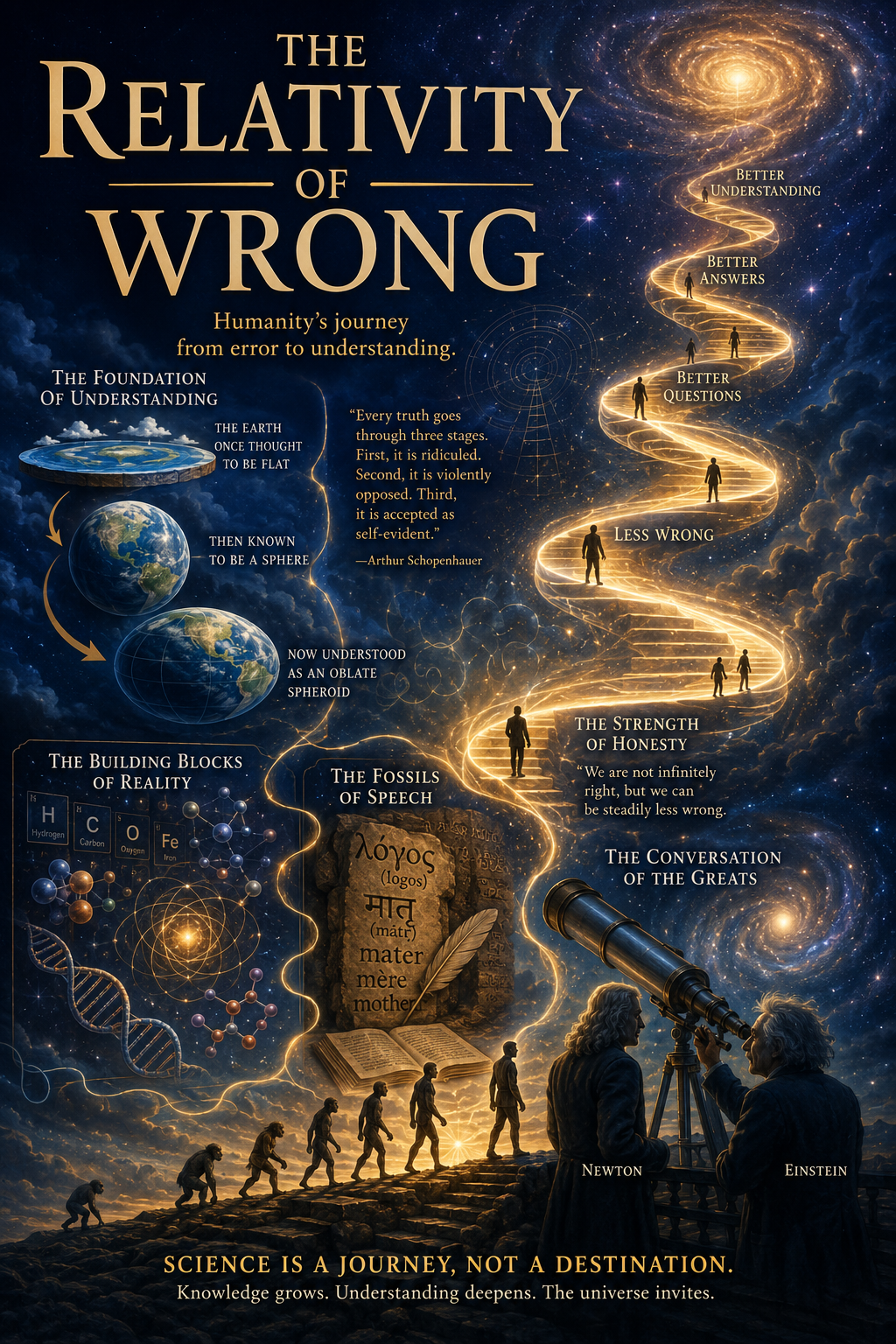
The story of human knowledge is not a series of sudden jumps from darkness into light, but rather a long and steady climb up a ladder where each rung is a bit higher than the last. In this collection of essays, the narrative begins with a fundamental question: if scientific theories are always being corrected, are scientists just as wrong today as they were in the past?. The answer forms the heart of this journey, revealing that knowledge exists in degrees and that being wrong is a relative term.
At the start of our journey, we find ourselves looking at the Earth. A long time ago, people believed the Earth was flat. Later, they believed it was a perfect sphere. Today, we know it is an oblate spheroid. While the first two ideas were technically wrong, they were not equally wrong. The person who thinks the Earth is flat is far more mistaken than the person who thinks it is a sphere. This simple realization serves as the foundation for the entire story: science does not replace truth with falsehood, but replaces useful approximations with even better ones.
As we move through the history of our species, the story turns toward the heavens. We see ancient astronomers observing the stars with nothing but their eyes, creating models of the universe that were remarkable for their time. These early thinkers were not failing; they were starting a conversation that would span centuries. With the invention of telescopes and the refinement of mathematics, each new generation of explorers corrected the mistakes of their ancestors, building a cumulative record of progress.
The story then introduces us to the great figures of science Copernicus, Galileo, Newton, and Einstein. They are not presented as flawless heroes who appeared out of nowhere, but as curious individuals who were willing to question what everyone else took for granted. They benefitted from the work of those who came before them and left new questions for those who would follow. We see that even when a giant like Einstein arrived, he did not prove Newton wrong in the way most people think. Newton’s physics still works perfectly well for our everyday lives; Einstein simply expanded our understanding to include the extremes of the universe. This is the essence of the story: newer theories expand older ones rather than discarding them.
Our journey then dives into the very fabric of matter. We learn that everything around us the air, the water, and even our own bodies is constructed from a limited set of building blocks called elements. The organization of these elements into the periodic table is not just a list to be memorized, but a story of how the universe itself is organized. We see that chemistry is the study of how these building blocks are arranged in endless combinations to create the world we see.
The narrative takes an unexpected turn into the world of language. We discover that words themselves are like fossils, preserving the history of how humans have thought about the world. Just as scientific theories evolve, the meanings of our words change and adapt as we make new discoveries. Communication is revealed to be a living system, constantly borrowing and shifting as civilization grows.
Supporting all of this is the silent language of mathematics. It is more than just arithmetic; it is the tool that allows us to see patterns in nature that our eyes might miss. Whether it is the path of a planet or the growth of a population, mathematics provides the logic that holds the story together. It is the language through which the universe expresses its rules.
The story of life then unfolds before us. We see that life did not appear suddenly in its final form, but developed through a process of adaptation called evolution. Every species on Earth today is a success story, a solution to the challenge of surviving in a specific environment. Human beings find their place in this narrative not as something separate from nature, but as a part of a long, unbroken continuity connecting every living thing on the planet.
As we reach the modern age, the story examines the tools we have built. Technology is shown to be the result of countless small improvements made over many generations rather than sudden, isolated flashes of genius. With this technological power comes a new chapter on responsibility. We learn that while science gives us the power to change the world, only human wisdom can decide how to use that power for the better.
The climax of the story is a realization about the nature of the scientific mind. The strength of science does not come from being certain, but from being honest. Scientists are willing to change their minds when new evidence appears. This flexibility is what allows knowledge to become more reliable over time. Error is not the enemy of understanding; the refusal to correct an error is.
By the end of the journey, we see that the search for knowledge is an endless pursuit. The universe will always have more mysteries to solve, and each discovery is merely the beginning of a new journey. We are left with a feeling of humility and hope, knowing that while we may never be perfectly right, we are working every day to be steadily less wrong.
The Foundation of Understanding: This mini story explains that truth is not an absolute destination but a direction. It uses the shape of the Earth to show that while our models change, they are becoming increasingly accurate refinements of previous ideas rather than complete reversals.
The Tale of the Ancient Heavens: This narrative tracks how humanity’s view of the cosmos expanded from small, Earth centered models to the realization that we live in a universe of billions of galaxies. It emphasizes that each step, though later corrected, was a necessary part of our growth.
The Conversation of the Greats: This story follows the lives of scientists like Newton and Einstein. It portrays science as a long, continuous dialogue where each participant builds on the work of the past to reach new heights of understanding.
The Building Blocks of Reality: This essay explores the discovery of the elements and the periodic table. It frames chemistry as the detective work of finding the hidden patterns that organize all matter in the universe.
The Fossils of Speech: A unique story that treats words as historical artifacts. It traces how the language we use to describe science and the world is constantly evolving, reflecting the changes in human culture and knowledge.
The Patterns of Nature: This story describes mathematics as the underlying architecture of the world. It shows how math allows us to predict and understand events in nature that go far beyond what we can see with our eyes.
The Adaptation of Life: This narrative tells the history of life on Earth through the lens of evolution. It explains that life is a process of natural selection and that humans are deeply connected to the rest of the natural world.
The Ladder of Invention: This mini story explores technology, showing that every invention, from the simplest tool to the most advanced computer, is a small step in a long line of human ingenuity and cooperation.
The Strength of Honesty: This final story focuses on the philosophy of science. It argues that the most important part of science is the willingness to admit when we are wrong, which is the only way we can ever hope to get closer to the truth.
Review
This collection of ideas is a masterpiece of logical presentation. By using simple words and clear analogies, the narrative takes complex subjects and makes them feel like a personal conversation. The story of science is presented as a deeply human endeavor, filled with curiosity, humility, and a relentless drive to understand the world. It is a powerful reminder that being wrong is not a failure, but a vital part of the process of learning. The book succeeds in teaching us not just what to know, but more importantly, how to think.