Isaac Asimov's Book of and Nature Questions
Earth and the Physical World details plate tectonics. Physics uses gravity. Photosynthesis powers Plants and Living World. Animals detail evolution. Astronomy and Space covers astronomy.
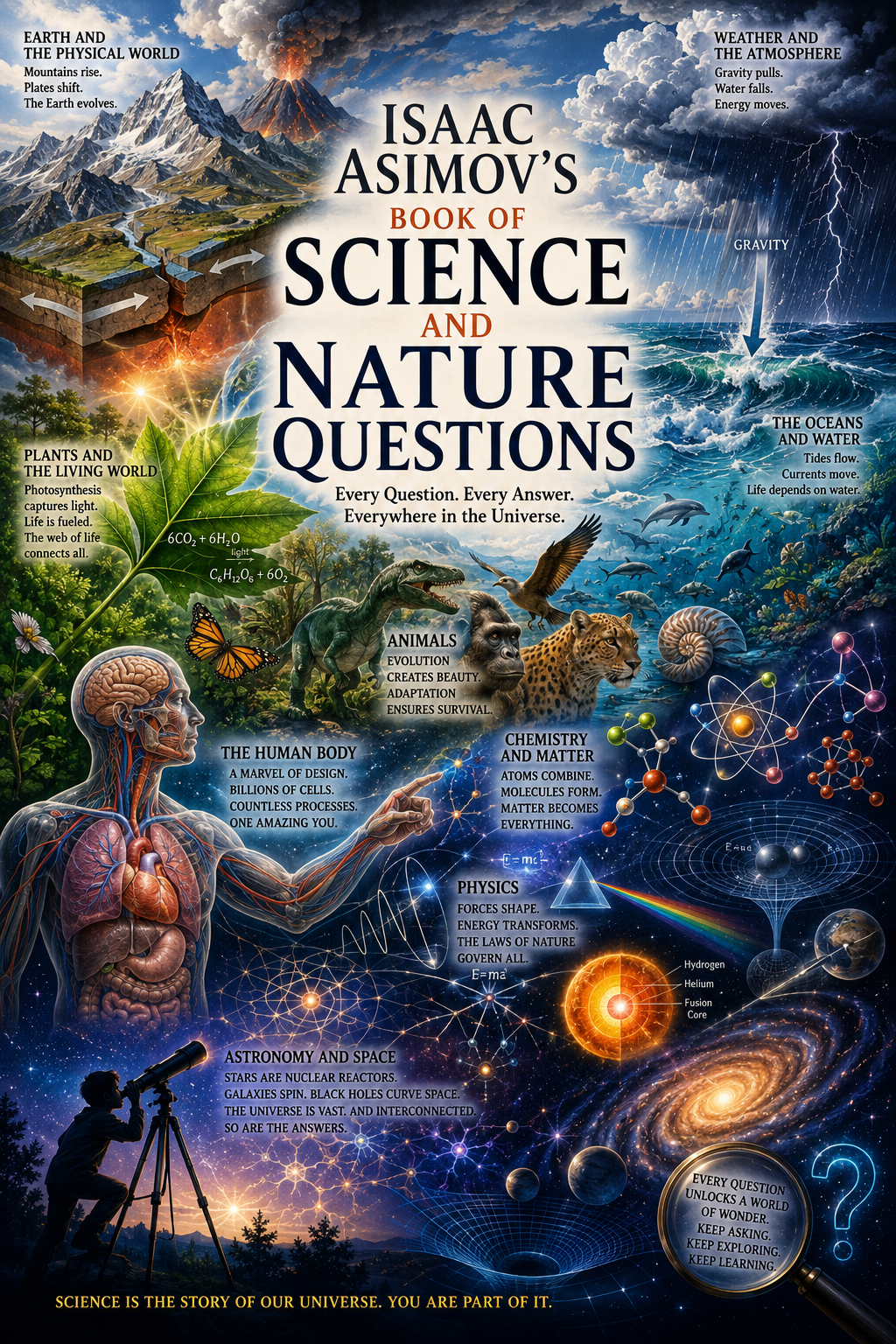
Isaac Asimov's Book of Science and Nature Questions is less a conventional book than an extended conversation between a scientist and an endlessly curious reader. Throughout its pages, Isaac Asimov gathers hundreds of questions that people commonly ask about the natural world and answers them with remarkable clarity. Every question becomes an opportunity not merely to provide a fact but to explain the scientific principles behind it. The book demonstrates that science is not a collection of isolated answers but an interconnected way of understanding the universe.
The journey begins with the simplest observations of everyday life. Why is the sky blue? Why do clouds float? Why does the Moon sometimes appear larger near the horizon? Why does ice float instead of sink? These familiar questions introduce one of the book's central lessons: ordinary events are extraordinary once we understand the science behind them. Asimov repeatedly reminds readers that curiosity often begins with noticing things everyone else accepts without question.
Earth and the Physical World The opening chapters explore Earth and the Physical World. Here, the reader learns that the Earth is not a static object but a dynamic planet constantly changing beneath our feet. Mountains rise over millions of years, continents slowly drift across the globe, volcanoes reshape landscapes, and earthquakes reveal the immense forces hidden within the Earth's interior. Rather than presenting geology as a list of terms, the book explains how the planet behaves like a living system whose surface is continually renewed.
Weather and the Atmosphere Questions about gravity naturally follow. Why do objects fall? Why do people weigh less on the Moon? Could gravity ever disappear? Through these discussions, readers discover that gravity is both one of the weakest and one of the most influential forces in nature. It governs the fall of an apple, the motion of planets, the structure of galaxies, and ultimately the shape of the universe itself. The next major section turns toward Weather and the Atmosphere. Here Asimov explains why winds blow, how hurricanes gain their enormous power, why lightning strikes, and what creates rainbows. Weather, which often appears unpredictable, emerges as the result of understandable physical processes involving heat, pressure, moisture, and the rotation of the Earth. Every storm becomes an illustration of energy moving through the atmosphere. The discussion of lightning is especially fascinating because it reveals that enormous electrical charges build inside storm clouds before suddenly equalizing in a brilliant flash. Thunder follows because air expands violently when heated by the lightning channel. What seems frightening becomes understandable once its underlying physics is explained.
The Oceans and Water From the atmosphere, the book moves naturally into The Oceans and Water. Readers encounter questions about tides, waves, currents, and the remarkable properties of water itself. Water proves to be one of the strangest substances in nature. Unlike most materials, it expands when frozen, allowing ice to float and protecting aquatic life during winter. Its ability to dissolve countless substances makes it essential for every known living organism. Ocean currents receive special attention because they function as Earth's climate regulators. They transport heat from tropical regions toward the poles, influencing weather patterns across entire continents. The sea is presented not merely as a body of water but as a vital component of the planet's environmental balance.
Plants and the Living World The book then shifts to Plants and the Living World, where familiar trees, flowers, and crops reveal surprising secrets. Readers learn how plants manufacture food through photosynthesis by capturing sunlight and converting it into chemical energy. This seemingly simple process supports almost every food chain on Earth. Oxygen itself owes its abundance largely to the activity of countless green plants. Questions about seeds, flowers, fruits, and forests demonstrate how evolution has produced astonishing diversity while following a few fundamental biological principles. Every plant becomes a successful solution to the challenge of survival in a changing environment.
Animals The companion discussion of Animals expands this theme. Why do birds migrate? How do fish breathe underwater? Why do some animals hibernate? Why are insects so successful? Rather than treating each species as an isolated curiosity, Asimov connects every answer to adaptation and evolution. Each creature possesses characteristics shaped by millions of years of natural selection. Particularly engaging are the explanations of animal senses. Bats navigate through echolocation, bees communicate through elaborate dances, snakes detect infrared radiation, and birds may use Earth's magnetic field during migration. Nature repeatedly demonstrates solutions that human technology has only recently begun to imitate.
The Human Body One of the richest sections concerns The Human Body. Here readers ask questions about the heart, lungs, brain, muscles, bones, digestion, sleep, memory, and disease. Instead of presenting anatomy as memorization, the book explains how countless organs cooperate to sustain life. The heart appears as a remarkably efficient pump capable of working continuously for decades without rest. The lungs expose an enormous surface area for oxygen exchange. The brain emerges as the most complex known object in the universe, containing billions of interconnected nerve cells that produce thought, memory, creativity, and consciousness. Questions about aging, illness, and healing reveal that the body is constantly repairing itself while also facing gradual wear over time. The immune system becomes one of the body's greatest defenses, identifying and destroying invading organisms with astonishing precision.
Chemistry and Matter The book next broadens its scope toward Chemistry and Matter. Readers discover why substances combine, why metals rust, why fire burns, and how atoms form molecules. Invisible particles become easier to imagine through clear analogies that connect microscopic events with everyday experiences. Asimov explains that chemistry is fundamentally about relationships between atoms. Every familiar object wood, glass, plastic, air, food, and even the human body is constructed from a surprisingly small number of chemical elements arranged in different ways. This realization highlights one of science's greatest achievements: extraordinary complexity emerging from simple building blocks.
Physics The exploration continues into Physics, where questions about light, sound, electricity, magnetism, heat, and motion are answered with elegant simplicity. Readers learn why mirrors reflect, how radio waves travel through space, why sound cannot exist in a vacuum, and how electricity powers modern civilization. Rather than presenting mathematical equations, the book emphasizes physical intuition. Every phenomenon can be understood through observation, experimentation, and logical reasoning. Science becomes less intimidating because it grows naturally from curiosity.
Astronomy and Space No science book by Asimov would be complete without a substantial journey into Astronomy and Space. Here readers ask why stars shine, how planets formed, whether black holes exist, and if life might inhabit other worlds. The Sun emerges not simply as a bright object but as a gigantic nuclear reactor converting hydrogen into helium every second. Stars are shown to possess life cycles remarkably similar to living organisms: they are born, mature, age, and eventually die, sometimes leaving behind white dwarfs, neutron stars, or black holes. The vastness of the universe repeatedly challenges human imagination. Galaxies contain hundreds of billions of stars, while the observable universe contains billions of galaxies. Yet despite these unimaginable distances, the same physical laws operate everywhere, demonstrating the remarkable unity of nature.
Throughout the book, Asimov also addresses questions that seem humorous or trivial at first glance. Why do onions make people cry? Why do cats always seem to land on their feet? Why do bubbles form? Why does bread rise? Instead of dismissing these questions, he treats each one with the same respect given to astronomy or geology. This equality of curiosity becomes one of the book's defining strengths. Every question deserves an answer because every question deepens understanding.
Another recurring theme is the importance of scientific thinking itself. Asimov frequently distinguishes observation from assumption and evidence from superstition. He demonstrates that science advances not because scientists know everything but because they continually ask better questions. Every answer naturally leads to new mysteries waiting to be explored. By the conclusion, readers realize that the book has quietly transformed their way of seeing the world. Rain is no longer merely weather but part of Earth's water cycle. A tree is no longer simply a plant but a solar powered chemical factory. A rainbow becomes an optical phenomenon, the stars become distant suns, and the human body becomes an extraordinary collaboration of countless microscopic processes.
As a whole, Isaac Asimov's Book of Science and Nature Questions succeeds because it celebrates curiosity rather than merely satisfying it. The book encourages readers to look more closely at everyday life and to recognize that every ordinary object conceals extraordinary science. It teaches that understanding grows not through memorizing facts but through asking thoughtful questions and following evidence wherever it leads. Even decades after its publication, the book remains an inspiring introduction to scientific thinking. Its greatest achievement is not simply answering hundreds of questions but convincing readers that the universe is far more fascinating than they ever imagined and that every question, no matter how small, is the beginning of another adventure in discovery.