Earth Our Home Base
Asimov frames Earth as a dynamic, living sanctuary and cosmic launchpad, comparing its unique geological and atmospheric conditions to barren neighboring planets.
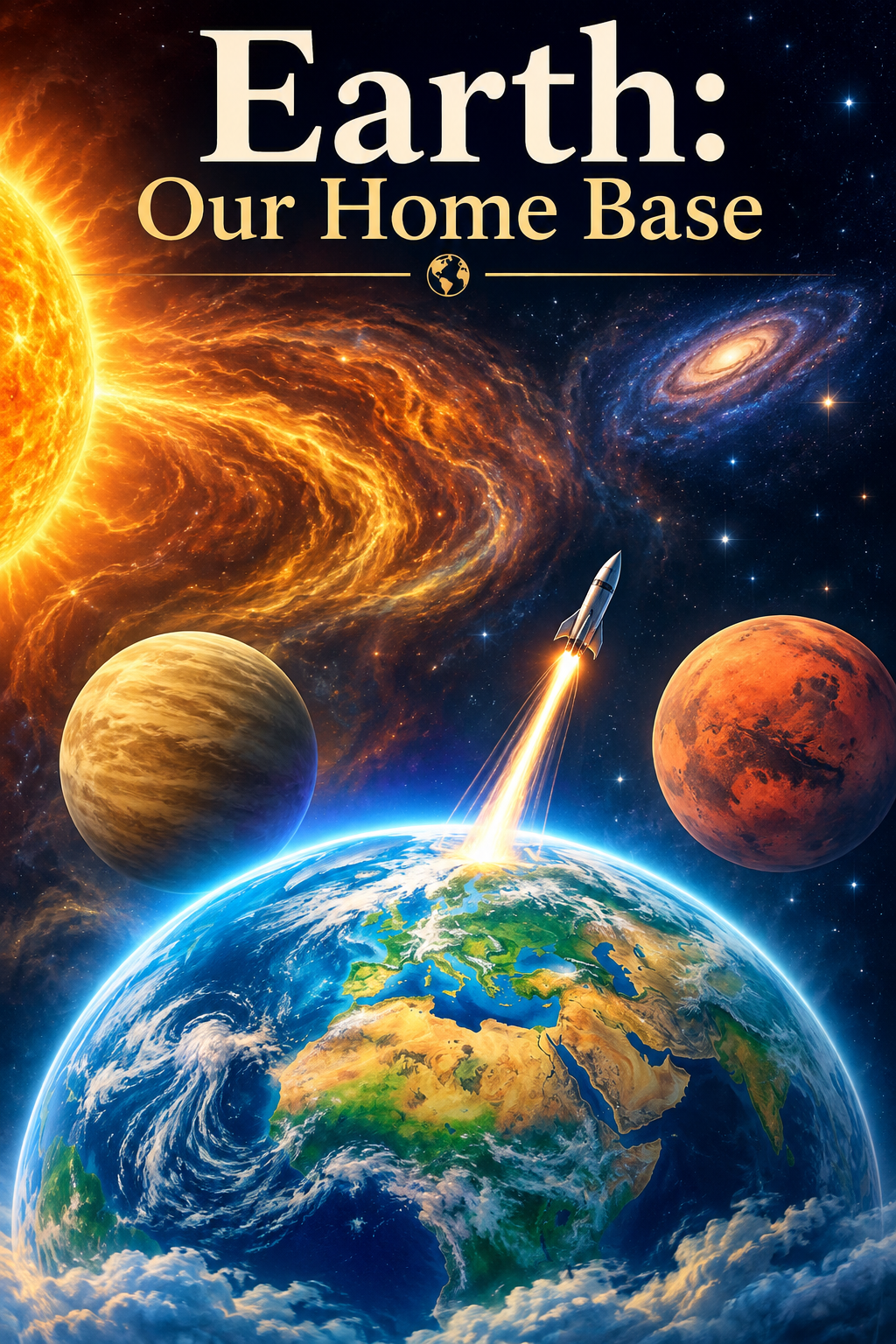
The story of our world begins not in isolation, but as a small part of a grand cosmic process. Nearly five billion years ago, a massive cloud of dust and gas slowly swirled through the emptiness of space. Driven by the invisible pull of gravity, this material began to draw together, eventually forming the Sun and the family of planets that orbit it. It is from this ancient cosmic crucible that Earth emerged, not as an independent anomaly, but as a sister to the other worlds of our Solar System. This planetary birth is the starting point of Isaac Asimov’s Earth: Our Home Base, a continuous science narrative published in 1988. Through this work, Asimov invites us to step back and view our planet not just as a familiar landscape, but as an active astronomical body and the launchpad for all our journeys into the unknown.
To truly understand our home, we must first look at its neighbors in the rocky inner family of the Solar System. Earth does not exist in a vacuum; its character is revealed through comparison with Mercury, Venus, and Mars. Mercury is a small world, heavily heated by its close proximity to the Sun. Venus, though similar to Earth in physical size, is choked by a hostile atmosphere that makes its surface conditions incredibly deadly. Mars, on the other hand, is a frigid desert with a thin, fragile atmosphere. In contrast to these extreme environments, Earth occupies a remarkable middle position, possessing temperatures that allow liquid water to flow over vast regions, an atmosphere capable of supporting a biosphere, and a dynamic interior. Asimov teaches us that Earth's importance is not a matter of sheer size or spectacular features, but rather the delicate and precise combination of circumstances that allows complex life to flourish.
The planet beneath our feet is a restless engine of change, constantly reshaped by forces from within and without. As Earth moves through space, it rotates on its axis, giving us the steady rhythm of day and night, while its orbital journey around the Sun and axial tilt produce the seasons. This astronomical machinery is so familiar to us that we often take it for granted, yet it is what regulates the rhythm of life. Furthermore, Earth is far from a static, finished object. Beneath its solid looking crust lies a complicated and extremely hot interior. Geological processes operating deep within the planet continually reshape its surface, pushing up mountains only for them to erode, and melting rocks down only to bury and transform them over eons. Earth is a living, changing planet that is never truly finished.
This dynamic world is wrapped in a protective blanket of air and filled with the fluid of life. The atmosphere surrounding our planet is not merely empty space, but a vital mixture of gases dominated by nitrogen and oxygen. It protects us from cosmic hazards, regulates our temperature, and drives the weather patterns that sustain the surface. Working alongside the atmosphere is water, which makes Earth exceptionally unusual among known planets. Enormous quantities of liquid water cover the majority of our world, flowing through oceans, rivers, and lakes, frozen in massive ice sheets, and circulating through clouds and underground reservoirs. The movement of water through evaporation, condensation, precipitation, and runoff acts as a circulatory system, binding the atmosphere, land, and oceans into one giant, interconnected planetary entity.
At the heart of this interconnected system is the energy of our parent star. The Sun supplies the life giving energy that drives almost all activity on Earth's surface. Living plants capture this sunlight and use it to manufacture food, initiating the massive biological chains of activity upon which all animals and human beings depend. Without this constant solar input, Earth would be a frozen, lifeless wasteland, radically different from the green and blue world we know. Yet, Earth is not a passive recipient of solar warmth; its atmosphere, oceans, and active geology cooperate to create a balanced environment where life can continually adapt and evolve. Over immense stretches of time, the history of Earth has been a story of coevolution, where the physical planet and its living organisms have shaped one another.
As human beings, our understanding of this home base has evolved from local observations to a grand cosmic perspective. For the vast majority of our history, we could only study our world from the ground, climbing mountains, sailing across vast oceans, and drawing incomplete maps. Eventually, the development of scientific instruments transformed our vision. Telescopes allowed us to peer at other worlds, while the advent of rockets and spacecraft allowed us to rise above our atmosphere and look back. This is where the concept of the "home base" becomes incredibly powerful. When we send spacecraft to the Moon and other planets, we are not abandoning Earth; rather, we are using it as our operational center, bringing back knowledge that paradoxically teaches us more about our own planet. From the vantage point of space, national boundaries vanish, and the continents and oceans merge into a single, fragile planet wrapped in a thin, protective layer of air.
This cosmic perspective naturally leads to one of the most profound questions in science: are we alone in the universe? Asimov does not treat the search for extraterrestrial life as a matter of wild fantasy, but as a rigorous scientific problem. By studying the exact conditions that allowed life to develop on Earth, scientists can evaluate other worlds and search for similar environments. Furthermore, if humanity is to someday inhabit other planets or live in space, we must recognize that surviving away from our home planet will require sophisticated technology to replicate what Earth provides automatically, such as air, water, stable temperatures, and shielding from radiation. Earth is our ultimate home base because its natural systems perform these complex, life sustaining tasks for us every second without us ever having to think about them.
In reviewing this elegant work, we must acknowledge that there are no conventional short stories or separate fictional mini stories within its pages. Instead, Earth: Our Home Base is structured as a continuous, elegant science narrative that moves outward and inward repeatedly, flowing from the immense scale of the Solar System down to Earth's geology, and then back out into the depths of space. Published in 1988, some of its technical details inevitably reflect the knowledge of that era, yet the fundamental questions it raises remain as vital and powerful today as they were then. Asimov’s clear, simple, and logical presentation succeeds because it transforms the most ordinary aspects of our daily lives, the air we breathe, the ground we walk on, and the light we see, into a profound scientific mystery. Ultimately, we are left with the realization that Earth is a truly extraordinary planet, a cosmic oasis that is not merely the place we happen to occupy, but the home base from which we will always explore the stars.