Asimov's Annotated Gilbert and Sullivan
Asimov enthusiastically annotates Gilbert and Sullivan’s operas, explaining Victorian satire and history to modern readers, revealing the timeless, logical absurdity hidden within human social institutions.
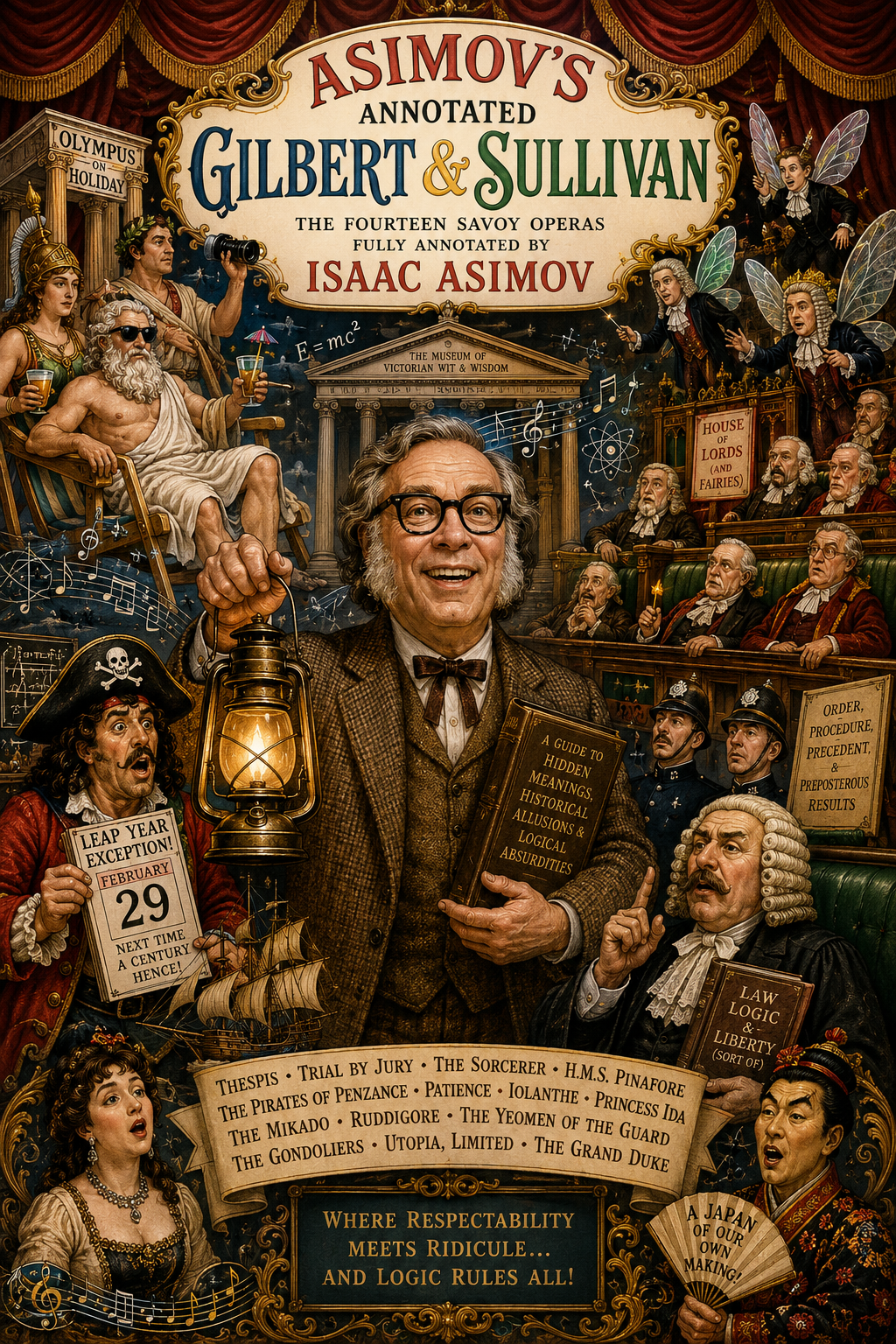
Isaac Asimov, a man who spent his life explaining the universe from the smallest atom to the furthest galaxy, found a unique and logical challenge in the Victorian stage. In Asimov's Annotated Gilbert and Sullivan, he acts as an enthusiastic companion rather than a dry academic scholar. He approaches this work much like a guide opening the doors to a vast museum of human folly and wit. Asimov recognizes that the passage of time has made many of the best jokes of the nineteenth century feel like locked rooms to modern readers. His goal is to provide the keys, restoring references that were once common knowledge so that the humor can breathe again. He does not seek to change the work of Gilbert and Sullivan but to remove the obstacles that prevent us from seeing their genius clearly.
At the heart of this book is the story of a remarkable and sometimes difficult partnership between two very different men. W.S. Gilbert possessed an imagination for topsy-turvy situations that were utterly absurd yet followed a relentless internal logic. Arthur Sullivan was a serious composer who provided elegant and sophisticated music that often stood in stark contrast to the ridiculous scenes on stage. Together, they created a series of operas that did more than just make people laugh; they used comedy to quietly expose the absurdity hidden inside respectable institutions like the law, the military, and the government. Asimov understands that their brilliance lay in showing how human vanity and bureaucracy often make sense only to those trapped inside them.
The way Asimov presents this summary is through a conversational style that feels like a long, pleasant walk with a knowledgeable friend. Whenever a lyric mentions a forgotten statesman, a complex naval custom, or a bit of classical mythology, Asimov pauses the narrative just long enough to explain it. These annotations are not dry footnotes but are instead miniature stories that wander through history, science, and literature. Reading his notes becomes an experience as entertaining as reading the plays themselves, as he turns every explanation into a journey through Victorian civilization. He proves that learning, when presented with wit and curiosity, is one of the highest forms of entertainment.
The journey begins with Thespis, where the weary gods of Olympus decide to take a vacation and leave their divine duties in the hands of a troupe of ordinary actors. It is a story that explores the gap between appearing noble and acting responsibly, showing that human weaknesses follow us even into the heavens. Asimov uses this opening to explain the Greek myths and the Victorian theatrical traditions that shaped the authors first collaboration.
In Trial by Jury, the entire British legal system is condensed into a single, ridiculous courtroom. A young man is sued for a broken promise of marriage, and the dignity of the law quickly turns into a farce as judges and lawyers let their own emotions and romantic interests take over. Asimov points out the specific legal customs that make this satire of the judicial process so sharp. This is followed by The Sorcerer, which tells the story of a magician who distributes a love potion that forces people into irrational pairings. It demonstrates that love itself can be irrational, and Asimov enriches the comedy by explaining the rigid Victorian class distinctions that make these magical matches so scandalous to the characters.
The setting shifts to the sea in H.M.S. Pinafore, where life on a Royal Navy vessel is governed strictly by social rank. Gilbert mocks the British class system by revealing that status is often merely an accident of birth rather than a reflection of genuine merit. Asimov provides extensive notes on naval terminology and the politics of the Admiralty to help the reader see the bite behind the humor. The theme of duty and logic is pushed even further in The Pirates of Penzance, where a young man named Frederic is trapped by a legal technicality involving a leap year. Asimov explains the complicated logic of the calendar and the literary references that make Frederic's sense of duty so absurdly funny.
As the satire moves toward the world of art and fashion, we find Patience, which mocks the aesthetic movement of the Victorian era. This story features poets who cultivate an exaggerated sense of refinement and beauty. Asimov explains the real world history of this movement so that the jokes about artistic pretension regain their original brilliance. In Iolanthe, the authors combine fairy magic with British parliamentary politics. By having fairies interfere with the House of Lords, Gilbert suggests that inherited privilege is just as magical and irrational as a fairy tale. Asimov’s notes here are particularly deep, explaining constitutional history and the complex structure of the British government.
The collection then explores Princess Ida, which focuses on a university established exclusively for women who have rejected the society of men. The story uses comedy to navigate the Victorian debates surrounding education and gender. Asimov is careful to help the modern reader distinguish between Gilbert’s satire of extremism and the actual social attitudes of the time. This is followed by The Mikado, perhaps the most famous of their works, which uses a fictional version of Japan as a safe mirror to ridicule English bureaucracy and government. Asimov reminds us that the Japan on stage is entirely fictional, allowing the authors to mock their own society without causing a diplomatic or political scandal.
A darker tone emerges in Ruddigore, a parody of Gothic ghost stories and family curses. Each baronet of the family is forced by a curse to commit a daily crime or face a terrible death. Gilbert applies relentless logic to these supernatural conventions, and Asimov explains the literary traditions of the Gothic that the play is dismantling. This depth continues in The Yeomen of the Guard, set in the Tower of London. This work balances its comedy with genuine emotional tragedy and heartbreak. Asimov notes that this opera stands apart because the music and the story move much closer to the intensity of grand opera.
In The Gondoliers, the story returns to joyous comedy and themes of mistaken identity in Venice. It satirizes the monarchy by suggesting that ordinary citizens might govern better than those born into privilege. Asimov enriches the setting with historical details about Venice and the nature of European royalty. Moving toward imperial politics, Utopia, Limited looks at an island kingdom that tries to modernize by copying every single British institution. Asimov explains how this reflects the expansion of the British Empire and the ironic idea that progress is often just an imitation of someone else's mistakes.
The final story in this journey is The Grand Duke, which involves theatrical conspiracies and a legal loophole where life and death are decided by a game of cards. Even though it is one of their less celebrated works, Asimov shows that it still relies on the same logical machinery and delight in legal absurdities that defined the earlier operas. He concludes the book by reflecting on why these stories remain timeless. He argues that because every generation invents its own new bureaucracies, pretensions, and social rules, the satire of Gilbert and Sullivan will always be relevant.
The true achievement of this work is how it transforms the act of annotation into a form of high entertainment. Asimov does not just explain the text; he turns every note into a window that opens onto history, language, and culture. By the end of the book, the reader has not only gained a complete understanding of these famous operas but has also experienced Asimov’s remarkable gift for making knowledge itself irresistibly enjoyable. He proves that when logic and wit are applied to the study of human society, the result is as entertaining as the finest performance on any stage.