Isaac Asimov Presents the Great SF Stories, 17
This science fiction collection explores humanity's deep psychological and ethical evolution through stories addressing faith, identity, and society, transforming speculative fiction into profound, mature philosophical literature.
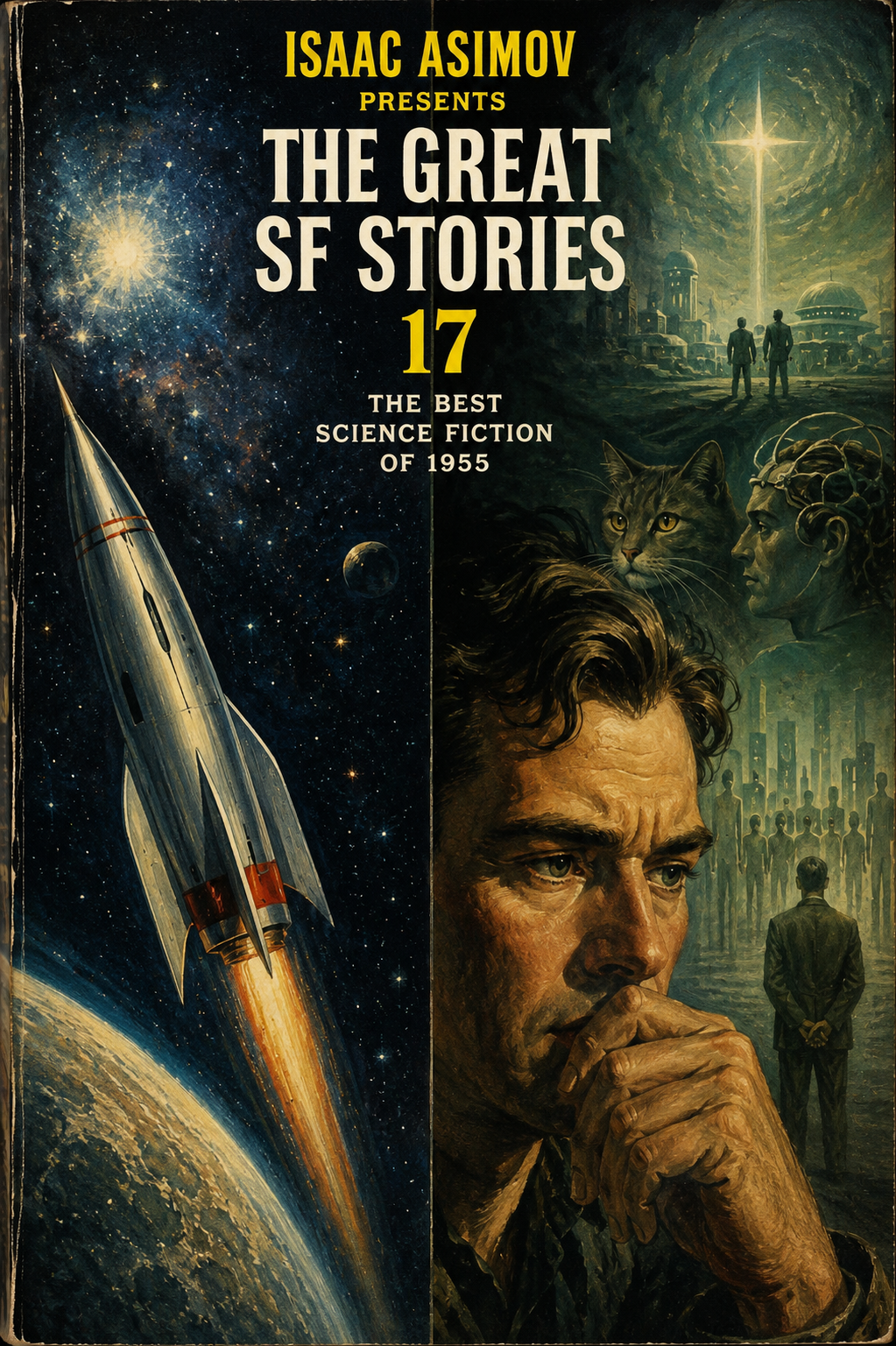
In the history of science fiction, certain years stand out as turning points where the genre moves from the simple wonder of gadgets to the complex study of the human soul. The year 1955 was exactly such a pivot point, and in the seventeenth volume of our series, we see a collection of stories that began to ask what humanity becomes after it has mastered the stars. These tales demonstrate that while the exuberant optimism of earlier years remained, writers were becoming more interested in the inner workings of the mind and the hidden costs of progress. It was a time when the Golden Age began to mature into something deeper and perhaps more permanent.
The Star by Arthur C. Clarke remains one of the greatest meditations on faith ever written in our field. It concerns a man of science serving as an astrophysicist on an interstellar mission. The crew finds the remains of a beautiful civilization that was destroyed when its sun became a supernova. Building from the classic conflict between observation and belief, this story leads toward the more philosophical and contemplative science fiction that would define the next decade. Clarke does not attack religion; instead, he explores the intense loneliness of a man who finds that scientific facts may not always sit comfortably with spiritual belief. It is a story about the search for cosmic justice in a universe that often seems indifferent.
The Game of Rat and Dragon by Cordwainer Smith takes us into a future where space travel is a psychic battlefield. In the void between stars, invisible entities attack human ships, and the only way to fight them is through telepathy between humans and animals. This partnership is not merely one of master and pet; it is a deep emotional merging that transcends species. Smith uses dreamlike language to show that loyalty and love can exist across different forms of intelligence, making the familiar idea of space combat feel entirely strange and new. This work builds from the pulp adventures of the past but adds a layer of poetic complexity that leads the way toward the experimental styles of the New Wave.
The Country of the Kind by Damon Knight takes a different path by examining a future society that has supposedly eliminated violence. The narrator is a man who still possesses the urge to hurt others, making him an outcast in a world of peace. Rather than using bars or execution, society punishes him through a sophisticated application of psychology. He becomes a ghost among the living, discovering that being ignored by everyone is a form of torture far worse than physical imprisonment. The story builds from traditional utopian concepts but leads to a darker exploration of how societies enforce conformity through social isolation.
Fondly Fahrenheit by Alfred Bester is a disturbing psychological thriller. It follows a wealthy man and his advanced robot as they flee from a series of unexplained crimes. As the story progresses, the distinction between the owner and the machine begins to blur. Bester uses a unique narrative style to show how mechanical detachment and psychological instability merge into a single identity. This story builds from the foundational laws of robotics but leads toward a future where the line between human and machine is no longer clear. It is a brilliant exploration of how technology can sometimes absorb our worst traits, leaving us unsure of who is truly responsible for our actions.
Exploration Team by Murray Leinster takes us to the frontier of human expansion. On a dangerous planet where settlers are forbidden, one man survives through a partnership with genetically modified creatures. These intelligent animals are his protectors and his family against both the predators of the wild and the interference of distant bureaucrats. Leinster celebrates the adaptability of the human spirit and the idea that local ingenuity is often more valuable than the rigid rules of a centralized authority. This tale builds from the survival stories of the early frontier and leads toward a more nuanced understanding of ecology and cooperation with nature.
The Tunnel under the World by Frederik Pohl takes us into the dark side of the consumer world. A man wakes up every morning only to realize that his town is trapped in a repeating cycle where every detail of life is controlled by an invisible force. He eventually discovers that he and his neighbors have become the subjects of an elaborate experiment in marketing. Pohl’s satire was remarkably ahead of its time, predicting a world where individual lives are treated merely as data and every thought is a target for manipulation. This story builds from the social anxieties of the nineteen fifties and leads toward the reality of the modern information age.
Allamagoosa by Eric Frank Russell reminds us that even in a technological future, humans will still be prone to their own foolishness. This story is a delightful comedy about a spaceship crew that realizes it is missing a piece of equipment during an official inspection. Because they are terrified of the bureaucratic consequences, they attempt to fake the existence of the device, despite none of them knowing what it actually is. The escalating misunderstandings serve as a reminder that science fiction does not always have to be solemn; sometimes it is most effective when it is laughing at the absurdity of human institutions. This humorous approach builds from the military satires of the past and leads toward a more grounded view of human nature in space.
Together, these stories show that by 1955, the real frontiers of science fiction had moved inward. While we still traveled to other worlds, we did so to find mirrors for our own fears, hopes, and responsibilities. This volume serves as a testament to the evolution of the genre into serious literature that is capable of exploring the deepest questions of our existence through the lens of the imagination.