Beginnings The Story of Origins
Asimov unifies scientific disciplines to trace universal origins, from ancient myths and the Big Bang to the evolution of life, humanity, and our complex civilization.
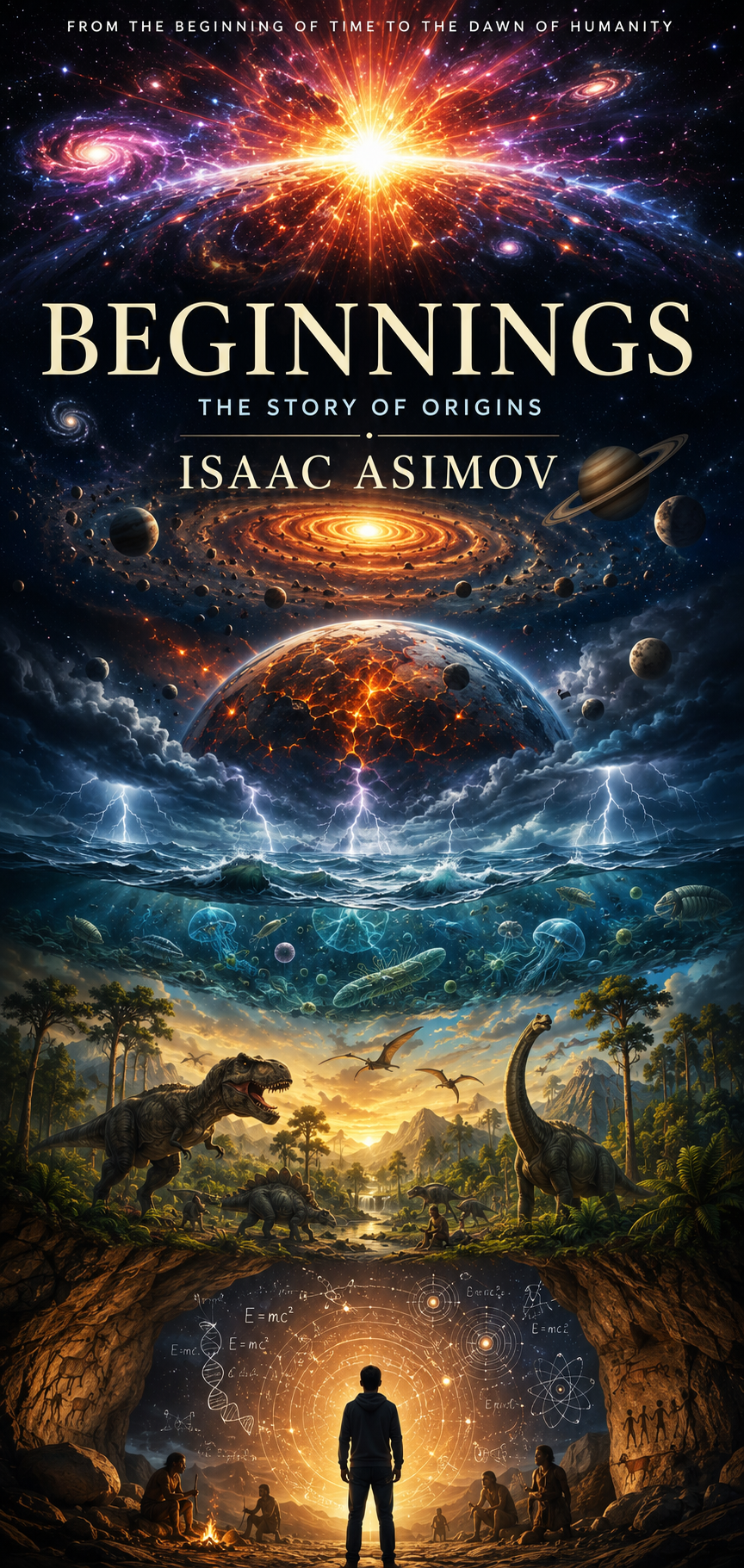
In the vast library of Isaac Asimov’s work, which spans from the positronic brains of robots to the fall of galactic empires, there is one book that attempts to tell the most difficult story of all. It is not a work of fiction, yet it reads like a grand epic. This book is Beginnings: The Story of Origins. In this work, Asimov sets aside his starships and focuses his clear, logical mind on a single, deceptively simple question: where did everything come from? To understand this book is to understand the very foundation of Asimov’s worldview that the universe is a puzzle waiting to be solved through reason.
The story begins not with stars, but with ourselves. Before humans had the tools of science, they had the power of imagination. Every civilization, from the smallest tribe to the largest empire, crafted stories to explain the world around them. They imagined giants, dragons, and gods shaping the earth and breathing life into clay. Asimov treats these myths with respect because they represent humanity’s first attempt at science. They were our first efforts to transform terrifying ignorance into understandable narratives. However, the true turning point in this story occurs when ancient Greek philosophers like Thales and Democritus dared to suggest that nature might operate according to rules rather than the whims of gods.
As the narrative progresses, we see the focus shift from philosophy to observation. For centuries, humanity was limited by its own eyes, but the Renaissance changed the scale of the world. Figures like Copernicus and Galileo removed the Earth from the center of creation and showed that the heavenly bodies were not perfect divine spheres, but worlds of their own. When Newton united the falling apple and the orbiting planet under a single law of gravitation, he proved that the universe followed the same physical laws everywhere. This realization is the heartbeat of the book: the universe is a single, unified system that can be understood by the human mind.
The mini stories within this grand odyssey are the various scientific disciplines that Asimov weaves together. The first of these stories is the discovery of Deep Time. For a long time, we thought the world was young, but the rocks beneath our feet told a different tale. Geologists like James Hutton and Charles Lyell realized that the Earth changes slowly through processes that take millions of years. The mystery of the Earth's age was finally solved not by looking at the stars, but by looking at the atom. Radioactivity provided an internal clock, proving the Earth is approximately 4.6 billion years old, a number that changed every science connected to our origins.
The next story concerns the Birth of the Solar System. Asimov examines how we moved past the idea of celestial miracles to the nebular hypothesis. This is the idea that a great cloud of gas and dust slowly collapsed under its own gravity to form the Sun and the planets. It was a natural consequence of physics, not a sudden event. He describes a young, alien Earth that was once a molten sphere bombarded by impacts, eventually cooling to allow oceans to condense and continents to emerge.
Perhaps the most compelling mini story is the Origins of Life. Asimov dismantles the old idea of spontaneous generation that life just appears from mud—and replaces it with the revolutionary concept of chemical evolution. He explains how the early Earth’s atmosphere, combined with energy from lightning and volcanoes, acted as a laboratory to create complex organic molecules. From these simple building blocks came the first self-replicating polymers, leading to the first primitive bacteria. These tiny organisms eventually transformed the entire planet by releasing oxygen, which allowed for more complex, multicellular life to flourish and eventually conquer the land, sea, and air.
The final chapters of this history bring us to the Evolution of Humanity. Asimov is careful to note that humans were not the goal of evolution, as nature has no destination. Instead, we are a product of natural selection, where intelligence proved to be a powerful tool for survival. With the arrival of language, knowledge no longer died with the individual. We created a new kind of evolution the evolution of ideas—where successful theories survive and incorrect ones are discarded through experiment. This brings the story full circle, back to the science that allowed us to write the book in the first place.
In reviewing Beginnings, it is clear that this is one of Asimov’s finest achievements in scientific storytelling. He manages to unify astronomy, geology, chemistry, and biology into a single coherent narrative. His prose is exactly what an admirer of his fiction would expect: simple, clear, and focused on the logical progression of ideas. He avoids the trap of many science writers who claim to have all the answers. Instead, Asimov displays a profound humility, emphasizing that science is a process of constant revision and that every answer we find only leads to a deeper, more interesting mystery.
The book concludes by looking at the Big Bang, which marks the start of space and time themselves. Yet, even here, the story is not finished. Asimov reminds us that every generation thinks it is close to the end of the search for origins, and every generation is wrong. The true value of this book is not just the facts it presents, but the philosophical lesson it leaves us with: the search for our beginnings is an ongoing adventure driven by reason and the endless willingness to ask why? For anyone who has followed Asimov from the caves of steel to the edges of the galaxy, Beginnings serves as the essential prequel to the history of everything.