Did Comets Kill the Dinosaurs
Asimov explores the mystery of dinosaur extinction, showing how scientific clues from fossils and chemical layers revealed a revolutionary theory about an ancient global catastrophe.
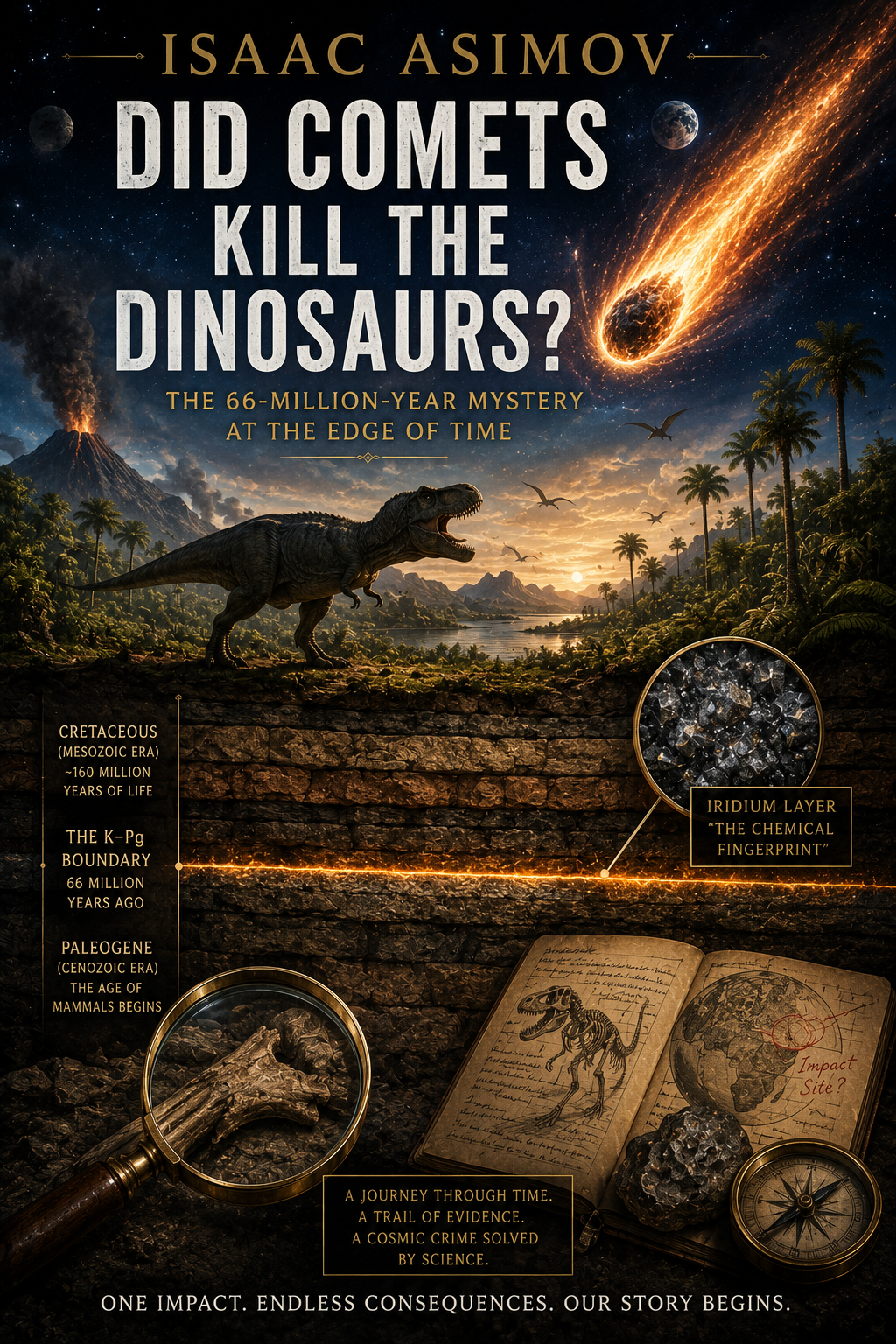
In the vast library of human curiosity, few writers have possessed the ability to untangle the complexities of the universe with as much clarity and reason as Isaac Asimov. In his work exploring the fate of the dinosaurs, he approaches a sixty six million year old cold case not merely as a chronicler of fossils, but as a detective of the cosmos. He begins by inviting the reader to look at the Earth as it once was a planet dominated for an incredible span of 160 million years by creatures of such variety and power that our own tenure as a species seems brief by comparison. To understand the magnitude of the mystery, one must first appreciate that for the majority of the Mesozoic Era, the world belonged to the dinosaurs, while the ancestors of mammals remained small and hidden.
The story of how we came to understand this lost world is, in itself, a testament to the growth of human logic. Asimov traces the path from a time when fossils were dismissed as the remains of mythical dragons or giants to the revolutionary eighteenth and nineteenth century realization that nature is not a static, unchanging gallery. He explains with his characteristic simplicity that the discovery of fossils was the discovery of extinction the profound idea that entire groups of organisms could vanish forever. This realization turned the Earth’s rock strata into a historical document, a book written in stone where different layers preserved different chapters of life.
As the narrative of the investigation unfolds, we see the scientific community grappling with various suspects for the disappearance of these great reptiles. Asimov meticulously weighs early explanations, such as group senescence, competition from mammals, or the shifting of continents and climates. He presents these theories with the fairness of a judge, noting that while climate and competition certainly played roles in the history of life, they seemed insufficient to explain the sudden, worldwide collapse seen in the fossil record. This leads the reader into the twentieth century, where the tools of the detective shifted from the pickaxe to the mass spectrometer.
The pivotal moment in this cosmic detective story arrives with the discovery of a chemical fingerprint: a thin layer of iridium rich clay marking the boundary between two geological periods. Because iridium is rare on Earth but common in celestial bodies, its presence suggested a dramatic intrusion from the stars. Asimov describes the work of Luis and Walter Alvarez and their colleagues as they moved from observing an anomaly to proposing a bold new hypothesis that a massive object from space had collided with our planet. He avoids sensationalism, instead using logic to describe the physics of such an event: a collision releasing energy equivalent to millions of nuclear weapons, resulting in vaporized rock, global firestorms, tsunamis, and a suffocating shroud of dust.
The true focus of the story, however, is not the explosion itself, but the disruption of the delicate balance of life. Asimov explains how the resulting clouds of debris would have blocked the sun, halting photosynthesis and causing a domino effect of starvation through the food chain. It was not necessarily the impact that killed the dinosaurs, but the darkness that followed. Yet, ever the cautious scientist, he does not present this as an absolute truth. He includes the search for physical evidence microscopic glass spheres and the eventual identification of a massive crater in the Yucatán while also leaving room for alternative ideas like volcanic activity. He reminds us that a theory is only as strong as its ability to explain the facts.
In a fascinating sub story within the larger investigation, Asimov explores the nature of comets themselves. He describes these icy wanderers as ancient remnants from the dawn of the Solar System. Most follow distant, lonely paths, but occasionally, gravity nudges one toward the inner planets. This perspective reminds the reader that Earth is not an isolated fortress but is intimately connected to the dynamic, and sometimes dangerous, environment of space. He also addresses the selective nature of the extinction, wondering why small mammals, birds, and crocodiles survived while the giants did not, pointing toward the importance of ecological flexibility.
The story concludes by looking toward the future. The disappearance of the dinosaurs, a catastrophe of unimaginable proportions, was the very event that created the opportunity for mammals to flourish and for humanity to eventually evolve. We are, in a sense, the children of that ancient impact. Asimov’s review of this scientific journey emphasizes that the power of science lies in its willingness to follow evidence wherever it leads, reconstructing the deepest chapters of history through patient observation. It is a story of a universe that is both orderly and filled with surprises, and of a humanity capable of decoding its secrets.
The Discovery of the Chemical Fingerprint
The investigation took a dramatic turn when scientists looked beyond the shape of bones and into the chemistry of the earth itself. Luis and Walter Alvarez, while studying rock layers in Italy, found a curious thin band of clay that contained an unusually high concentration of iridium. Since iridium is generally found deep within the Earth's core or in objects from space, its presence at the very layer where dinosaurs vanished was a startling clue. This led the team to hypothesize that an impact event a comet or asteroid was responsible for the worldwide deposition of this rare element.
The Smoking Gun in the Yucatán
For a theory to become widely accepted, it requires a smoking gun, and for the impact hypothesis, that meant finding the crater left behind by the collision. Scientists began searching for minerals that only form under the extreme heat and pressure of a cosmic impact, such as shocked quartz and tiny glass spheres. Eventually, evidence pointed toward the Yucatán Peninsula in Mexico, where a massive, circular structure lay buried beneath the surface. This crater, though hidden by time, serves as a physical scar from the event that reshaped the history of life on Earth.