Atlantis
Asimov logically investigates Atlantis through archaeology and geology, debunking its physical existence while explaining how human psychology transforms philosophical allegory into enduring myth.
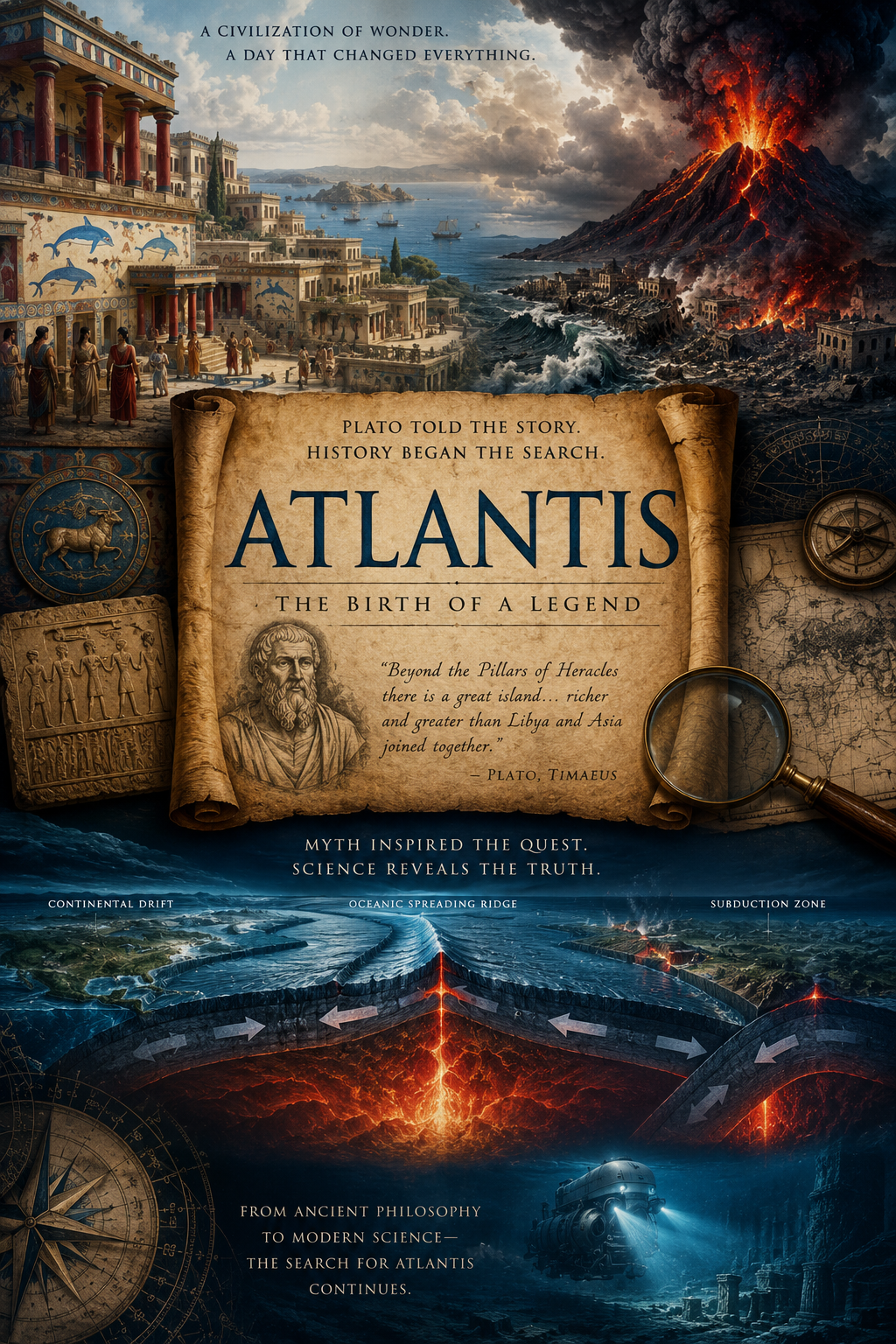
The search for a lost world does not always require a ship or a submarine. Sometimes, it only requires a clear mind and a careful look at the past. In the beginning of the investigation, we find the story of Atlantis as told by the philosopher Plato. He did not write it as a history book but as a lesson in his dialogues. He described a great island kingdom located beyond the Pillars of Hercules, which we now know as the Strait of Gibraltar. This land was rich with advanced engineering and powerful fleets, but its people became too proud. To show what happens when a nation loses its way, Plato told how the gods destroyed the island in a single day and night of catastrophe. This was the first story, a moral tale meant to compare a greedy empire with a virtuous city like ancient Athens. It was never meant to be a map to a real place, yet it sparked a fire in the human imagination that has never gone out.
As time passed, the world changed and people began to read Plato’s words differently. During the era when explorers were finding new lands across the sea, the search moved from the world of ideas into the physical world. This transition marks the beginning of the story of the Age of Discovery. People began to use the tools of archaeology to look for signs of the lost continent. They looked everywhere from the cold north to the hot sands of the desert. The problem was that many of these seekers were not following the evidence. They decided where Atlantis was first and then tried to make the facts fit their ideas. This is the danger of starting with a conclusion instead of a question, and it is where the narrative shifts from history into the realm of human error.
This leads to a turn in the investigation known as the story of Atlantis and the rise of pseudoscience. In this part of the journey, we see how writers in the nineteenth century tried to claim that Atlantis was the source of all human progress. They suggested that the pyramids of Egypt and the temples of the Americas were all built by people from this one lost island. It is a story of how we often try to find a single magic answer for complex things. It ignores the fact that human beings are clever and can invent great things on their own without needing help from a mythical ancestor. This way of thinking takes the credit away from real people and gives it to an imaginary ghost. It reflects a discomfort with uncertainty and a desire for mystery over the slow, patient work of real science.
One of the most convincing chapters in this investigation is the story of the Minoan civilization. On the island of Crete, a real and beautiful culture lived thousands of years ago. They had grand palaces and traded across the sea, much like the people in Plato’s tale. Their world was changed forever by a massive volcanic eruption on the nearby island of Thera. This event was so big that it sent waves across the sea and ash into the sky, devastating the region. It is easy to see why someone might think this was the real Atlantis. However, logic shows us that the timing and the details do not quite match what Plato wrote. It is a lesson in how a real event can be the seed of a legend, even if the legend grows into something much bigger and different from the truth.
To find the final answer, the investigation must look at the earth itself. This brings us to the story of plate tectonics. We now know that the surface of our planet is made of giant pieces that move very slowly over immense spans of time. This scientific understanding tells us that a whole continent cannot simply sink into the deep ocean in a single day. The crust under the ocean is fundamentally different from the crust that makes up the land we walk on. The story of continental drift explains that the Atlantic Ocean has been there for millions of years, leaving no room for a sunken kingdom to have existed just a few thousand years ago. Nature provides its own evidence that contradicts the old legend, showing that the floor of the ocean is not a graveyard for lost cities.
The investigation then turns to the story of the birth of a legend and why it endures. It explores the way human memory works. We tend to make stories simpler and more exciting as we tell them over and over. A small flood becomes a global disaster. A local war becomes a battle for the world. This is not because people are lying, but because it is how we share our history. The story of why Atlantis survives is really a story about human psychology. We love the idea of a lost golden age where everything was perfect. It gives us hope and feeds our curiosity. We remake Atlantis in every age to fit our own dreams, whether those dreams are about magic or advanced technology or visitors from other worlds.
The final story is about the meaning behind the myth. It reminds us that Plato’s original goal was to talk about morality. The sinking of the island was a metaphor for what happens when a society becomes too focused on wealth and power. In this review of the work, we can see that the investigation is a masterpiece of clear thinking. It shows that science is not about taking the mystery out of the world, but about finding a deeper and more real wonder. The book is a guide for how to think clearly and how to value the truth over a beautiful lie. It teaches us that the real achievements of human history are more than enough to be proud of. We do not need a lost continent to be a remarkable species.
Isaac Asimov presents this journey with the calm and logical tone of a true teacher. He does not mock those who believe in the legend but instead invites them to look at the facts with him. The narrative moves seamlessly from philosophy to geology, showing how different fields of knowledge all point toward the same reality. It is a compelling demonstration of why reality is often more fascinating than legend, precisely because reality reveals its truths through careful investigation rather than wishful thinking. In the end, the search for Atlantis is not a search for a place in the ocean, but a search for an understanding of how we think and how we tell stories about ourselves.