Uranus The Sideways Planet
Isaac Asimov details the historic discovery, extreme sideways tilt, pale color, and mysterious moons of Uranus, celebrating human curiosity and the power of scientific observation.
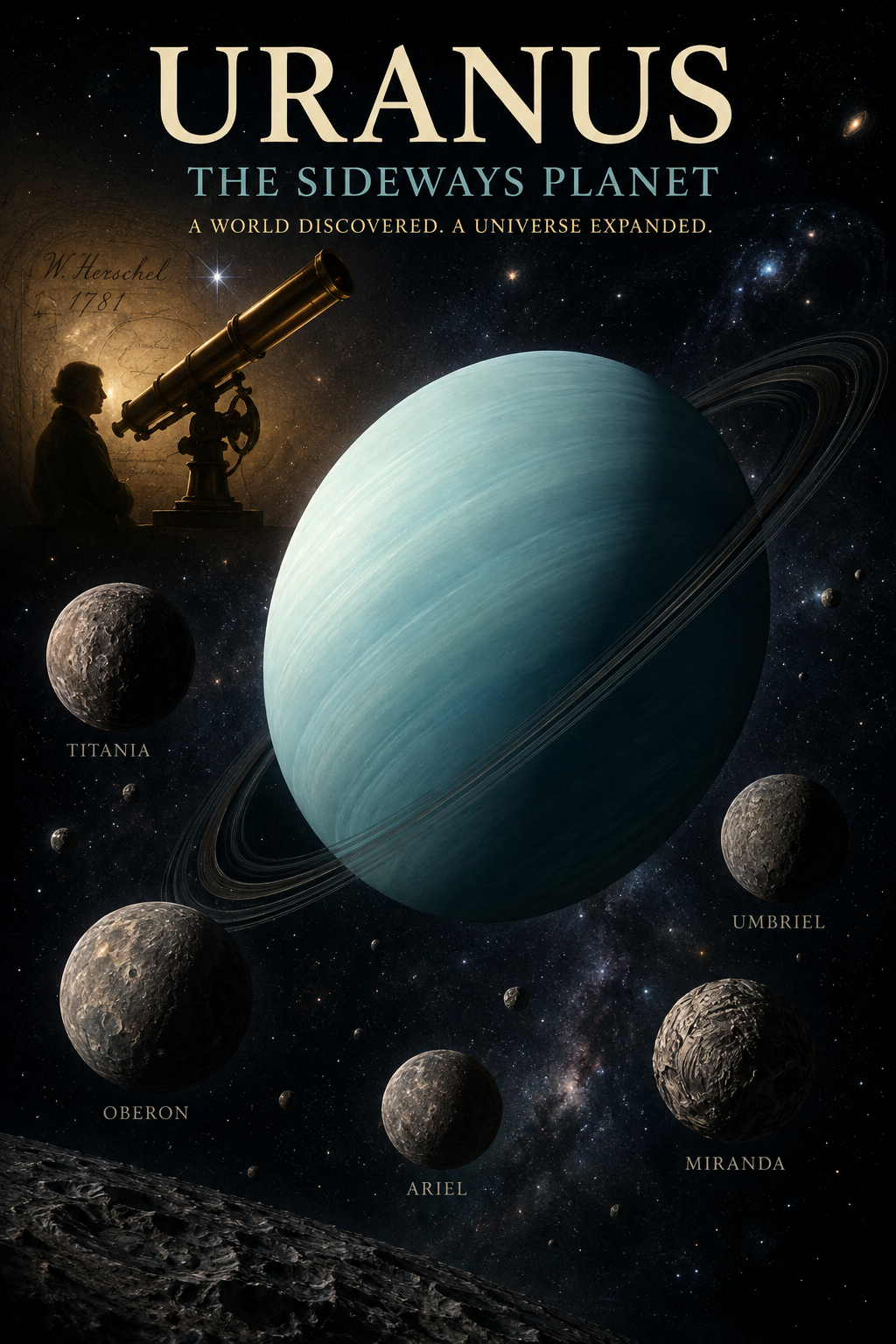
Isaac Asimov’s Uranus: The Sideways Planet is far more than a dry collection of scientific facts. As is characteristic of Asimov's vast body of work, he approaches the subject not just as a scientist, but as a master storyteller. He transforms the complex field of astronomy into a living, breathing narrative of human curiosity. Instead of simply handing the reader a list of planetary statistics, Asimov tells the grand story of how humanity came to understand one of the most peculiar worlds in our solar neighborhood. Because the book unfolds as a series of interconnected mysteries and discoveries, the best way to understand this work is to explore the distinct mini stories that make up the larger adventure.
The Story of the Hidden Wanderer The first mini story is a tale of a world hiding in plain sight. For thousands of years, ancient civilizations looked up at the night sky and occasionally saw Uranus, but they failed to recognize what it was. Because the point of light moved so incredibly slowly across the heavens, everyone assumed it was simply another ordinary, distant star. For most of human history, the known solar system ended safely at Saturn. The true plot begins to unfold in 1781 when an English astronomer named William Herschel decided to look closer. When Herschel first observed the object through his telescope, he assumed he had found a comet because it looked slightly larger than the surrounding stars. However, as he and other scientists applied careful mathematics to track its circular path, they realized they had stumbled upon an entirely new planet. Asimov uses this story to show how a single, patient observation shattered the ancient boundaries of the known universe and doubled the size of humanity's planetary neighborhood.
The Story of the Ice Giant Once the planet was discovered, the next great story involved uncovering its true nature. Through early telescopes, Uranus appeared to be a tiny, plain, bluish green disk. It lacked the magnificent, colorful storms of Jupiter or the dazzling, bright rings of Saturn, making it seem rather disappointing at first glance. But Asimov quickly reveals that this calm exterior was hiding a bizarre environment. He takes the reader on a journey into the planet's makeup, explaining that Uranus is an enormous ice giant filled with vast amounts of water, ammonia, and methane. The narrative beautifully explains how the planet gets its color: the methane in its atmosphere absorbs red light from the Sun and reflects a soft, pale blue green light back into the darkness of space. Asimov also tells the story of the planet's immense isolation. Orbiting nearly two billion miles from the Sun, a single year on Uranus takes eighty four Earth years to complete. This means that entire human generations live and die while the planet makes just one slow journey around the Sun, a fact Asimov uses to humble the reader and show how vastly different life is on other worlds.
The Story of the Great Collision The most gripping scientific mystery in the book centers around the planet's strange behavior in space. While every other major planet spins on an axis that is roughly upright, Uranus rolls around the Sun entirely on its side. Tilted at ninety eight degrees, it is as though the planet was knocked over. Asimov builds a fascinating detective story around this tilt, painting a vivid picture of the extreme seasons it causes. Because of this sideways posture, one pole of the planet faces the Sun for forty two years of continuous daylight, while the other pole is plunged into forty two years of deep, freezing night. To explain this mystery, Asimov takes the reader billions of years into the past. He introduces the theory that during the chaotic early days of the solar system, a gigantic collision with another massive object struck the young planet. While the full details of this ancient catastrophe remain hidden, the sideways tilt of Uranus serves as a permanent, lasting scar of a violent cosmic history.
The Story of the Literary Moons and Hidden Rings The final mini story expands the focus from the planet itself to the complex family of objects caught in its gravity. As telescopes slowly improved over the centuries, astronomers began spotting moons orbiting the distant world. In a delightful twist that perfectly suits a writer like Asimov, these moons were not named after figures from classical mythology like the rest of the solar system. Instead, moons like Titania, Oberon, Ariel, and Miranda were named after characters from the literary works of William Shakespeare and Alexander Pope. Each of these moons tells its own story, with some covered in ancient craters and others showing signs of violent geological activity. Alongside the moons, Asimov shares the thrilling realization that Uranus also possesses a system of rings. Unlike Saturn's bright bands of ice, the rings of Uranus are thin, dark, and incredibly difficult to find. This discovery serves as a reminder that the universe is far more varied and surprising than scientists ever expect.
Review Uranus: The Sideways Planet stands as a brilliant example of Isaac Asimov’s unparalleled ability to make complex science accessible and deeply engaging. Assuming the role of a patient and enthusiastic guide, Asimov uses clear, simple language and logical steps to build the reader's understanding. He never relies on heavy jargon, but instead focuses on the fundamental principles of physics, chemistry, and observation.
One of the greatest triumphs of this book is how it frames the scientific method. Asimov does not just want you to know facts about a distant planet; he wants you to understand the power of logical deduction. By showing how astronomers used faint light, orbital mathematics, and stellar shadows to understand a world they could not touch, he celebrates the sheer power of human reasoning. Furthermore, he expertly preserves the mystery of the unknown. While modern missions like Voyager 2 have since flown past Uranus and gathered new data, Asimov’s original text remains incredibly durable. It survives the test of time because it is fundamentally a book about how we learn, rather than just what we know at any given moment.
In the end, Asimov leaves the reader with a profound sense of perspective. He teaches us that the universe rarely matches our simple expectations, and that every answered question naturally leads to a new mystery waiting in the dark. It is a masterful, highly recommended work that perfectly captures the joy of exploration and the unending quest for knowledge.