Mars Our Mysterious Neighbor
Asimov details humanity's evolving relationship with Mars, this tracing how ancient myths and illusory canals gave way to robotic discoveries and visions of future human exploration.
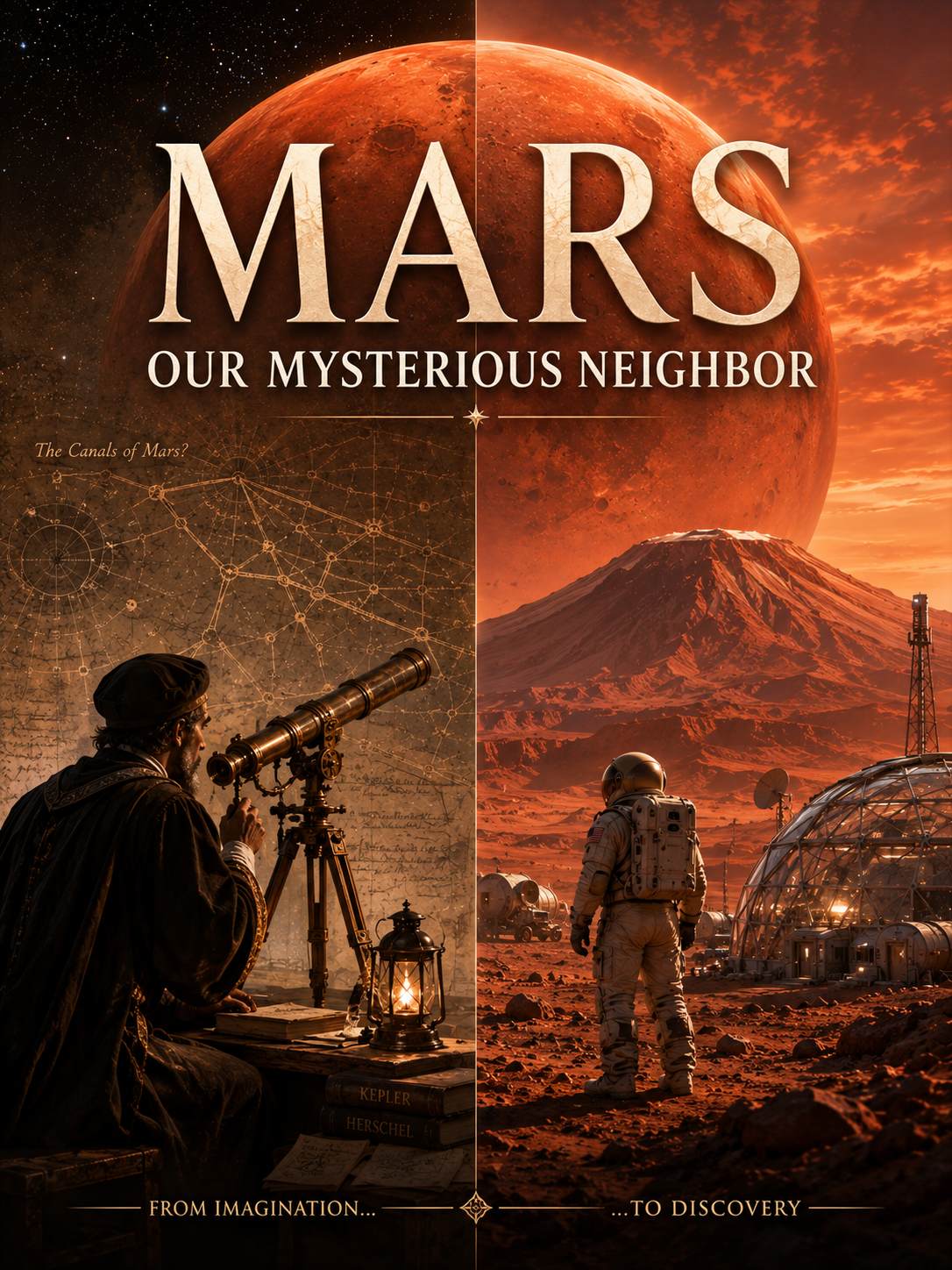
Humanity's relationship with the cosmos has always been defined by a deep seated curiosity about our closest celestial neighbors, and among them, none has captured our collective imagination quite like the fourth planet from the Sun. Isaac Asimov’s Mars: Our Mysterious Neighbor is not a conventional tale of fictional characters, but rather a grand biography of a world that has stood for millennia halfway between the familiar and the unknown. It is a story of changing ideas, charting how humanity transitioned from viewing Mars as an unpredictable omen in the night sky to recognizing it as a real, physical place governed by the same scientific laws that control our own Earth. In telling this story, Asimov adopts his classic, accessible style, guiding the reader step by step from ancient observations to the complex discoveries of modern interplanetary probes. He presents science not as a dry collection of static facts, but as an active, self correcting journey where evidence slowly and beautifully replaces speculation.
The narrative begins in the ancient world, where early skywatchers watched a bright, reddish light wander unpredictably across the background of fixed stars. Because of its striking, fiery color, many ancient cultures instinctively associated the planet with blood, war, and fire, naming it after their respective gods of battle. These myths, though varied across civilizations, reflected a universal human awe toward this strange celestial wanderer. As centuries passed and the tools of observation grew more sophisticated, the mythical red light was transformed into a physical world. Through the groundbreaking work of Copernicus, Kepler, and Newton, humanity learned that Mars follows a regular, predictable orbit around the Sun. Asimov clearly explains that because Earth and Mars travel at different speeds and distances, the gap between them is constantly changing. Every twenty six months, our planet catches up to Mars, bringing them relatively close together in an event called an opposition. These oppositions became crucial windows of opportunity, allowing astronomers to train their telescopes on the red planet when it was at its brightest and most visible.
With the advent of the telescope, the story of Mars entered a phase of intense speculation and exciting possibilities. Early astronomers no longer saw a mere point of light, but a tiny reddish disk. Through their primitive lenses, they noticed white patches at the Martian poles that grew and shrank in direct response to the changing seasons, suggesting the presence of ice. They also observed shifting dark and bright markings across the planet's surface, which led many to wonder if they were witnessing the seasonal growth of alien vegetation. This telescopic exploration set the stage for one of the most famous and captivating misunderstandings in scientific history: the mystery of the Martian canals. During the nineteenth century, the Italian astronomer Giovanni Schiaparelli mapped fine, linear markings on the Martian surface and referred to them as canali, meaning natural channels. However, the word was translated into English as canals, a term that strongly implied artificial construction by intelligent hands.
This linguistic slip ignited the imagination of the American astronomer Percival Lowell, who became convinced that these features were part of a vast, planet wide irrigation system. Lowell theorized that an advanced, highly intelligent Martian civilization had built these canals to transport water from the icy polar caps across a drying, dying planet. Asimov vividly describes how this romantic idea captured the global public imagination, inspiring newspaper articles, lectures, and early science fiction novels that depicted a heroic alien civilization struggling against planetary drought. Yet, as Asimov reminds us, the ultimate strength of science lies in its willingness to demand evidence over desire. As telescopes improved and robotic spacecraft finally photographed the Martian surface directly, the majestic canals vanished. They were revealed to be an optical illusion, a trick played on the human eye trying to connect scattered dark markings near the limits of visual resolution. Rather than portraying this as a disappointment, Asimov frames it as a triumph of scientific integrity, proving that false theories must always yield to better, more accurate observations.
Once the illusion of the canals was swept away, the story shifted to the true, physical nature of Mars. Asimov details a world that is only about half the diameter of Earth and possesses roughly one tenth of its mass. Because of its smaller size, Mars cooled much faster during its early history, leaving behind a unique geological record. Its gravity is about thirty eight percent of Earth’s, a detail that Asimov notes would allow future human explorers to walk with ease while remaining securely anchored to the ground. The atmosphere of Mars is incredibly thin and composed primarily of carbon dioxide. This thin blanket cannot hold heat well, resulting in extreme temperature drops between day and night. Furthermore, the atmospheric pressure is so low that liquid water cannot remain stable on the surface for any significant length of time. Despite this thinness, the Martian atmosphere is surprisingly active; winds sweep across the vast, iron oxide rich red deserts, occasionally whipping up colossal dust storms that can grow to envelop the entire planet and temporarily hide all of its surface features.
The physical landscape of Mars, as revealed by spacecraft, is a study in magnificent geological extremes. It is home to ancient impact craters that date back to the violent early days of the Solar System, as well as massive shield volcanoes that dwarf anything found on Earth. The grandest of these, Olympus Mons, towers so high that it makes Mount Everest seem small. Asimov explains the science behind this colossus: because Mars lacks moving tectonic plates, the Martian crust remained completely still over a stationary volcanic hotspot, allowing lava to pile up in the exact same spot for millions of years. Alongside these volcanoes are colossal canyon systems that stretch for thousands of kilometers across the surface, providing clear evidence of massive geological forces that once shaped the planet.
The most intriguing chapter of the Martian story, however, concerns the history of water. While the modern polar caps are composed of a mix of frozen carbon dioxide and water ice, the dry surface of Mars is carved with unmistakable signs of a wetter past. Branching channels, ancient river valleys, and sweeping flood plains suggest that liquid water once flowed freely across Mars billions of years ago. This realization reshapes our understanding of the planet, transforming it from a permanently dead desert into a world with a highly dynamic climate history. Naturally, the presence of ancient water leads to the ultimate scientific question: did Mars ever support life? Asimov approaches this with characteristic scientific caution, noting that while intelligent Martians belong to the realm of myth, the possibility of ancient, microscopic life remains highly plausible. The discovery of even the simplest fossilized microorganism would be one of the greatest events in human history, proving that life is not unique to Earth.
The final phase of the narrative recounts humanity’s robotic assault on Mars. Early missions were plagued by failures, demonstrating the immense difficulty of traveling across the void of space. However, persistent efforts eventually led to successful flybys, orbiters that mapped the planet in exquisite detail, and landers that touched down safely to test the Martian soil directly. Each successful mission stripped away another layer of mystery, revealing that the real Mars is far more complex, with deeper valleys and higher mountains, than anything astronomers had imagined through telescopes. Asimov concludes this magnificent journey by looking toward the future. Mars is the most accessible planet in our Solar System, far more hospitable than the crushing pressure of Venus or the distant gas giants. It stands as the logical next step for human exploration, a place where future astronauts may someday build habitats, study ancient geology in person, extract water from hidden ice, and establish a permanent outpost for humanity among the stars. In the end, Asimov’s work is a testament to our ongoing relationship with the unknown, leaving us with the inspiring thought that the greatest secrets of Mars are still waiting to be uncovered beneath its dusty, reddish sands.