The Earth's Moon
Asimov presents the Moon as a historical witness, explaining its cycles, tidal locking, and craters while framing exploration as humanity's ultimate stepping stone to space.
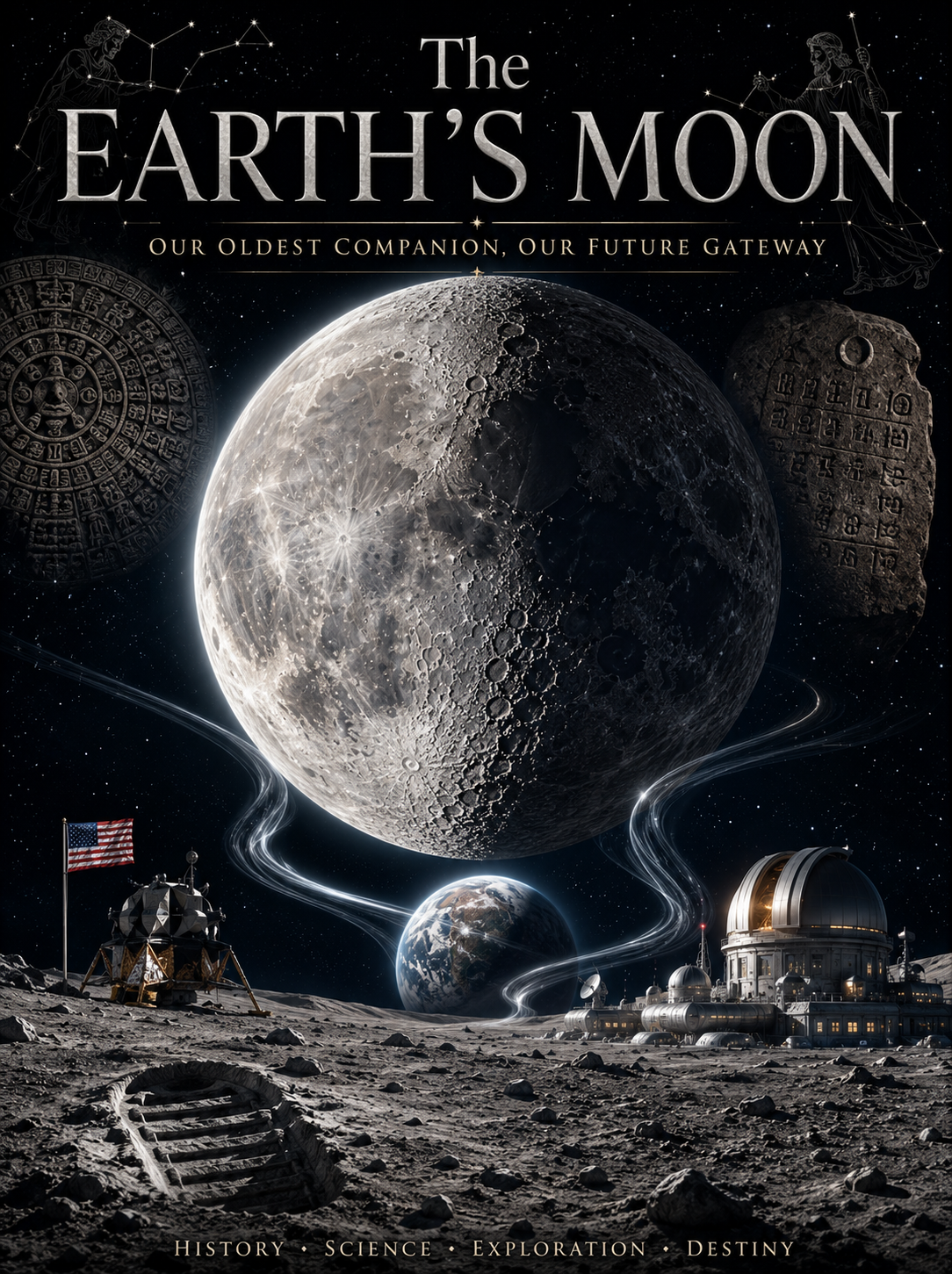
Isaac Asimov spent a lifetime building a bridge between the cold facts of science and the warm curiosity of the human mind. Whether he was writing about the laws of robotics or the rise and fall of a Galactic Empire, his goal was always clarity through logic. In the sources, we find him applying this same dedication to a subject that is often taken for granted: the Moon. He does not view it as a mere rock in space, but as a historical witness that has watched the Earth evolve since the dawn of the Solar System. This work serves as a biography of a faithful companion, leading the reader from the simple wonder of the night sky to a future where humanity lives among the stars.
In the tradition of his other works, Asimov begins with the familiar. He understands that humans are often blind to what they see every night. The Moon appears simple because it is always there, yet it is the primary key to understanding our own history and our potential future beyond the home world. His presentation follows a logical ladder, where each rung is a concept that must be grasped before moving higher, eventually transforming a distant light into a tangible world with its own complex story.
The biography of the Moon can be understood through several mini stories that Asimov unfolds with his trademark precision.
The Story of the Changing Face
The first mini story involves the Moon as humanity’s oldest companion. Long before we had the tools to measure the stars, the Moon served as our first clock. This story describes how ancient civilizations watched the Moon transform its shape night after night. While early cultures created myths to explain why the light grew and faded, Asimov replaces these myths with the elegant truth of geometry. He explains that the Moon never truly changes its form; we simply see different portions of its sunlit half as it travels its orbital path. Within this story, he also explains the drama of eclipses, rare moments of precise alignment where the Earth, Moon, and Sun cast shadows upon one another, demonstrating that even the most spectacular celestial events are governed by predictable celestial mechanics.
The Story of the Locked Dance
The next story concerns the invisible bond of gravity. Asimov addresses the common mystery of why the Moon always shows us the same face. This is not a coincidence but the result of tidal locking. Over immense spans of time, Earth’s gravity acted as a brake, gradually slowing the Moon's rotation until it perfectly matched the time it takes to orbit our planet. This story extends to the Earth itself, explaining how the Moon’s gravitational pull creates the rhythmic rising and falling of our tides. This gravitational dance is not one sided; while the Moon shapes our tides, the Earth has shaped the Moon’s very rotation, illustrating a deep physical relationship that continues to evolve.
The Story of the Silent Archive
Asimov then moves to the physical landscape of the Moon, portraying it as a silent historian. Because the Moon has no atmosphere, there is no wind or rain to wear away its features. This mini story explains that the Moon is a fossil of the early Solar System. Its mountains and maria, enormous plains of hardened volcanic lava once mistaken for seas, remain unchanged for billions of years. The countless craters on its surface are not just scars, but records of ancient impacts. While the Earth erases its history through weather and tectonic activity, the Moon preserves a violent record of the past that is three to four billion years old.
The Story of the Great Mystery
One of the most compelling segments is the story of the Moon’s origin. Asimov presents this as a scientific detective story, weighing different theories against the evidence. Did the Moon form elsewhere and get captured by Earth’s gravity? Did it split off from a rapidly spinning young Earth? Or did the two worlds grow together from the same cloud of cosmic dust? Rather than providing a single final answer, Asimov shows how science works by honestly comparing competing ideas and evolving as new data, like the rocks brought back by astronauts, becomes available.
The Story of the First Step
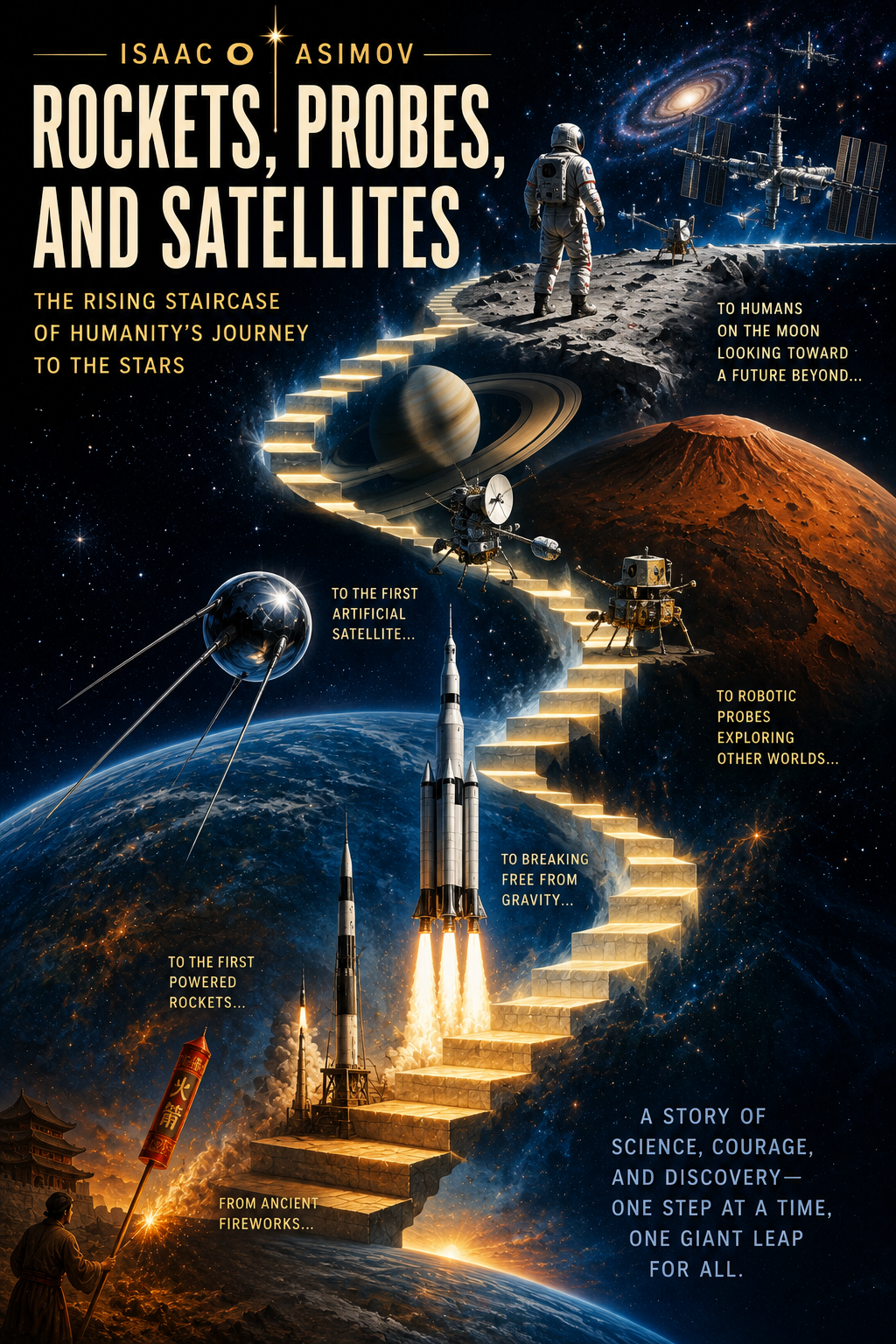
The narrative reaches a peak with the story of exploration. For centuries, the journey to the Moon was the province of dreamers and science fiction writers. Asimov tracks the transition from imagination to engineering, beginning with robotic probes and culminating in the Apollo missions. He describes the moment humans first stepped onto another world not as the end of a journey, but as the true beginning of our understanding of planetary history. The samples returned by these explorers did more than satisfy curiosity; they revolutionized our knowledge of where our own world came from.
The Story of the Gateway
The final mini story looks forward. Asimov argues that the Moon’s environment, though harsh and airless, offers unique scientific advantages. Its lack of atmosphere makes it the perfect site for future observatories, and its weak gravity, only one sixth of Earth’s, makes it an ideal launching pad for deep space travel. In this view, the Moon is not just a destination but humanity's first stepping stone into a wider interplanetary civilization.
Review of the Work
As a review of this biography, one must admire Asimov’s commitment to his logic of the ladder. He never uses a complex word where a simple one will do, and he never introduces a difficult concept without first laying the groundwork. This is a hallmark of his non fiction, much like how his robot stories are built on the firm foundation of the Three Laws. He takes a subject that could be a dry list of statistics and turns it into a compelling narrative of discovery.
The strength of the work lies in how it bridges the gap between the ancient past and the far future. By the end, the reader realizes that the Moon is not just a light in the sky, but a part of our own story. Asimov leaves us with a sense of wonder that is grounded in reason. He suggests that every time we look at the Moon, we are seeing a mirror of Earth’s past and a doorway to humanity’s future. For any reader who has enjoyed the logical puzzles of Asimov’s fiction, this exploration of our nearest neighbor will feel like a conversation with a wise friend who sees the universe as a grand, solvable mystery.