How Was the Universe Born
Isaac Asimov explains how the expanding universe evolved from the hot Big Bang, tracing cosmic history through light to explore its mysterious fate.
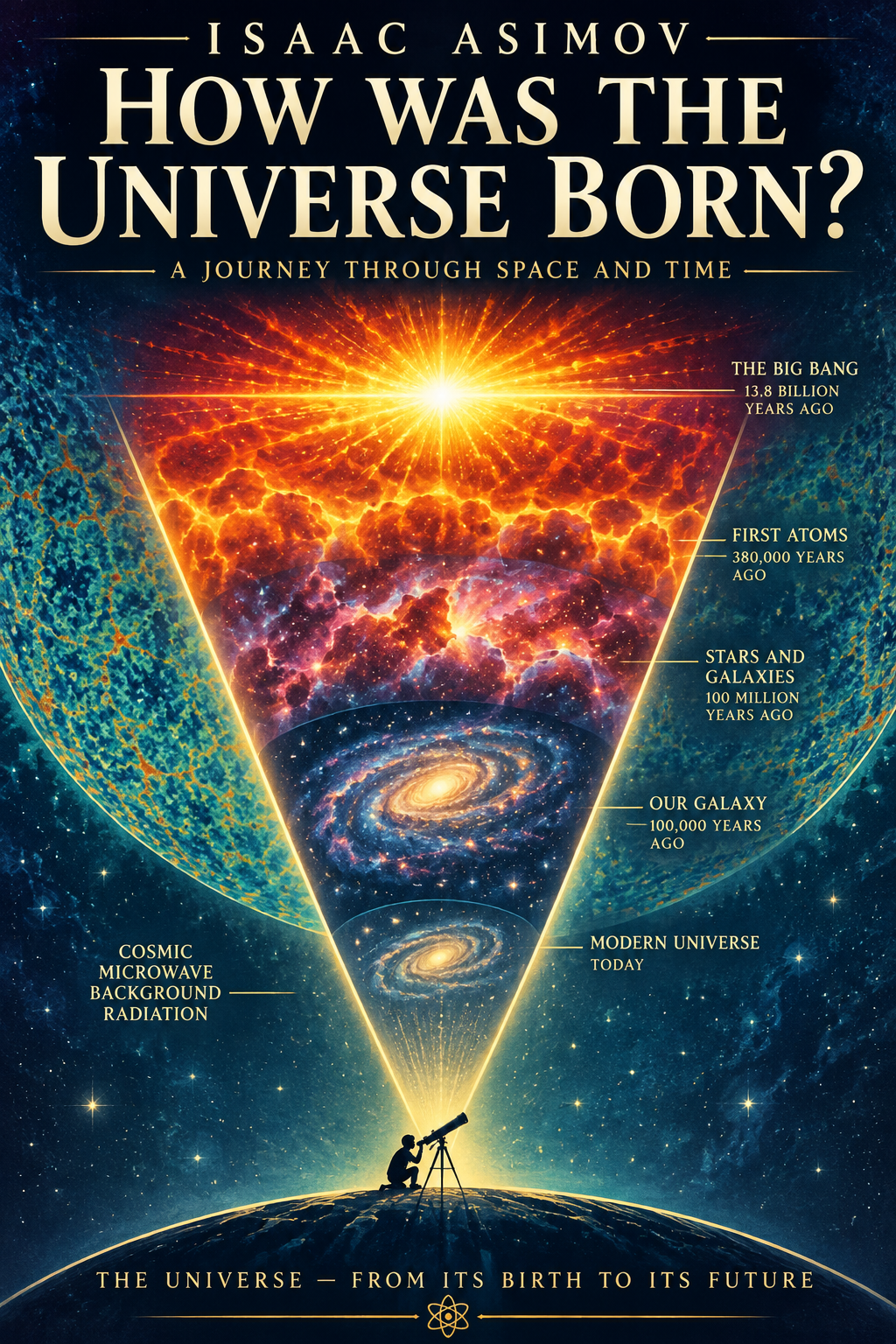
The grand story of our cosmos begins not with a collection of permanent stars floating in a static, empty container, but with a dynamic protagonist that grows, changes, and journeys through time: the universe itself. In his short yet wonderfully ambitious work, How Was the Universe Born? by Isaac Asimov, Asimov takes a subject that is almost impossibly vast and translates it into a clear, logical, and deeply human detective story where light itself serves as the primary evidence. Written as part of his library of the universe, this thirty two page book does not overwhelm the reader with dense mathematical equations. Instead, it invites us to participate in a profound intellectual adventure, tracing the cosmic path from a mysterious birth toward an equally mysterious and unresolved future.
To understand where this cosmic narrative is building from, we must first follow Asimov as he raises a deceptively simple question about how everything could have possibly begun. He notes that our ordinary daily experiences teach us to think of beginnings as events that occur in a specific, pre existing place. A building begins when workers assemble it on a plot of land, a tree begins when a seed takes root in the soil, and a fire begins when we ignite a fuel source. But the universe is fundamentally different because it contains all of space itself. If the entire universe had a beginning, we cannot easily ask where that beginning occurred, nor can we easily define what existed "before" the beginning occurred. This intellectual puzzle forms the very heart of the book, forcing us to stretch our minds beyond the boundaries of our localized, everyday experience.
The breakthrough that resolves this puzzle lies in the realization that our universe is actively changing. Far from being static, the vast distances separating galaxies are continuously increasing. Asimov highlights the crucial work of Edwin Hubble, who observed that distant galaxies display red shifts in their light. This phenomenon indicates that these galaxies are receding from us, and further observation reveals that the farther away a galaxy is, the faster it appears to be moving away. This leads logically to the conclusion that the universe is undergoing a continuous, large scale expansion of the universe.
By establishing this current state of expansion, the narrative gains a powerful tool: the ability to run the history of the cosmos backward in our minds. If we rewind the cosmic film, we see the vast distances between galaxies shrink. The space separating them becomes smaller, and all the matter in the cosmos is crowded closer and closer together. As the universe becomes increasingly dense, it also becomes extraordinarily hot. Eventually, if we carry this logical regression far enough back, we reach a threshold where the familiar structures of our world, galaxies, stars, planets, and even the basic atoms that make up our bodies, could not have existed in their present forms.
This brings us to the threshold of the Big Bang, which is the foundational point from which the modern universe built outward. Asimov is incredibly careful to dispel a very common misunderstanding about this event. The Big Bang should never be envisioned as a conventional explosion that took place at a single, specific location within some pre existing empty space. There is no central point in the cosmos from which galaxies were shot outward like shrapnel from a bomb. Instead, the expansion is an expansion of space itself. From the perspective of an observer in any sufficiently distant galaxy, the rest of the universe would appear to be expanding away from their specific location. Consequently, our own planet Earth does not occupy any central or privileged position in the grand architecture of the cosmos.
How can we as human beings verify this remarkable history? The cosmic detective story relies on the simple but profound truth that light travels at a finite speed. When we look up at the Moon, we do not see it as it exists at this exact microsecond; we see it as it was slightly more than a second ago. When we look at our Sun, we see light that departed its surface about eight minutes earlier. As astronomers peer deeper into space, observing stars thousands of light years away or galaxies millions of light years distant, they are effectively looking backward into cosmic history. The night sky is therefore not a photograph of a single present moment, but a beautiful, layered tapestry of different moments from different cosmic ages. Astronomers possess the unique advantage of being able to observe different stages of cosmic evolution simply by adjusting the distance of the objects they choose to study.
This reliance on observation brings us to the question of the universe's age and the scientific process itself. Astronomers estimate this age by comparing the distances of galaxies with the rate at which they are moving apart, a relationship governed by Hubble's law and the Hubble constant. Yet, measuring these immense cosmic distances is a notoriously difficult task, which explains why estimates of the universe's age and size have changed over time as our technology has improved. Asimov uses this uncertainty to teach a vital lesson about the nature of science: scientific knowledge is not a rigid collection of permanently fixed numbers. Instead, it is an evolving framework that continuously refines itself as our instruments and observations become more precise.
The narrative then guides us through the physical evolution of the newborn universe. As the cosmos expanded, it underwent a fundamental physical change: it cooled. In the extremely hot and dense conditions of the earliest moments, ordinary matter could not exist. But as cooling progressed, simpler particles began to form, eventually organizing into atoms. Hydrogen and helium emerged as the dominant early elements. Much later, the gentle but relentless pull of gravity began to gather this matter into increasingly massive clouds, igniting the first stars and forming the first galaxies. These stars became the cosmic furnaces where heavier elements were forged, elements that would much later gather to form planets, moons, and eventually, human beings.
This evolutionary story is supported by powerful physical clues that Asimov describes with his trademark clarity. The first clue is the ongoing expansion of the universe, and the second is the sheer abundance of light elements like hydrogen and helium, matching the predictions of the Big Bang model. The third and perhaps most striking clue is the cosmic microwave background radiation. The early, hot universe was filled with intense radiation, and as space expanded, this radiation stretched and cooled. Today, it remains as a faint, cold background radiation spread evenly throughout the cosmos, a surviving echo and a direct memory of the universe's birth.
Asimov contrasts this evolving picture with the steady state model, a major competing theory of the twentieth century which proposed that the universe had always existed without a definite beginning. According to this theory, new matter was continuously created to maintain a constant density and appearance as space expanded. However, the steady state model struggled to survive as observations accumulated. If the universe had always looked the same, we would not observe the evolutionary differences that astronomers see when they look at highly distant, younger regions of space. The discovery of the cosmic microwave background radiation ultimately delivered a decisive blow to the steady state model, cementing the Big Bang as the dominant scientific explanation.
Having explored the birth and evolution of the universe, the story naturally leads toward its final chapters: the mystery of how it will end. At the time of the book's writing, this ultimate fate depended on the overall density of matter in the cosmos and the resulting strength of gravity, which acts as a brake on cosmic expansion. If the universe contains enough matter, gravity will eventually slow the expansion to a halt, reverse it, and pull everything back together in a catastrophic collapse known as the Big Crunch. This would set the stage for a cyclical cosmic history of expansion, contraction, and perhaps new beginnings. Alternatively, if there is insufficient matter, the universe will expand indefinitely, growing colder and darker as stars exhaust their nuclear fuel and usable energy fades away.
Ultimately, Asimov's work is far more than a simple astronomy primer. Its greatest value lies in its demonstration of the scientific method of thinking, showing readers how to move systematically from observation to hypothesis, from hypothesis to prediction, and from prediction back to observation. The book closes not with absolute certainty, but with a profound, unresolved question about our future, framing the unknown not as a defeat, but as the thrilling next stage of human discovery. We find ourselves living on a tiny planet orbiting an ordinary star in one galaxy among billions. Yet, the most beautiful lesson of this cosmic story is that we are not passive observers. The universe has a history that we can read, and from our small corner of space, we have successfully learned how to look backward, understand our origins, and ask the questions that define our existence.