Ghosts
This fourteen story anthology explores diverse hauntings, revealing how ghosts embody memory, guilt, literary creations, spiritual forces, and extraterrestrial organisms.
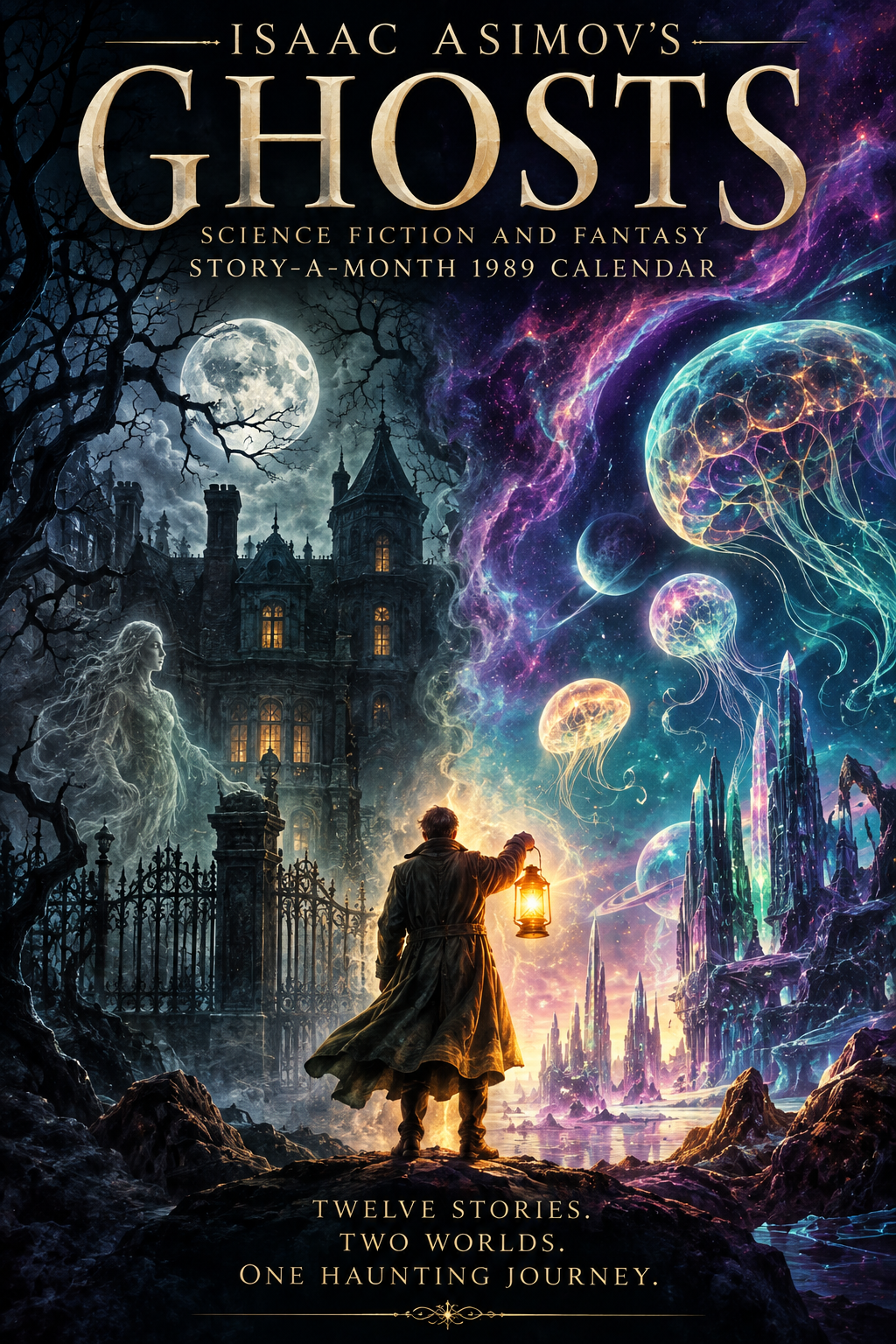
Ghosts: A Journey Through the Fourteen Chambers of the Soul
The investigator stood before the heavy wooden doors of the old estate, holding a volume that promised to reveal the secrets of the supernatural. This book was Ghosts, the tenth volume of Isaac Asimov’s Magical Worlds of Fantasy, edited by Asimov alongside Martin H. Greenberg and Charles G. Waugh. As a person of science, the investigator approached the threshold with the same cool, logical curiosity that Asimov himself displayed in his introduction. The investigator wondered if a ghost was merely a dead person refusing to depart, a memory given physical form, an instrument of vengeance, or perhaps nothing more than the product of human fear and guilt. With these questions in mind, the investigator pushed open the door and stepped into a series of fourteen chambers, each containing a distinct vision of the afterlife.
In the first chamber, the investigator witnessed a newly married couple, Gerald and Phrynne Banstead, who had arrived in the remote seaside town of Holihaven for their delayed honeymoon. They expected a quiet holiday, but the town felt cold, and the church bells immediately began to ring. The investigator watched as Gerald slowly realized that these bells were not practicing, but were instead ringing to wake the dead. The story built from the atmosphere of an unsettling, empty seaside resort and led toward a grotesque resurrection festival where the boundary between life and death completely collapsed. Yet, the investigator noted that the true haunting was not merely the physical resurrection, but the emotional awakening of Phrynne, who found in this terrifying event a liberation from the deadness of her own marriage.
Stepping into the second chamber, the investigator was surprised to find a brightly lit office that felt delightfully Asimovian in its logical and witty presentation. Here, a successful writer named Graham Dorn was having a strange argument with his own fictional detective hero, Reginald de Metzter, who had somehow stepped out of his imagination. Reginald was dissatisfied with how his creator was treating him, demanding better plots, more dignity, and control over his destiny. The story built from a writer's frustration with a famous character and led toward a humorous labor dispute between creator and creation. The investigator realized that Asimov had cleverly turned the concept of a ghost into a literary problem, where a fictional character becomes a spirit haunting the mind of the man who invented him.
The third chamber echoed with the distant, energetic sounds of electric guitars, taking the investigator into the world of popular music. In this room, the ghosts of Buddy Holly, Ritchie Valens, and J. P. Richardson were continuing their musical careers posthumously. The story built from the idea of a legendary concert featuring deceased rock stars and led toward a poignant reflection on celebrity, memory, and the strange immortality that music provides. The investigator observed that these ghosts were not frightening; instead, they represented how a powerful identity can survive death through recordings and legends, creating an atmosphere that felt like a melancholy episode of a classic television mystery.
In the fourth chamber, the atmosphere grew silent and deeply disturbing as the investigator entered a quiet parlor in Ford Village. A woman named Rebecca Flint had arrived to collect her young niece, Agnes, but was met with evasion from the child's stepmother, Mrs. Dent. The story built from subtle, unexplained occurrences, a rose bush thrashing in the garden despite a complete lack of wind, and soft music playing in empty rooms. It led toward the tragic realization that Agnes was already dead due to neglect and abuse. The investigator saw that the horror of this tale lay entirely in absence; the ghost was not a visible specter, but the heavy shape of a hidden injustice that the living could not conceal.
The fifth chamber opened onto the rural American countryside, where a Vietnam veteran was attempting to build a peaceful, quiet life with his adopted child. The child had formed a deep attachment to a pony, but when a hostile neighbor killed the animal, the child's intense grief began to merge with the veteran's own suppressed memories of wartime violence. The story built from this quiet domestic tragedy and led toward an eruption of supernatural vengeance. The investigator realized that the ghost in this room was not just a dead animal, but the terrifying release of buried human trauma where the boundary between worldly violence and ghostly retribution ceased to exist.
Ascending to the sixth chamber, the investigator entered an apartment filled with the lingering, lonely presence of a deceased actress named Gayla Damon. A young couple, Alice and Lowen, had recently moved into the space, and Gayla found herself watching them, feeling a deep jealousy of Alice's physical life. The story built from Gayla's attempts to communicate and her gradual influence over Alice's body. It led toward an emotionally complex connection where Lowen recognized the spirit's presence and responded with deep sympathy. The investigator noted that this ghost was not an evil force, but a lonely soul seeking understanding, making it one of the most emotionally developed and celebrated stories in the collection.
In the seventh chamber, the investigator found a classic, dark haunted house where a group of boastful friends had gathered to spend the night. One of the men, Jack Barnes, insisted that supernatural occurrences were nothing but nonsense born of imagination. The story built from their initial confidence and jokes, but as the night deepened and strange events occurred, it led toward a terrifying struggle for survival. The investigator watched as their logical defenses crumbled before a house that seemed to demand a victim, leaving the true nature of the horror delightfully uncertain.
The eighth chamber was cold and stark, presenting the deteriorating urban district of Hawkhill, where an Anglo Catholic priest named Father Thomas Montrose was fighting a spiritual battle. The story built from the priest's dedication to his parish despite the surrounding decay and crime. It led toward a literal, terrifying confrontation with dark supernatural forces that began to press upon the priest himself, tempting him with lust, fear, and despair. The investigator realized that these ghosts were not dead people, but active spiritual evils that proved even the most faithful are not immune to temptation.
In the ninth chamber, the investigator walked through a damp, gloomy hallway where a guilty man was running in terror from a persistent, simple sign: the tiny wet footprints of a drowned child. The story built from a hidden, terrible crime and led toward relentless supernatural retribution. The investigator observed that the ghost did not need to physically attack the murderer; its mere, unyielding presence was enough to destroy his peace. Every wet footprint served as a terrifying reminder that the past can never be truly buried.
The tenth chamber was hazy and dreamlike, set in nineteenth century France, where three impoverished artists were facing their own mortality. Each man encountered a mysterious woman associated with death, who appeared in one of three forms: the Thief, the Seductress, or the Slaughterer. The story built from the artists' extreme exhaustion and hunger, leading toward a series of haunting visions. The investigator was left to ponder whether these women were true supernatural entities or merely the tragic hallucinations of dying men, reflecting the multi faceted nature of death itself.
Stepping into the eleventh chamber, the investigator met an eminent historian named Kraft, who was spending time in Nova Scotia while having an affair with a younger woman. Kraft's intellect was entirely consumed by the past, making it impossible for him to live fully in the present. The story built from his academic obsession and led toward a highly subtle, temporal haunting where he looked at the world and saw it already transformed into ruins. The investigator realized that the ghost here was not a dead person, but the future itself haunting a man who could not escape history.
The twelfth chamber was quiet and isolated, housing a simple, uneducated man named Luiz o Bobo, who possessed the unique ability to see the invisible daemons that accompanied every human being. Luiz had no daemon of his own, which left him feeling deeply separated from the rest of humanity. The story built from his profound isolation and led toward a tense confrontation with a brutal ship captain whose daemon was a terrifying scarlet. The investigator saw that the ghost in this tale was transformed into a visible representation of the human soul, exploring themes of innocence, isolation, and the hidden burdens we carry.
In the thirteenth chamber, the investigator entered a gloomy country house where Alice Hartley, a maid recovering from illness, had accepted a position serving Mrs. Brympton. Alice soon encountered the ghost of the previous maid, Emma Saxon, who seemed desperate to communicate a warning. The story built from the suffocating, secret tensions of an unhappy marriage and Mrs. Brympton's relationship with a neighbor. It led toward a dramatic climax where the ghost appeared as the hidden secrets of the house were forced into the open. The investigator noted that the ghost represented the suppressed history and guilt of the household, signaled by the chilling ring of a servant's bell.
The final chamber was completely different, metallic and futuristic, transporting the investigator to the planet Moritaba. Here, the clever detective Magnus Ridolph was dealing with competitive prospectors and a local race that valued theft. The story built from this science fiction premise and led toward a brilliant, logical solution where Ridolph discovered that the ghosts on the planet were actually near gaseous organisms that required uranium for fuel. By treating the supernatural as biology, Ridolph resolved the dispute, proving that what appears to be magic is often just poorly understood science.
Leaving the fourteen chambers behind, the investigator sat down to write a review of the entire journey. This anthology was a brilliant progression through different definitions of haunting, moving from physical resurrections to literary disputes, celebrity memories, hidden guilt, spiritual warfare, and extraterrestrial biology. The editorial selection, characteristic of Asimov's rationalism, invited the reader to look beyond simple frights and ask what our belief in ghosts tells us about ourselves. The investigator concluded that the most persistent spirits are not those that rise from graves, but the unfinished business of the living, the things we cannot finish, forget, forgive, or understand.