Saturn The Ringed Beauty
Asimov’s book traces Saturn’s exploration from Galileo’s telescope to Voyager’s discoveries, showing how explaining its rings, atmosphere, and moons only unlocks deeper, unresolved cosmic mysteries.
In the vast landscape of popular science writing, Isaac Asimov occupied a unique position, bringing the cold, silent facts of the cosmos to life with unmatched clarity, simplicity, and logic. In his short illustrated work, Saturn: The Ringed Beauty, published as part of Isaac Asimov's Library of the Universe, he does not merely compile planetary statistics. Instead, he crafts a narrative around the very act of human curiosity, treating our exploration of the sixth planet as a grand detective story. This thirty two page book is structured not as a dry list of facts, but as a carefully arranged journey of discovery. It begins with humanity's first blurred telescopic glimpses of a strange planet and progresses logically toward the astonishing close up revelations of modern spacecraft. Through twelve distinct chapters which function as mini stories of exploration Asimov presents a compelling argument about the nature of science itself: that every answer we find only opens the door to deeper, more captivating mysteries.
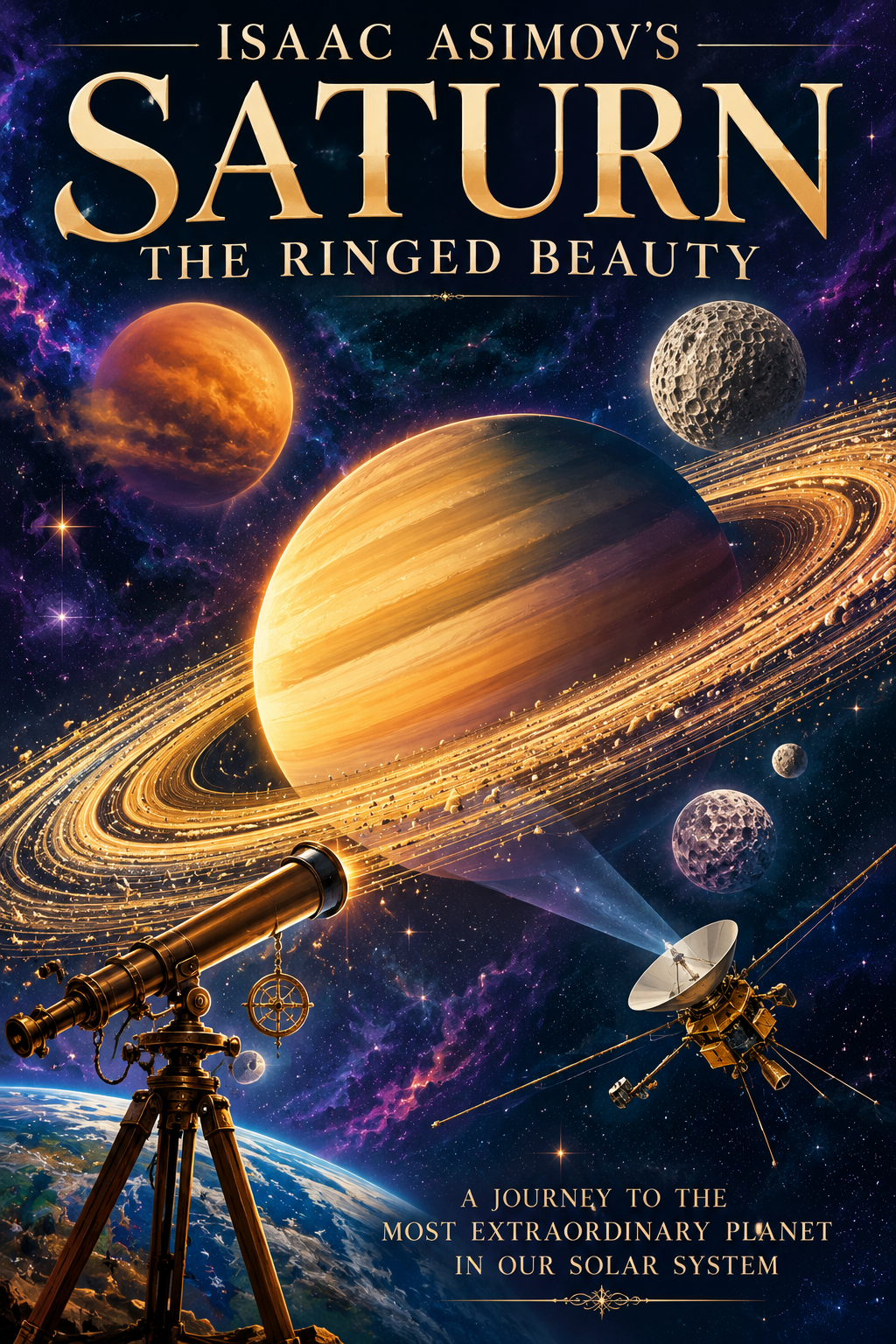
The adventure begins with the mini story “A Planet with Ears?”, which transports the reader back to the year 1610, when Galileo Galilei first pointed his primitive telescope toward Saturn. Because his instrument was too weak to resolve the planet clearly, Saturn appeared to have strange, inexplicable projections on either side. Galileo was deeply puzzled, and his confusion grew when these "ears" later seemed to vanish entirely from view. The resolution to this mystery would require decades of patience and technological advancement. It was Christian Huygens who, utilizing a much better telescope, finally realized that Saturn was surrounded by a thin, flat ring system. When these rings were viewed edge on from Earth, they became practically invisible, explaining Galileo's baffling observations. Through this historical opening, Asimov establishes a vital philosophical lesson that runs through all his works: nature does not become mysterious because it is irrational; it becomes mysterious simply because our instruments and knowledge are incomplete.
Having resolved the initial mystery of the rings, the narrative moves naturally into the second mini story, “A Giant Planet,” where Asimov introduces the true scale of this distant world. Saturn is revealed as the second largest planet in our Solar System, measuring roughly 75,000 miles, or 120,000 kilometres, across about nine and a half times the diameter of Earth. Yet, in typical Asimov fashion, we are urged to look past mere size. Despite its immense volume, Saturn is surprisingly light, possessing only about one third the mass of its giant neighbor, Jupiter, though it still has ninety five times the mass of Earth. Because of its enormous distance from the Sun, Saturn travels at a leisurely pace, taking approximately twenty nine and a half Earth years to complete a single orbit. Conversely, it spins with dizzying speed on its own axis, completing a full rotation in roughly ten and a half hours. This rapid spin generates a powerful centrifugal force that causes the planet to bulge dramatically at its equator, leaving Saturn visibly flattened when viewed through a telescope.
This contrast between immense size and low mass leads directly into the third mini story, “A Floating Giant”. Here, Asimov poses a delightful question: why is such an enormous planet so incredibly light for its size? The answer lies in its extraordinary composition, consisting primarily of hydrogen and helium, the two lightest common elements in the universe. Because of this, Saturn's average density is only about seventy percent that of water. To make this abstract physical property memorable, Asimov conjures the absurd and highly imaginative image of an ocean large enough to hold the planet. If such an ocean existed, Saturn would actually float upon its surface. Yet, even as he explains the numbers, Asimov points to a deeper scientific mystery: why is Saturn's density so much lower than that of the other giant planets? Rather than inventing answers, Asimov leaves this question open, showing younger readers that true science is comfortable with what it does not yet know.
In the fourth mini story, “A Cloudy World,” the narrative plunges beneath the visible facade of the planet. Unlike Earth, Saturn has no solid surface upon which a traveler could land. When we gaze at Saturn, we are looking at the top layers of an immense, thick atmosphere composed of hydrogen, helium, and trace elements that paint the sky with colored clouds. Deep beneath these swirling atmospheric structures, there may exist a relatively small core of rock and metal, but the planet we can observe is essentially a massive ball of gas. Asimov emphasizes this critical distinction between seeing a planet's actual surface and seeing its atmosphere, helping readers understand that the visible face of Saturn is a dynamic, shifting veil rather than solid ground.
The visual and scientific centerpiece of the book arrives with the fifth mini story, “The Rings A Jewel of Nature”. These rings are extraordinarily broad, extending out for tens of thousands of miles, yet they are shockingly thin, measuring only a few hundred feet in thickness. This extreme thinness is precisely why they seem to disappear when viewed edge on. The rings are not a single, solid sheet of material, but a vast system divided into major sections, such as the prominent A and B rings, which are separated by a dark gap known as the Cassini Division, named after the astronomer Giovanni Cassini. Through Asimov’s clear and logical prose, we begin to perceive the rings not as a static ornament, but as a complex, swirling system of material in perpetual orbit around the planet.
The narrative of discovery takes a dramatic leap forward in the sixth mini story, “How Many Rings?,” which highlights how direct robotic exploration revolutionized our understanding. Before the historic flights of Voyager 1 and Voyager 2 in 1980 and 1981, astronomers believed the rings were composed of just a few broad bands. The Voyager spacecraft, however, revealed that these bands are actually made up of hundreds of incredibly narrow, individual ringlets. Up close, the rings presented a complex cosmic landscape, with some possessing gaps, others showing wavy edges, and some even appearing twisted or braided. Furthermore, the probes confirmed that this entire system is made of countless independent pieces of ice and rock, ranging from tiny dust grains to objects as large as houses. Thus, what appears from Earth as a smooth, simple ribbon of light is revealed up close to be a highly complex and dynamic structure.
From the rings, Asimov expands the reader's view to the wider environment in the seventh mini story, “A Miniature Solar System”. Saturn is not a solitary world, but the ruler of a vast gravitational family. At the time of the book's writing, scientists had counted at least twenty three natural satellites orbiting the planet, ranging from massive spheres to tiny chunks of rock discovered by passing spacecraft. These moons are scattered across immense distances; some circle close to the planet’s gaseous atmosphere, while others, like the distant moon Phoebe, orbit millions of miles away. Together, the planet, its ringlets, and its moons form a nested system of orbital motions that behaves exactly like a miniature planetary system, bound together by the invisible fingers of gravity.
The diversity within this family is explored in the eighth mini story, “Billiard Balls and Two toned Moons”. Here we meet Enceladus, a moon that is remarkably smooth and bright, resembling an enormous icy billiard ball reflecting the distant sunlight. In stark contrast, the moon Iapetus presents a baffling appearance, with one side of its surface dramatically darker than the other a striking two toned mystery that puzzled astronomers of the era. Then there is Phoebe, which orbits Saturn in the opposite direction of the other major moons. This retrograde orbit suggests that Phoebe was not born from Saturn's original material, but was instead a passing comet or asteroid captured by the planet's powerful gravity. By highlighting these anomalies, Asimov makes the unexplained parts of astronomy just as exciting as the facts we have already cataloged.
The moons are not just passive companions; as explained in the ninth mini story, “Battered Satellites,” they are geological historical documents. When we look at the scarred surface of Tethys, we find an enormous impact crater and a massive fracture that stretches across a significant portion of the moon. Mimas possesses a crater so gargantuan that the impact which created it must have nearly shattered the tiny moon entirely. These craters and cracks are physical scars left over from the violent infancy of our Solar System, a time when countless pieces of rock and ice collided with growing worlds. Asimov helps us see that these icy bodies are archives, preserving the history of cosmic cataclysms that occurred billions of years ago.
The story becomes even more intricate in the tenth mini story, “The Small Satellites,” where we learn that size does not dictate a moon's importance in the cosmic machinery. Tiny satellites orbiting near or within the ring system act as "shepherds," using their weak but persistent gravity to keep the particles of the rings confined and organized, preventing them from spreading out into space. Others share complex orbital dances with larger moons, creating a highly mechanical system of gravitational tugs and adjustments. Asimov also reaches beyond the immediate family of moons to discuss Chiron, a strange object discovered by Charles Kowal in 1977. Chiron’s unusual orbit raised the possibility that it might once have been associated with Saturn, demonstrating that the Solar System is not a static, perfectly understood clockwork machine, but a place where orbits can change and origins remain uncertain.
The ultimate destination of this journey is the eleventh mini story, “A Giant Satellite,” which focuses on Saturn's largest and most famous moon, Titan. Measuring about 3,200 miles, or 5,120 kilometres, across, Titan is one of the largest moons in the Solar System. Its defining feature is its incredibly thick atmosphere, which is actually denser than the atmosphere of Earth. Composed primarily of nitrogen, with smaller amounts of methane and other chemicals, this atmosphere is choked by a thick, orange organic smog or haze. This haze completely blocks our view, leaving Titan's actual surface hidden from the sight of Earth based telescopes and passing space probes alike.
This orange veil leads directly into the twelfth mini story, “Unanswered Questions,” where Asimov shares his excitement for future exploration. Writing from a 1980s perspective, he asks what might lie beneath Titan's thick haze. Could there be oceans, lakes, or rivers of liquid methane? Could solar radiation have transformed the atmospheric methane into complex organic compounds resembling tar? Might Titan host continents of organic materials? Asimov notes that these are the questions that future space missions must answer. For Asimov, the true joy of exploration is that learning one fact does not end the search; instead, every answer we find only raises more sophisticated questions.
In reviewing Saturn: The Ringed Beauty, one is struck by how masterfully Asimov structures this science book as an elegant narrative of human discovery. The book moves from Galileo's initial confusion to Huygens' rings, through the physical properties of the gas giant, and finally out to the complex system of ringlets and moons revealed by the Voyager spacecraft. By concluding with Titan’s unanswered questions, Asimov ensures the reader's gaze remains fixed on the horizon of the unknown. While written simply for younger readers, the book's clarity is deliberate, teaching a vital scientific habit: to look closely, ask why, discover an explanation, and then identify what remains unexplained.
Underneath the scientific data lies a charming philosophical truth. Saturn appears to us as a perfect, serene jewel of nature because we view it from a vast distance. Yet, when we inspect it closely through the eyes of science, that simple beauty dissolves into a dynamic and chaotic complexity made of millions of icy rocks, gravitational waves, braids, gaps, and ancient craters. This is the ultimate lesson of Asimov’s work: the closer we look at the universe, the more complex and beautiful it becomes. Saturn stands as a perfect symbol of science itself an object of immense beauty that becomes gradually understandable without ever losing its sense of mystery. It is a world so extraordinary that once you look at it, it is nearly impossible to look away. Show numbersCreate a retro-futuristic book cover page for Isaac Asimov's Saturn: The Ringed Beauty. The centerpiece is a majestic, flattened Saturn with intricate, glowing golden rings composed of tiny icy ringlets. On one side, show Galileo's vintage 17th-century brass telescope silhouetted against Earth, pointing toward the planet. On the other side, show a sleek Voyager spacecraft scanning the rings. In the starry, deep space background, include the orange, smog-veiled moon Titan and the heavily cratered moon Mimas. The mood must convey intense scientific wonder, using a rich palette of deep cosmic blues, purples, and warm radiant gold to captivate the viewer.