History of Biology
Asimov’s chronological chart traces biology's evolution over thousands of years, showing how collaborative, intergenerational discoveries transformed basic prehistoric survival into modern molecular science.
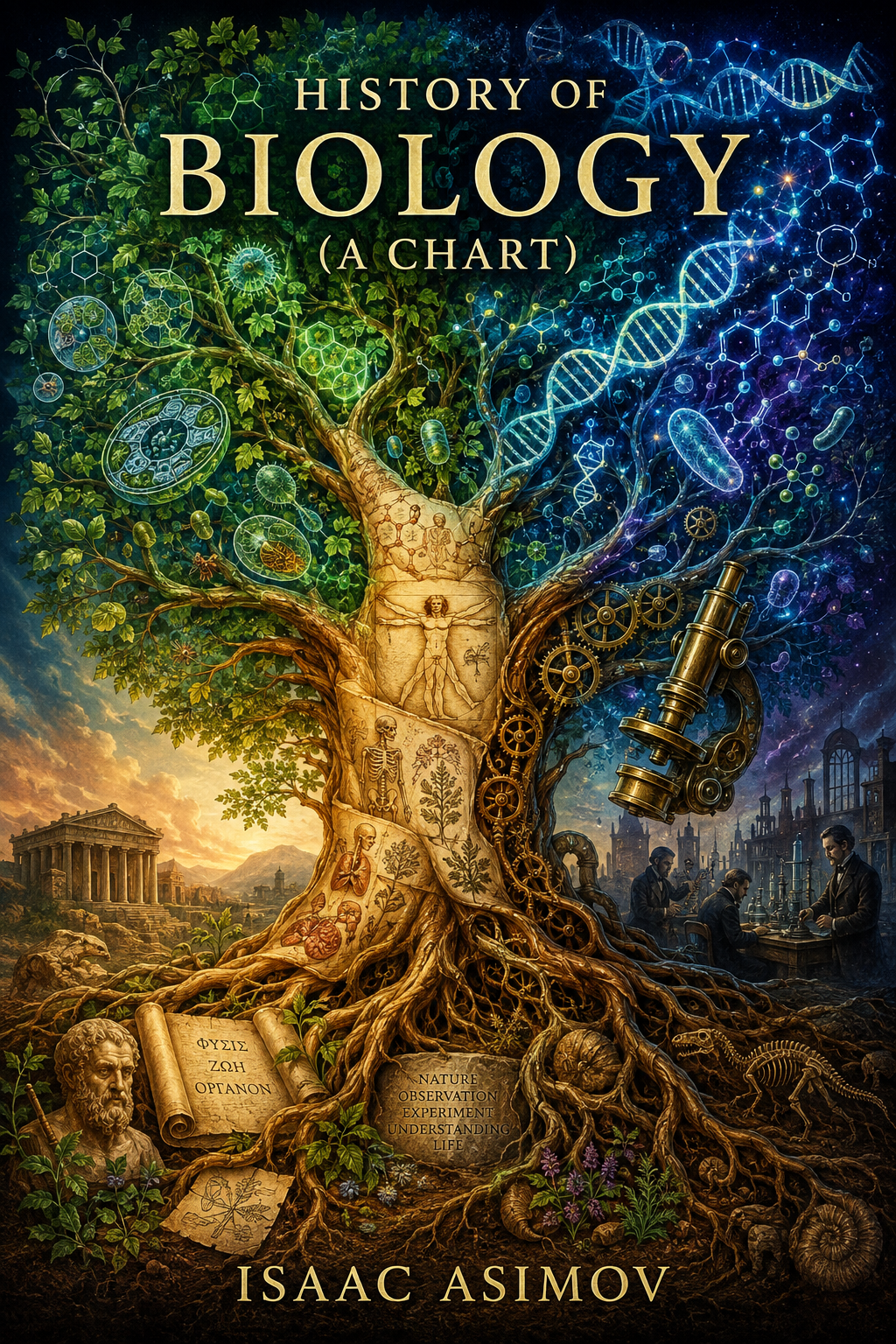
The human mind is a remarkable tool, designed to seek patterns in a universe that often seems chaotic. In his work, History of Biology (A Chart), Isaac Asimov does not present a dry list of names and dates, nor does he write a traditional dramatic novel. Instead, he treats the history of science as a single, unfolding epic. Asimov's unique approach uses a chronological chart to show that scientific progress is a collaborative, intergenerational journey. He presents scientific knowledge not as a series of sudden, isolated miracles performed by lonely geniuses, but as a slow, organic growth, like a massive tree branching out from a single, humble seed. By structuring this history as a chart, Asimov builds a narrative where each discovery is a logical consequence of what came before and a necessary stepping stone for what must follow. It is a story about the grandest adventure of all: humanity's quest to understand the nature of life itself.
To review this work is to appreciate how Asimov manages to tell a compelling story without a traditional plot. The protagonist of this narrative is not any individual scientist, but humanity itself, driven by an insatiable curiosity. Because this is a history of biology, there are no fictional twists or fabricated suspense. The "plot" is the gradual revealing of reality, building from basic survival mechanisms and leading directly to the mapping of our own molecular blueprints. Asimov uses simple, clear, and logical language to show how different streams of thought, which seemed completely unrelated for centuries, slowly and inevitably converged. To understand where this story is building from and where it is leading is to see how the simple act of observing a plant eventually led to our ability to rewrite the very code of life.
Mini Story 1: The Dawn of Survival
The epic begins in the dim recesses of prehistory, during an era where biological knowledge was a matter of life and death. Long before there were laboratories or universities, early humans had to act as practical naturalists simply to survive. They had to learn, through trial, error, and shared experience, which berries would nourish them and which would kill them, which herbs could soothe a wound, and how wild animals behaved. This was a time when humans observed patterns without asking why they existed. As civilization emerged in places like Egypt, Mesopotamia, India, and China, these practical observations became more organized. Farmers learned to breed better crops, and physicians began to study human anatomy, though their early efforts were heavily clouded by superstition, mythology, and the belief that disease was a spiritual punishment rather than a physical process. This first mini story is about laying the raw, empirical foundation of survival upon which all future science would be built.
Mini Story 2: The Spark of Reason
The narrative takes a dramatic leap forward when the ancient Greeks decided to look at the world with fresh eyes. Thinkers like Aristotle established a revolutionary principle: that nature should be observed carefully rather than explained away through religious myths. Aristotle personally dissected and studied hundreds of animal species, examining their structures, habits, and ways of reproducing. Although his conclusions were often incorrect by modern standards, his insistence on classification and systematic observation became the true birth of biological science. He showed that the living world could be organized and categorized based on shared physical characteristics.
Mini Story 3: The Silent Custodians
Following the brilliance of the Greek era, the story of biology enters a quiet, prolonged phase during the Middle Ages. For centuries, progress slowed to a crawl as scholars ceased to ask new questions, choosing instead to defer to the authority of ancient texts. Rather than looking at the natural world themselves, they merely recopied and memorized Aristotles writings. Yet, Asimov astutely notes that this era of preservation was not a waste of time. Without these dedicated copyists and scholars who guarded ancient manuscripts, the spark of classical knowledge might have been extinguished forever, forcing later generations to start their journey from the very beginning.
Mini Story 4: The Triumph of the Eye
The quiet of the Middle Ages was shattered by the intellectual explosion of the Renaissance, an era that brought biology back to life. Artists like Leonardo da Vinci began dissecting the human body to map its muscles and bones with artistic and scientific precision. The ultimate breakthrough in this period came from Andreas Vesalius, a physician who refused to blindly accept ancient Roman medical doctrines. Vesalius conducted his own highly detailed human dissections, correcting centuries old anatomical errors by trusting his own eyes rather than old books. This profound shift, moving away from blind respect for ancient authority and toward direct, empirical observation, became the foundational law of modern science.
Mini Story 5: The Unseen Worlds
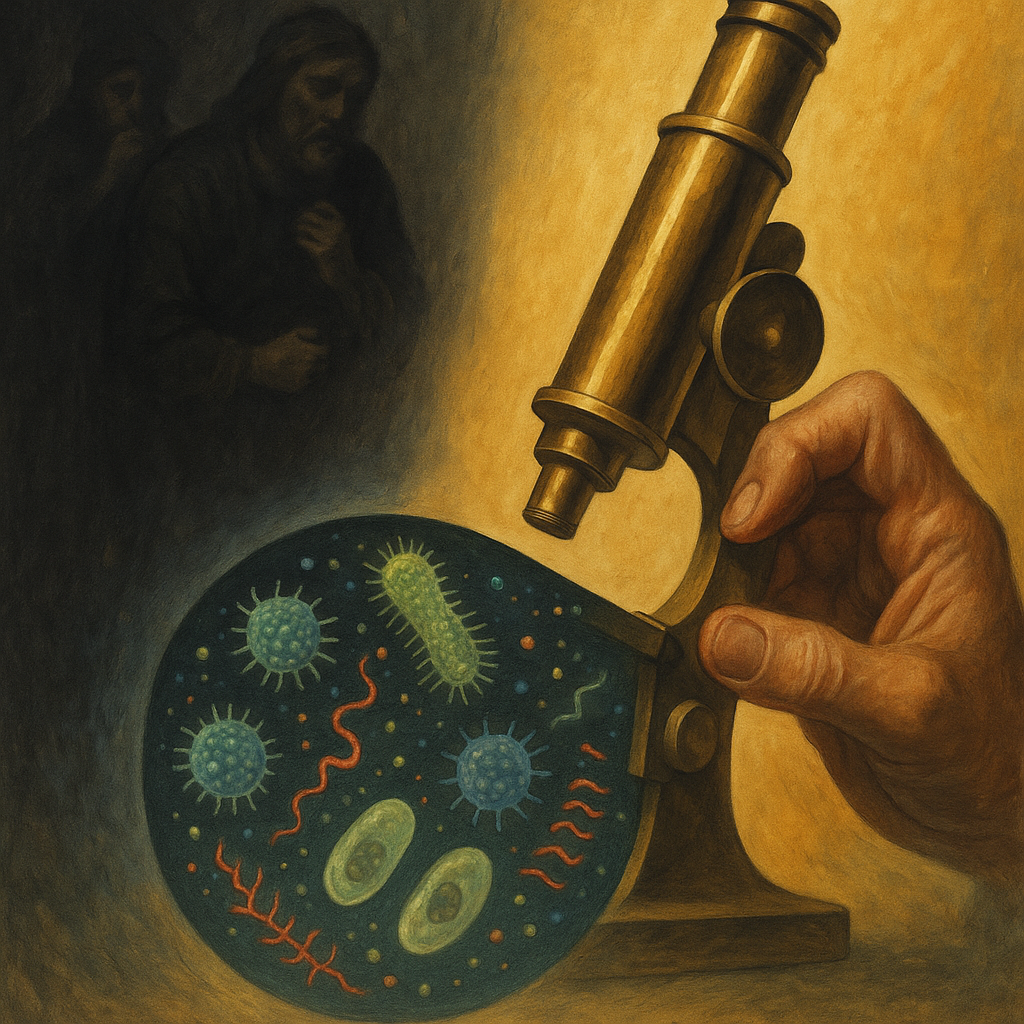
As the story progresses, a major technological revolution occurs with the invention of the microscope, completely altering humanity's scale of perception. Suddenly, an invisible universe was laid bare. Robert Hooke peered at a thin slice of cork and coined the word cell to describe its tiny compartments, although he did not yet grasp the immense significance of his discovery. Shortly after, Antonie van Leeuwenhoek crafted incredibly powerful lenses, becoming the first human to witness microscopic organisms swimming in a simple drop of water. This mini story reveals how biology expanded overnight into dimensions previously unimagined, showing that life existed in places where human eyes had never before been able to see.
Mini Story 6: The Great Unifiers
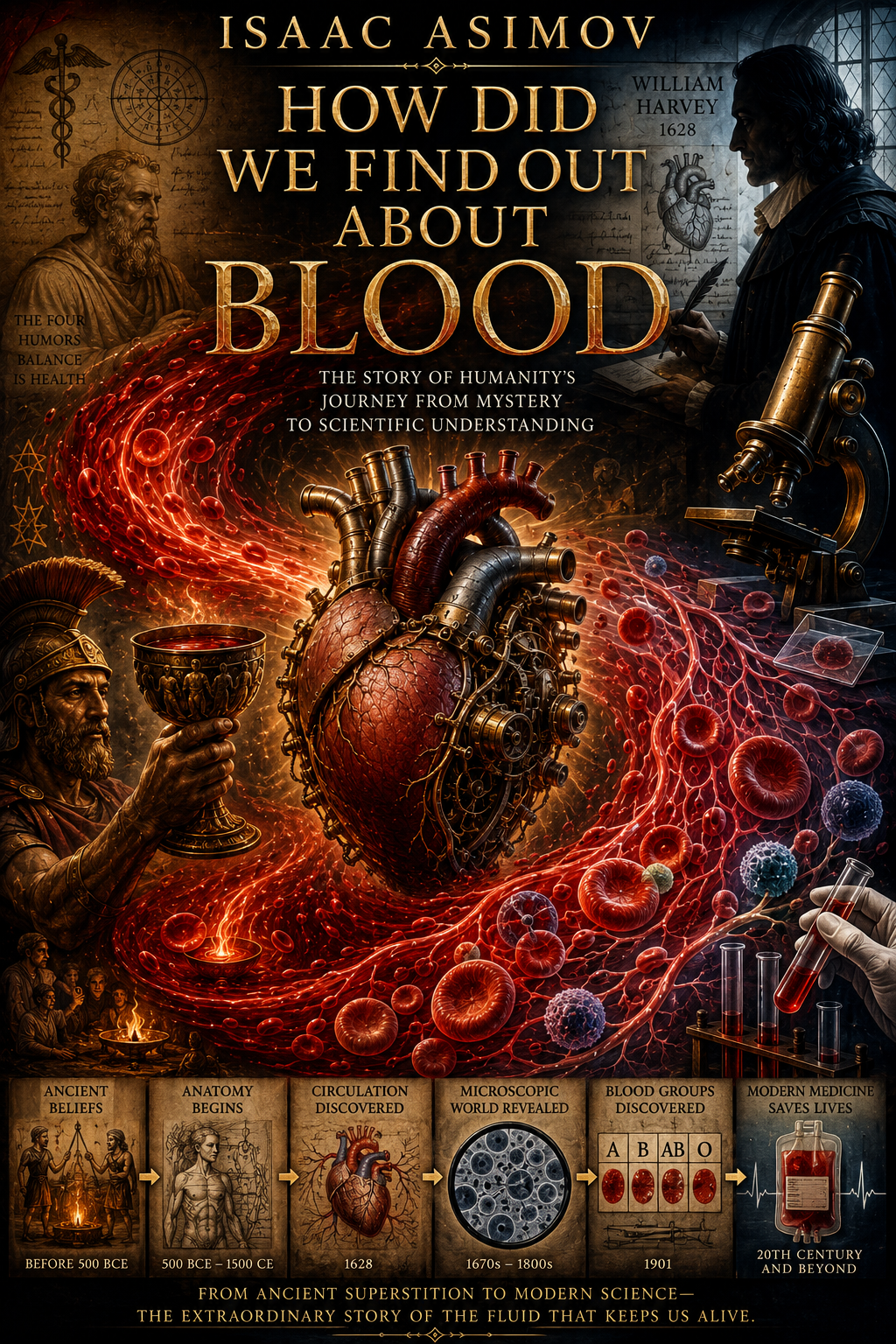
Once the microscopic world was revealed, the pieces of the biological puzzle slowly began to fall into place. Scientists like Matthias Schleiden and Theodor Schwann established the Cell Theory, proving that all plants and animals share the same fundamental microscopic building blocks. Rudolf Virchow completed this grand idea by declaring that cells can only arise from preexisting cells, uniting all living organisms under a single, universal physical law. Around the same time, William Harvey overturned centuries of medical dogma by proving that the heart acts as a physical pump, circulating blood continuously throughout the body. This showed that living bodies follow understandable mechanical and physical laws rather than mystical forces.
Mini Story 7: Evolution and the Unseen Code
The narrative reaches its most profound climax with the twin discoveries of evolution and genetics. Charles Darwin shattered the ancient, static view that species were created fixed and unchangeable, replacing it with a dynamic picture of life. Through natural selection, Darwin showed that species adapt and change gradually over countless generations, linking all living things into one continuous, ancestral family tree. Meanwhile, working in quiet isolation, Gregor Mendel bred pea plants to uncover the precise mathematical laws of inheritance. Though Mendel's work was ignored for decades, the twentieth century brought a magnificent synthesis: Darwins theory explained why life changes, while Mendels genetics explained how those variations are physically preserved and passed on.
Mini Story 8: The Molecular Dawn
The final movement of Asimov's chart chronicles the transition of biology into the microscopic and molecular realm. Louis Pasteur disproved the old myth of spontaneous generation, demonstrating that microbes cause fermentation and disease, which directly led to life saving vaccines and sanitation. Robert Koch then linked specific bacteria to specific illnesses, establishing modern medical microbiology. Finally, the physical carriers of heredity, chromosomes, were investigated, culminating in the historic discovery of the double helix structure of DNA by James Watson, Francis Crick, Rosalind Franklin, and Maurice Wilkins. Heredity was no longer a vague mystery; it was a physical script written in molecular code.
Ultimately, Asimov’s History of Biology (A Chart) is a masterpiece of scientific exposition. By stripping away dense, jargon filled textbooks and presenting biology as an interconnected, cumulative pipeline, Asimov reveals the grand architecture of human thought. We see clearly how anatomy laid the groundwork for physiology, how microscopy made cell theory possible, and how genetics and evolution merged to birth modern molecular biology. The book reminds us that science is not a finished product, but a living, evolving enterprise. As we look back at where the story built from, the simple survival instincts of early humans, and see where it is leading, toward a deep, molecular understanding of our own existence, we are left with a profound sense of wonder at humanity’s relentless, unstoppable desire to know.