Isaac Asimov Presents the Best Crime Stories of the 19th Century
Edited by Isaac Asimov, this nineteenth century anthology traces the evolution of crime fiction from dramatic coincidence to logical observation and disciplined reasoning.
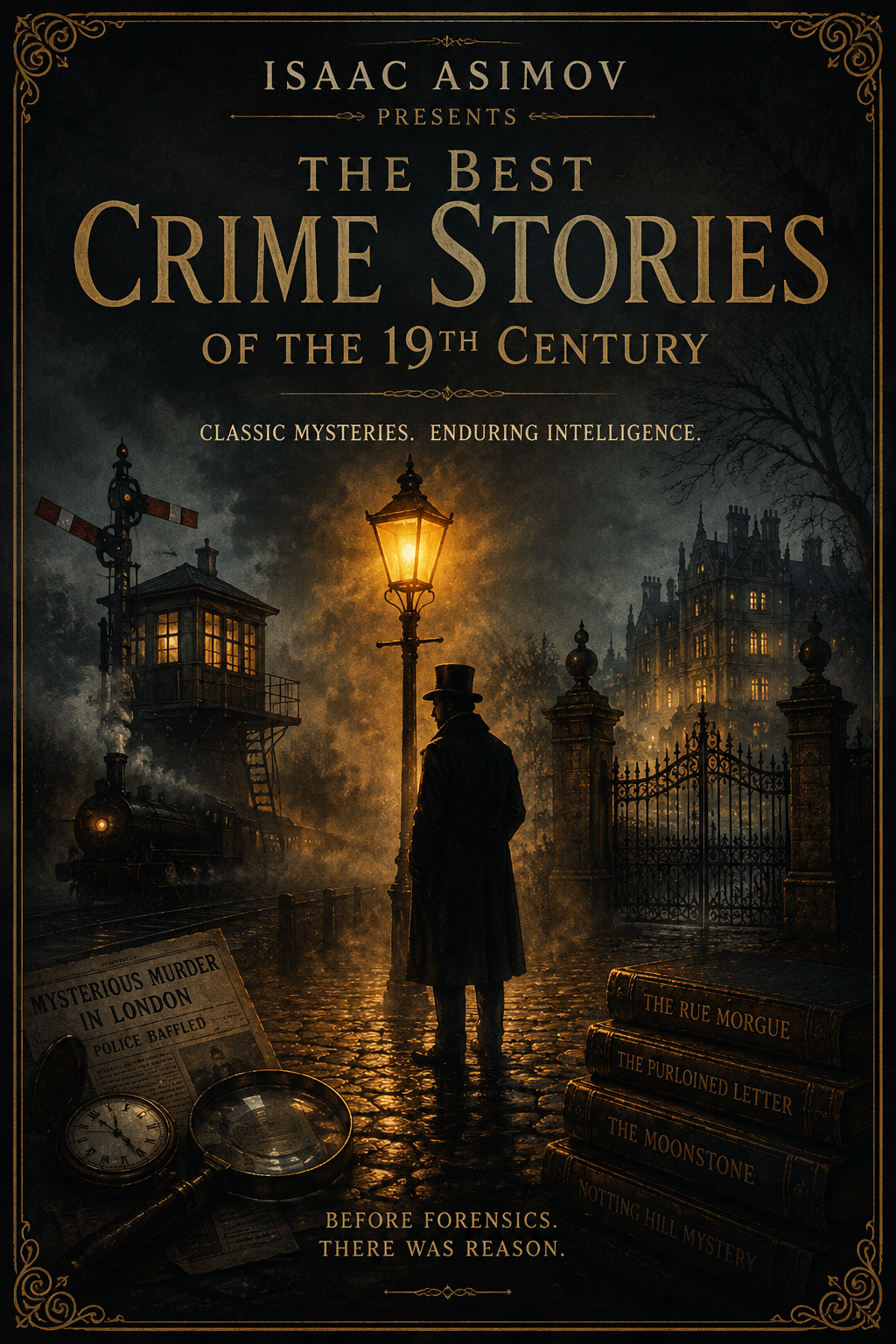
The gas lamps of the nineteenth century cast long, flickering shadows on damp pavements, the cool evening air carrying the faint scent of coal smoke. Through this historical mist, Isaac Asimov, a writer whose mind was always looking toward the stars, maintained a deep and abiding respect for the history of human reason. He spoke through his work with trademark clarity, using simple words to explain a grand idea: how the nineteenth century was a crucible of intellect. It was an era, he explained, when growing cities, expanding police forces, busier printing presses, and a rising belief in scientific thinking began to change how the world is viewed. Crime was no longer seen as a supernatural mystery or a dark act of fate, but as a puzzle that could be dissected and solved through the steady application of human logic. This collection, Isaac Asimov Presents the Best Crime Stories of the 19th Century, served as a guide through the very birth of the modern mystery genre, tracing how writers built the foundations of detective fiction, brick by logical brick.
In introducing these tales, Asimov pointed out that these early pioneers did not have the luxury of modern forensic science. There were no DNA databases, no fingerprint registries, and no high tech communication networks. Instead, the characters in these tales had to rely on basic human qualities: sharp observation, psychology, coincidence, courage, and pure, disciplined reasoning. This shift in storytelling was revolutionary. It showed that human intellect alone could bring order to chaos and light to the deepest darkness. This logical approach to solving puzzles was exactly what Asimov admired in his own writing, and why he found these early masterpieces so deeply compelling.
The historical exploration naturally turned to Paris, where the modern detective story was born in the mind of Edgar Allan Poe. Asimov described the atmospheric setting of The Murders in the Rue Morgue, where a brutal and seemingly impossible crime shocks the city. Two women are found murdered inside a room that is securely locked from the inside, leaving the local police completely baffled by the bizarre clues and strange voices heard by witnesses. It was here that Poe introduced C. Auguste Dupin, the world's first great fictional detective. Asimov explained that Dupin's brilliance did not lie in gathering endless piles of physical clues, but in studying the actual thinking behind the crime and looking for the logical relationships between the strange facts. Without giving away the startling resolution of the mystery, Asimov emphasized how this single tale established the classic blueprint that readers still love today: the brilliant investigator, the loyal companion who records the events, the confused police force, and the final, satisfying explanation that ties everything together.
Continuing the intellectual journey through Poe's Paris, the analysis turned to The Mystery of Marie Rogêt. Asimov explained that this story represented a fascinating departure, as it was directly inspired by a real world unsolved murder. In this tale, Dupin does not even leave his quiet room to examine the crime scene. Instead, he acts as an armchair detective, carefully analyzing conflicting newspaper reports, examining public rumors, and pointing out the contradictions in witness statements. In discussing the slower, more deliberate pace of this narrative, Asimov noted that its true significance lies in proving that pure reasoning alone can dissect a crime, while also highlighting the powerful and often misleading influence of public journalism on legal investigations.
The third Parisian case was The Purloined Letter, which Asimov described as perhaps the simplest yet most elegant of Dupin's adventures. A politically sensitive letter has been stolen, and despite dismantling furniture and searching every inch of the thief's apartment, the police find absolutely nothing. Dupin, however, realizes that the criminal is an intellectual who understands exactly how the police think. By placing himself in the mind of the thief, Dupin discovers that the letter has been hidden in the most obvious spot imaginable: right out in the open. Asimov remarked that this story is a beautiful testament to psychological deduction, demonstrating that intelligence and empathy with an opponent will succeed where brute force effort fails.
The exploration then crossed the English Channel to look at The Notting Hill Mystery by Charles Felix, which Asimov heralded as one of the very earliest detective novels. This narrative takes a unique approach, presenting its investigation entirely through a collection of formal documents, including insurance reports, letters, legal papers, and witness statements. An insurance investigator is tasked with examining a suspicious claim involving a young woman's death, and as readers look over his shoulder, a dark web of greed, deception, and meticulous manipulation begins to emerge. Asimov admired this documentary style of storytelling, noting that the suspense builds not from dramatic chases, but from the quiet, chilling accumulation of paper evidence, a technique that would go on to shape realistic mystery writing for generations.
The focus then turned to the grand estates of Victorian England with Wilkie Collins' The Moonstone. Although the anthology cannot include the complete novel, selections from Wilkie Collins' The Moonstone illustrate why it is regarded as one of the first great detective novels. A priceless Indian diamond disappears from a country home during the night, and every guest appears capable of theft, yet each has convincing reasons for innocence. Multiple narrators describe the same events from different perspectives, revealing how personal bias affects memory and judgment. Asimov highlighted how this narrative structure reveals the fragile nature of human memory, distorted by personal feelings, cultural misunderstandings, and hidden secrets. Solving the mystery, he observed, requires an understanding of human nature as much as physical evidence.
The atmosphere moved into a darker, more environmental realm with Charles Dickens' The Signal Man. Asimov described this haunting tale of a lonely railway worker who is repeatedly tormented by a spectral figure appearing just before terrible accidents occur on the tracks. A visitor attempts to find a rational explanation, wondering if these visions are supernatural warnings or merely the hallucinations of an emotionally exhausted mind. The suspense builds with every passing train until a sudden tragedy reveals the chilling connection between fear, coincidence, and human destiny. Asimov noted that while this is not a traditional detective story, it beautifully explores the deep human desire to discover logical, understandable causes behind frightening and inexplicable events.
The journey then led to the dusty interior of an antique shop in Robert Louis Stevenson's Markheim. The story begins with a cold blooded murder committed during a robbery, but instead of focusing on the subsequent police investigation, it turns inward to explore the criminal's own conscience. After committing the crime, Markheim believes he is being watched by a mysterious stranger who knows every secret of his life. Whether the visitor is a supernatural being or merely the voice of conscience remains uncertain. The narrative shifts from a crime story into a profound piece of moral philosophy, ending with the realization that escaping physical justice is meaningless if one cannot escape the judgment of one's own soul.
Next was The Squire's Story by Sheridan Le Fanu. Asimov explained that this tale deals with the slow, inevitable return of long buried crimes that come back to haunt a respectable family. Through strange occurrences, fading memories, and sudden, unexpected discoveries, the misdeeds of the past are gradually brought to light. Asimov remarked on how Le Fanu masterfully combined a brooding Gothic atmosphere with a careful, analytical investigation, showing how the dark secrets of an older generation continue to shape and threaten the present.
The path then took the narrative to the cold, wind swept Scottish coast in Robert Louis Stevenson's The Pavilion on the Links. Here, a young man becomes entangled in a dangerous situation involving secret societies, hidden money, bitter betrayal, and murder. Asimov praised how Stevenson used the bleak, unforgiving landscape almost as an active participant in the story, heightening the constant tension. In this narrative, the emphasis is placed heavily on atmosphere and rich character development, demonstrating that the setting itself can be a powerful tool in building suspense.
As the overview drew to a close, Asimov spoke of the other stories that filled his collection, noting that they explored a vast array of criminal themes. Some focused on bitter inheritance disputes where greed drove family members to murder, while others examined elaborate frauds, unexplained disappearances, and revenges planned over decades. Many of these stories lacked professional detectives entirely, showing how ordinary citizens, using only patience and common sense, could uncover the truth. The resolutions were rarely simple; justice was sometimes served by the law, sometimes by a voluntary confession, and other times through the psychological collapse of the guilty party. Asimov reflected that these early writers were deeply interested in why crimes occur and what consequences follow for the human mind. Looking through the clearing fog of the past, it becomes clear that every modern investigator stands upon the brilliant foundations laid down by these nineteenth century pioneers, who proved that disciplined observation and human reasoning could bring light to the deepest darkness.