Hound Dunnit
Hound Dunnit is an anthology of seventeen stories where canine instincts and behaviors expose hidden human motives, proving dogs are the ultimate silent witnesses.
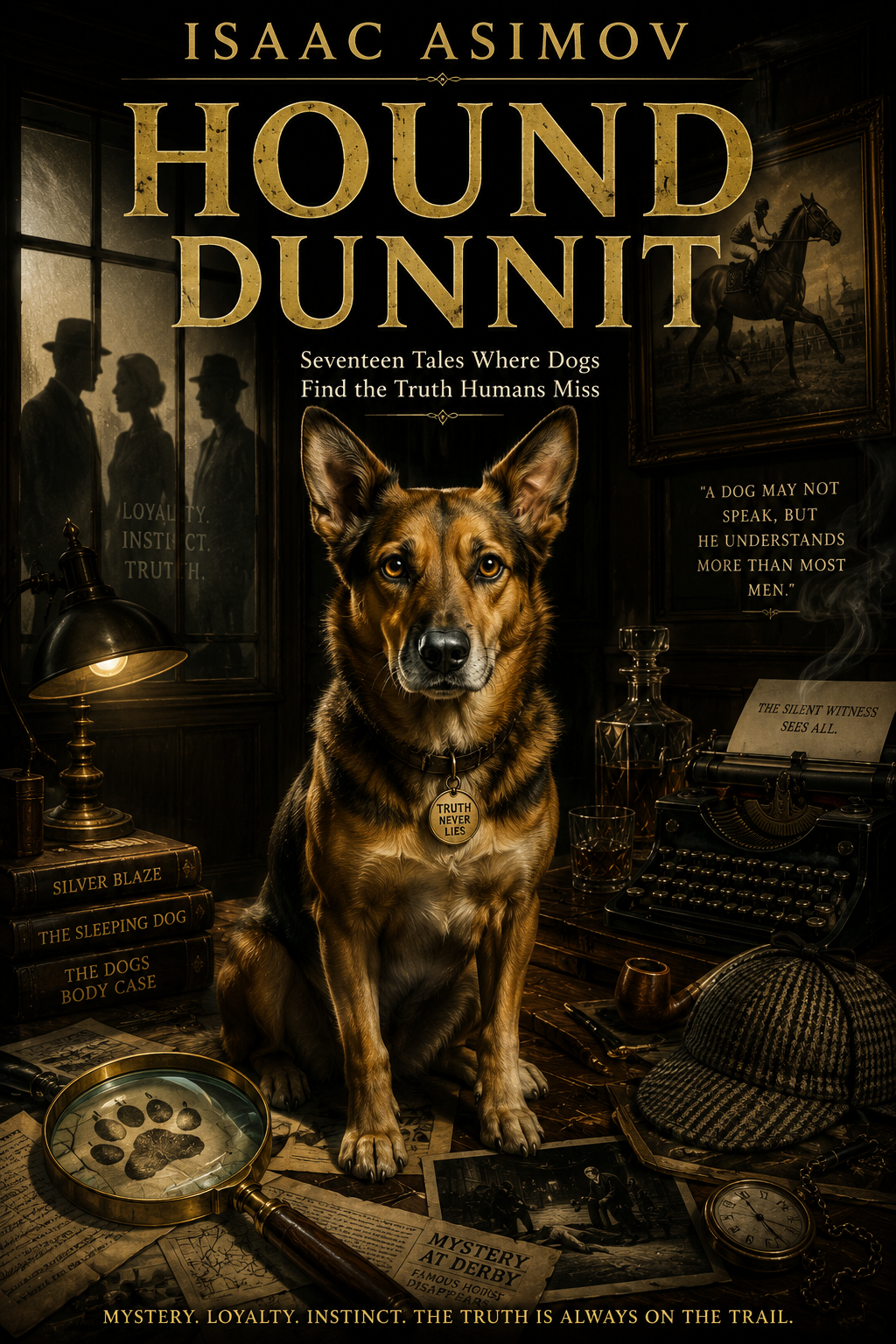
Hound Dunnit is not a novel but a themed mystery anthology edited by Isaac Asimov, Martin H. Greenberg, and Carol Lynn Waugh. The collection gathers seventeen detective and suspense stories in which dogs play a central role as witnesses, victims, clues, protectors, companions, or even detectives themselves. Asimov's introduction establishes the central idea: dogs have long occupied a special place in mystery fiction because their loyalty, instincts, and sensitivity often reveal truths that human beings overlook. The anthology demonstrates that a barking dog, a silent dog, or even a frightened dog can become the key that unlocks an entire mystery.
The stories vary greatly in tone. Some are classic detective puzzles, some are humorous, some are tragic, and others are suspenseful adventures. Yet all share a common theme: the unique relationship between humans and dogs often exposes hidden motives and concealed crimes.
The Sleeping Dog Ross MacDonald's contribution presents a mystery buried beneath layers of memory and deception. A seemingly insignificant dog becomes linked to long forgotten events whose consequences continue to affect the present. As the investigation unfolds, buried secrets emerge, revealing that human guilt can remain dormant for years, much like a sleeping dog that suddenly awakens. The story combines psychological depth with careful detection, demonstrating MacDonald's talent for uncovering emotional crimes hidden beneath ordinary lives.
The Enemy Charlotte Armstrong creates a tense atmosphere in which a dog senses danger long before humans recognize it. The animal's instincts identify a threat concealed behind a respectable appearance. The story explores how people often ignore obvious warnings because they prefer comforting illusions to uncomfortable truths. The dog becomes the silent voice of reality, recognizing the enemy before anyone else.
The Dog Who Hated Jazz William Bankier's story introduces humor into the collection. A dog's peculiar reaction to jazz music appears amusing at first, but gradually becomes connected to a puzzling mystery. What seems like an eccentric behavioral quirk eventually reveals important clues. The charm of the tale lies in its ability to transform an apparently trivial observation into the centerpiece of an investigation.
Silver Blaze No canine mystery anthology could ignore one of detective fiction's most famous animal related stories. In Arthur Conan Doyle's classic Sherlock Holmes adventure, a racehorse disappears and a trainer is murdered. The crucial clue involves a dog that did nothing. Holmes recognizes the significance of the dog's silence, leading him to solve the mystery through a brilliant chain of deductions. The story remains one of the greatest examples of logical reasoning in detective literature and demonstrates how the absence of an expected action can be more revealing than the action itself.
The Dark Road Home Paul W. Fairman presents a darker narrative in which a dog's loyalty becomes central to unraveling a crime. The journey home becomes both physical and emotional as characters confront hidden truths. The dog serves as a bridge between past events and present consequences, helping reveal what others wish to conceal.
The Emergency Exit Affair Michael Gilbert contributes a clever puzzle involving deception, timing, and misdirection. As in many classic detective stories, seemingly insignificant details become vital. The presence of a dog provides an observational perspective unavailable to human witnesses. Gilbert's craftsmanship shines through his ability to construct a mystery where every clue eventually falls perfectly into place.
How Come My Dog Don't Bark? Ron Goulart approaches the theme with humor and wit. The title itself echoes the famous Sherlock Holmes principle of the silent dog. A dog's unexpected behavior creates confusion, leading investigators through a series of amusing misunderstandings. Beneath the comedy lies a cleverly designed mystery whose solution depends upon understanding canine behavior.
Dispatching Bootsie Joyce Harrington offers one of the anthology's more emotionally engaging stories. The fate of a beloved dog becomes intertwined with criminal intentions. Human greed and affection collide, forcing characters to reveal their true nature. The story demonstrates how attachment to an animal can expose both virtue and villainy.
Captain Leopold Goes to the Dogs Edward D. Hoch blends mystery with lighthearted adventure. Captain Leopold, one of Hoch's recurring detectives, finds himself involved in a case where dogs provide both complications and solutions. The story balances humor with intellectual challenge, creating a satisfying puzzle that rewards careful attention.
Lincoln's Doctor's Son's Dog Warner Law constructs a historical mystery around an unusual canine connection. The title itself hints at layers of relationships and historical context. The dog becomes a living link between individuals and events, helping investigators uncover truths hidden by time and circumstance.
The Dogsbody Case Francis M. Nevins Jr. presents a mystery in which a dog occupies the center of the investigation. The title plays cleverly upon the phrase dogsbody, suggesting both literal and metaphorical interpretations. The story explores how assumptions can mislead investigators while simple observations lead toward the truth.
Puzzle for Poppy Q. Patrick contributes a carefully structured puzzle mystery. Poppy becomes involved in circumstances where a dog's behavior carries unexpected significance. The narrative rewards logical reasoning and demonstrates the author's mastery of fair play detection.
Chambrun Gets the Message Hugh Pentecost's detective Pierre Chambrun encounters a mystery where communication or miscommunication plays a central role. Dogs become part of a network of clues pointing toward hidden motives. The story combines character insight with methodical investigation.
Raffles on the Trail of the Hound Barry Perowne revisits the gentleman thief tradition. Here, adventure and mystery combine as Raffles becomes involved in a case featuring a notable hound. The story offers charm, wit, and suspense while maintaining the anthology's focus on canine significance.
Coyote and Quarter Moon Bill Pronzini and Jeffrey Wallman provide a story that broadens the anthology's scope. The narrative explores wilderness, instinct, and survival. Animal behavior becomes essential to understanding both the mystery and the characters involved. The atmosphere is richer and more reflective than many traditional detective tales.
Sellin' Some Wood John Rudin's contribution presents a rural mystery where everyday activities conceal deeper complications. Dogs function as silent observers whose actions reveal what people attempt to hide. The story captures the flavor of small communities where everyone appears familiar yet secrets remain plentiful.
A Dog in the Daytime Rex Stout closes the anthology with one of his celebrated Nero Wolfe mysteries. Wolfe and Archie Goodwin investigate a case where a dog once again becomes a significant clue. Stout's trademark dialogue, deductive brilliance, and character interplay elevate the story. The mystery demonstrates how careful observation of animal behavior can illuminate human motives.
Taken together, Hound Dunnit becomes more than a collection of mysteries involving dogs. It is a study of loyalty, instinct, observation, and the remarkable ways animals influence human lives. Some dogs reveal murderers. Some expose lies. Some become victims of human weakness. Others demonstrate courage and devotion that contrast sharply with human selfishness. Throughout the anthology, the recurring lesson is clear: dogs may not understand human language, but they often understand human nature surprisingly well.
As a mystery anthology, the book succeeds because it offers extraordinary variety while maintaining a consistent theme. The stories range from classic Holmesian deduction to modern psychological suspense, from comedy to tragedy, yet all demonstrate the enduring partnership between mystery fiction and man's oldest companion. In true Asimovian fashion, the collection celebrates intelligence, observation, and the idea that the smallest clue even the bark of a dog, or its silence can reveal the truth hidden in plain sight.