Fantastic Voyage II Destination Brain
Miniaturized scientists travel through a dying genius's body to retrieve vital neural secrets, uncovering the brain’s magnificent, evolving complexity and the enduring power of reason.
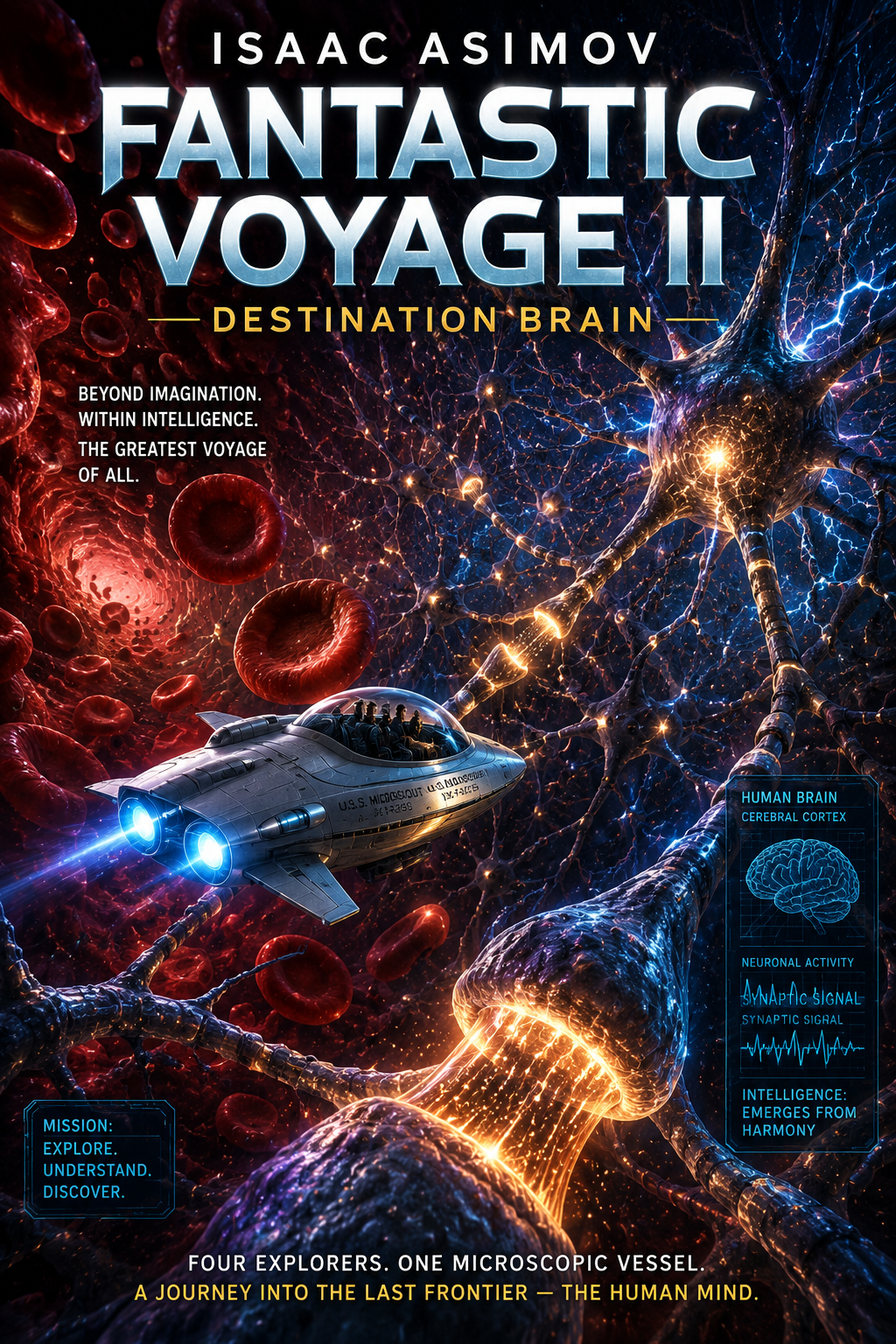
Fantastic Voyage II Destination Brain
In a future where the great powers of Earth remained locked in a delicate dance of political rivalry and scientific competition, a bridge of cooperation was built out of necessity. Humanity had conquered many physical frontiers, yet the most complex landscape of all the human brain remained largely a mystery., This is the setting for a story that is not merely an adventure, but a logical exploration of the very essence of what makes us human. Unlike the earlier novelization Isaac Asimov wrote for a film, this tale is his own distinct creation, reflecting his mature view of science as a tool for enlightenment rather than just a source of spectacle.
The central challenge of the narrative involves a brilliant scientist named Dr. Pyotr Shapirov, a man who has unlocked revolutionary secrets regarding the nature of memory and intelligence. However, Shapirov is dying from a degenerative brain condition, and his vital knowledge is on the verge of being lost forever. To prevent this tragedy, a mission of unprecedented scale or rather, a lack of it is conceived. Four specialists are selected to undergo the process of miniaturization, becoming small enough to be injected directly into the dying scientist body. Their goal is to navigate the interior of a living human being, reach the brain, and recover the hidden information before the miniaturization process becomes irreversible or the host expires.
Leading this expedition is Albert Morrison, a man defined by the calm, steady reasoning that characterizes so many of Asimov protagonists. He is joined by experts in medicine, biology, and neurophysiology, creating a team where success depends entirely on scientific cooperation rather than individual heroics. As their microscopic vessel enters the circulatory system, the world they know disappears, replaced by an alien landscape that exists within every one of us. Red blood cells are no longer microscopic dots but become enormous floating discs drifting through vast, crimson rivers. White blood cells are transformed into relentless, towering guardians, programmed by evolution to destroy anything they do not recognize as part of the self.
The journey through the body is described with a logical clarity that transforms anatomy into geography., Every breath creates weather systems of oxygen and carbon dioxide, and every heartbeat generates irresistible, rhythmic tides that dictate the movement of the travelers. The team quickly learns that the body is an active, shifting ecosystem where the ordinary laws of physics seem transformed by the change in scale., They must navigate winding canyons of capillaries with perfect precision, treating every change in blood pressure as a major shift in the environment. Their survival is not a matter of luck, but of constant observation and scientific deduction within the active immune system which mistakes them for invaders.,
As the expedition moves deeper into the host, they encounter the great organs of the body, which Asimov presents as triumphs of natural engineering. The lungs are seen as vast forests where the exchange of gases happens with elegant efficiency, and the liver is described as a colossal chemical refinery, processing the substances required for life with tireless precision. Throughout these descriptions, there is a sense of profound admiration for the complexity of biological systems, a theme that resonates through many of Asimov works where he seeks to find the underlying logic of the universe.,
The true heart of the story, however, is the journey into the brain. To the explorers, the brain is unlike any other organ. It is a place where electrical impulses flash like storms across an endless network of cells. Here, the neuron acts as the fundamental bridge that connects vast territories of thought and memory. As they penetrate the neural tissue, the mission changes from a simple retrieval of data into a deeper discovery about the nature of the mind. Morrison and his team realize that Shapirov greatest insight was not about isolated facts, but about the organization of intelligence itself. They begin to understand that consciousness is a dynamic process rather than a static collection of data.
They realize that identity and awareness emerge from relationships and invisible connections, creating a system so adaptable that no simple machine could ever hope to duplicate it. This realization brings a philosophical depth to the mission, suggesting that intelligence is a dynamic process rather than a static collection of data. As Shapirov condition worsens, the landscape around the explorers begins to collapse. Orderly neural pathways become chaotic labyrinths where memories fragment and signals disappear. The team must witness the literal breaking apart of intelligence, adding a layer of urgency and tragedy to their work. Furthermore, the stresses of their impossible surroundings create tension among the scientists, proving that even the most brilliant minds are subject to human fears and ambitions.
The final stages of the journey involve a race against time and the body own defenses., As the miniaturization begins to fail and the immune system intensifies its attacks, the explorers must use every bit of logic and observation they have gained to survive. They find that the outward journey has taught them how to interpret the hostile biological terrain, allowing them to treat obstacles as problems to be solved rather than reasons for panic. The climax of the story is thus a triumph of reason over fear, a classic Asimovian theme.
In reviewing this work, it is clear that the story functions as a bridge between the physical and the philosophical. It treats the human body not as familiar anatomy, but as an unexplored cosmos full of wonder and danger., The excitement of the narrative comes from the joy of discovery and the application of human intelligence to solve seemingly impossible problems. It is a story that argues that curiosity is our greatest strength and that cooperation is our most effective tool.
Ultimately, the voyage into the brain serves as a metaphor for the journey into the self. The explorers return with the conviction that the human mind is far more complex and magnificent than any theory had previously suggested., They realize that identity and consciousness emerge from billions of interacting elements working in harmony. This message is the core of the work that every discovery we make about the world around us or within us only reveals new and more fascinating questions. It is a celebration of the infinite landscape of the mind and the enduring power of human reason.