Space Shuttles
This anthology explores how Space Shuttles serve as essential bridges, transforming human society while linking distant civilizations across the stars through realistic and practical transportation.
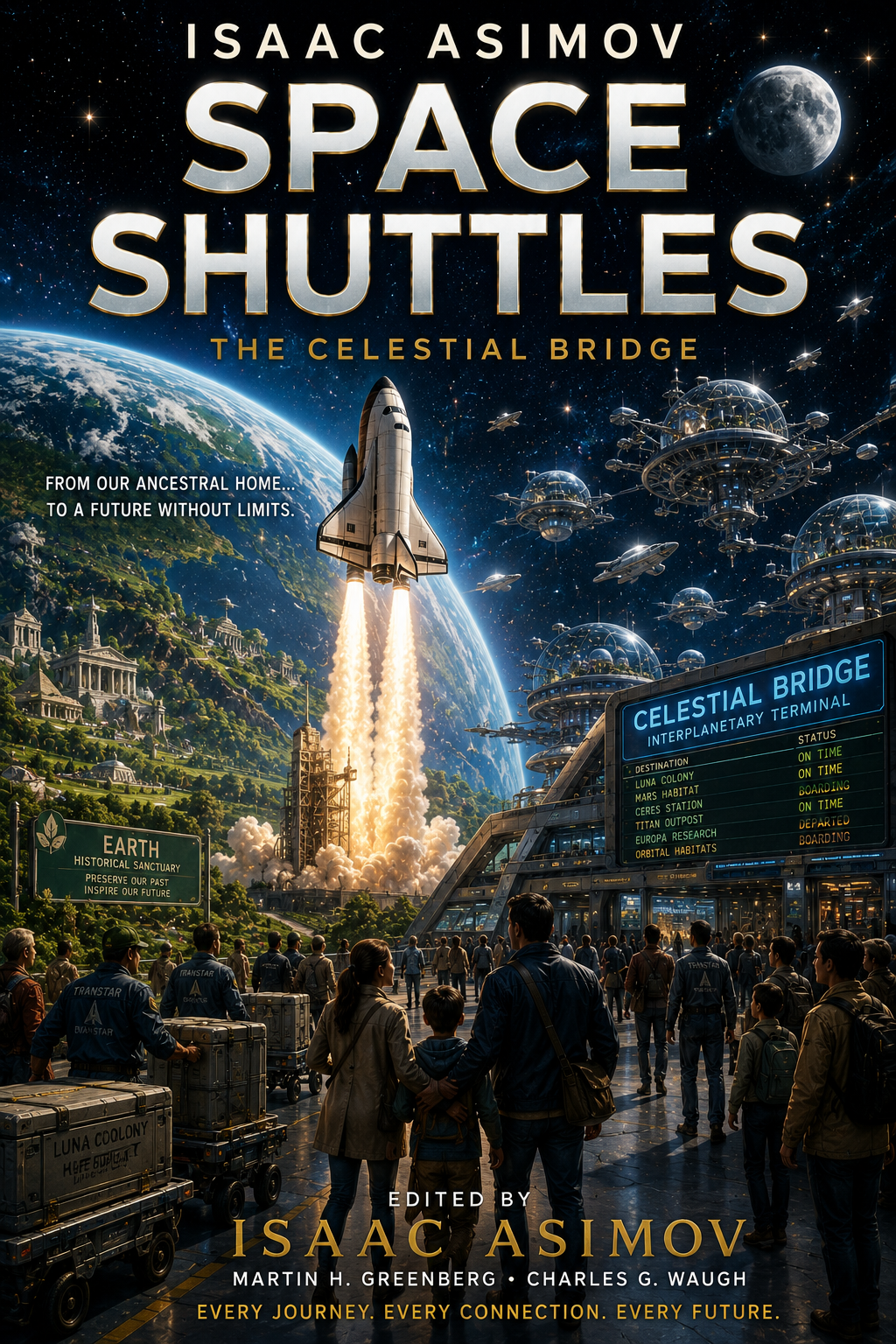
Imagine standing at a busy interplanetary terminal, watching humanity move outward in every direction as the great ships rise and fall. Space Shuttles is an anthology edited by Isaac Asimov, Martin H. Greenberg, and Charles G. Waugh that gathers stories about the vehicles connecting worlds. The shuttle is more than a simple craft; it is a bridge between the familiar and the unknown, representing the next stage of human development. In the introduction titled Shuttles, Asimov explains that civilization has always depended on transportation, from roads to aircraft. Now, the Spacecraft serves as the logical next step for a species spreading into the solar system. This collection reveals how these ships transform society, economics, and human dreams.
In Truck Driver by Robert Chilson, we meet a protagonist who is an ordinary worker instead of a glamorous explorer. He handles the Logistics of moving cargo through the vacuum, proving that every civilization depends on those who move supplies from one place to another. Hermes to the Ages by Frederick D. Gottfried explores how Telecommunication and transportation systems create continuity between settlements over many centuries. In contrast, Pushbutton War by Joseph P. Martino looks at how these vehicles can become instruments of military strategy in a future where conflict spans enormous distances. These stories remind us that while the technology changes, the human needs for connection and security remain the same.
The collection reaches a poignant peak in The Last Shuttle by Isaac Asimov. In this future, Space colonization has succeeded so well that humans live on the Moon, Mars, and orbital habitats while Earth is kept as a sanctuary. A pilot named Virginia Ratner carries the final group of people away from their ancestral world, marking a moment of both sadness and success. The Getaway Special by Jerry Oltion provides a more humorous look at how individuals find creative ways to reach space despite financial obstacles. Between a Rock and a High Place by Timothy Zahn uses a suspenseful scenario to show how survival depends on understanding both technology and human nature. Both stories celebrate the ingenuity and persistence required to survive in the void.
Power and societal growth are explored in stories like To Grab Power by Hayden Howard, where controlling transportation networks becomes a source of political influence. Coming of Age in Henson's Tube by William Jon Watkins follows young people who grow up within the shuttle systems, which shape their entire identities and expectations. The theme of cultural change continues in Deborah's Children by Grant D. Callin, as families scattered across space evolve in different ways. The Book of Baraboo by Barry B. Longyear reminds us that transportation carries ideas, myths, and memories along with people, ensuring that our history is never truly left behind.
The technical side of spaceflight is also a focus of the anthology. The Speckled Gantry by Joseph Green and Patrice Milton celebrates the Aerospace engineering and maintenance work performed by unseen individuals who keep civilization running. The Nanny by Thomas Wylde examines how advanced machines assist families in environments far from Earth, asking how human relationships survive amid such sophisticated technology. Hitchhiker by Sheila Finch shows how shared travel between strangers can lead to cultural understanding. Finally, Dead Ringer by Edward Wellen concludes the anthology with a mystery set in the confined and inescapable environment of a shuttle where every passenger is a suspect.
Together, these accounts create a broad portrait of a future where distances shrink and societies are transformed. The anthology avoids making spaceflight seem merely spectacular and instead treats it as a practical tool for everyday life. This perspective reflects a characteristic realism, suggesting that the true significance of technology lies in how it reshapes the lives of ordinary people. It delivers a profoundly optimistic message that the future belongs to the connectors who build the roads between the stars. Through these stories, the humble act of traveling from one place to another becomes one of humanity's greatest adventures.